Choosing the right bronze alloy feels complicated. Making the wrong call leads to early wear and failure. Understanding the core difference between CuSn8[^1] and CuSn6[^2] simplifies your decision.
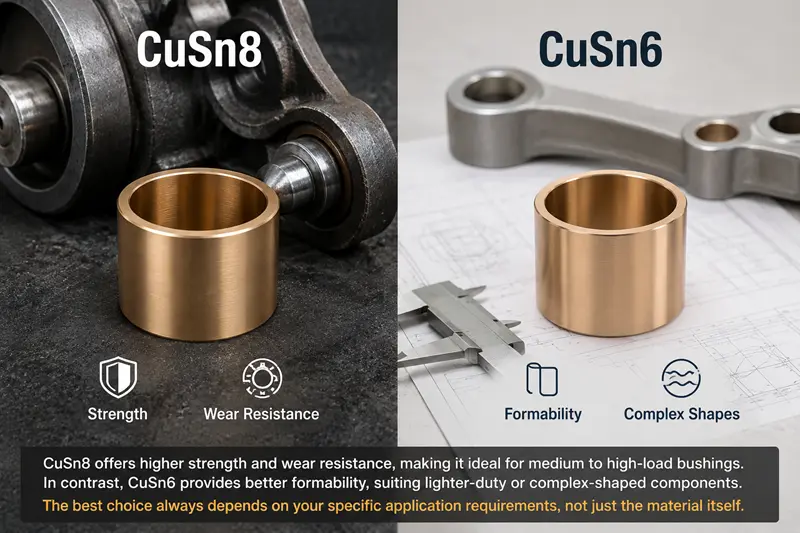
CuSn8 offers higher strength and wear resistance, making it ideal for medium to high-load bushings. In contrast, CuSn6 provides better formability, suiting lighter-duty or complex-shaped components. The best choice always depends on your specific application requirements, not just the material itself.
That quick answer helps, but as an engineer or buyer, you need to know why. The details determine whether your machine runs smoothly for years or fails prematurely. Let's dig deeper into the factors that should guide your decision, so you can source the right material with confidence.
What's the real difference in their makeup?
On the surface, CuSn6 and CuSn8 seem almost identical. This similarity can lead you to overlook the critical impact of a tiny 2% difference in tin content.
The primary difference is tin content. CuSn8 contains around 8% tin, giving it higher strength and wear resistance. CuSn6 has about 6% tin, which makes it more ductile and easier to form. This fundamental distinction dictates their ideal applications in manufacturing.
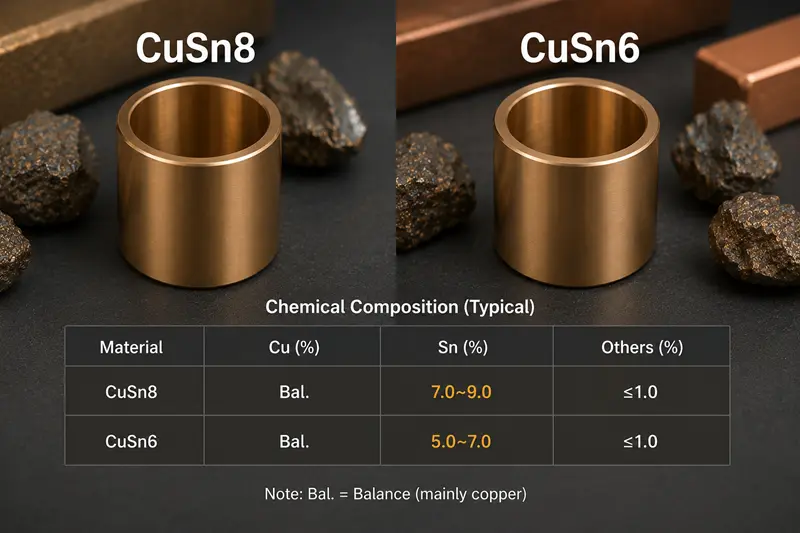
From our factory's perspective, this isn't just a chemical detail; it's the core logic behind material selection. The rule is simple: increasing the tin content in a copper alloy boosts its hardness and wear resistance, but it also reduces its plasticity. This means the material becomes less forgiving during manufacturing processes like bending or rolling.
Here is a simple breakdown:
| Material | Tin Content | Core Characteristic |
|---|---|---|
| CuSn6 | ~6% | Good ductility, easy to process |
| CuSn8 | ~8% | High strength, better wear resistance |
So, when we receive a drawing for a complex, thin-walled wrapped bushing, we immediately think about formability. CuSn6 is often the better starting point. But for a heavy-duty sliding part in industrial machinery, our focus shifts to durability, and CuSn8 becomes the primary candidate.
How do their performance metrics stack up for OEM applications?
Spec sheets are full of numbers, but what do they mean for your machine's real-world performance? Choosing based on one metric alone can lead to unexpected failures down the line.
CuSn8 clearly excels in strength, load capacity, and wear resistance, making it superior for high-stress applications. CuSn6, while less robust, offers significantly better formability, which is crucial for components requiring complex shaping like wrapped bushings.
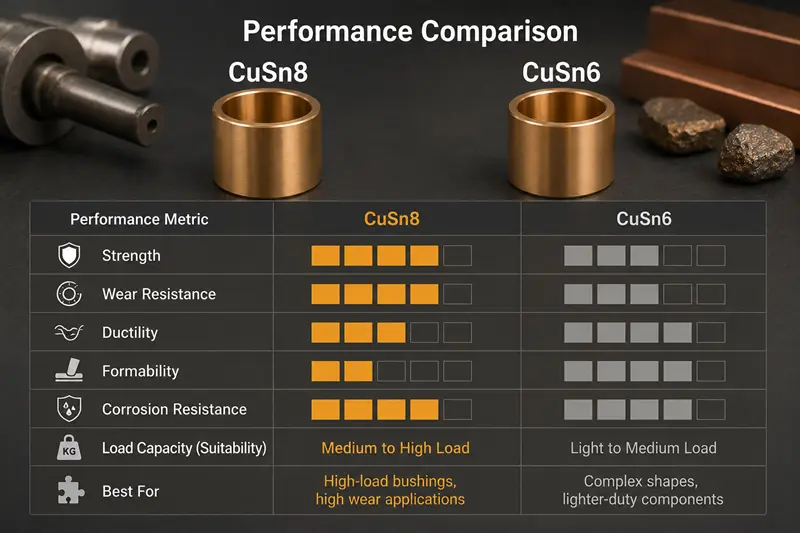
Let's break down the key performance differences from an OEM's point of view.
Strength and Load Capacity
CuSn8 is the undisputed winner here. Its higher tin content creates a stronger material matrix, allowing it to handle heavier loads without deforming. If your bushing is a critical pivot point in a piece of construction equipment, you need the higher load capacity of CuSn8.
Wear Resistance
Again, CuSn8 comes out on top. It stands up better to the friction and abrasion common in sliding applications. Over thousands of cycles, this superior wear resistance translates to a longer service life and less maintenance for the end-user.
Formability and Ductility
This is where CuSn6 shines. Its lower hardness makes it much easier to roll, bend, and shape without cracking. For wrapped bushings or parts with intricate features, CuSn6 is often the only practical choice. Trying to force CuSn8 into a complex shape can increase manufacturing defects and costs.
| Performance Metric | CuSn8 (Higher Performance) | CuSn6 (Better Processability) |
|---|---|---|
| Load Capacity | ✔️ | |
| Wear Resistance | ✔️ | |
| Formability | ✔️ | |
| Cost | Slightly Higher | Slightly Lower |
While CuSn8 is slightly more expensive in raw material cost, the difference is often negligible compared to the overall manufacturing cost.
Where is each alloy typically used in machinery?
Knowing the theory is one thing, but seeing where these materials are used in the real world makes the choice clearer. Misapplying an alloy can lead to costly redesigns and unhappy customers.
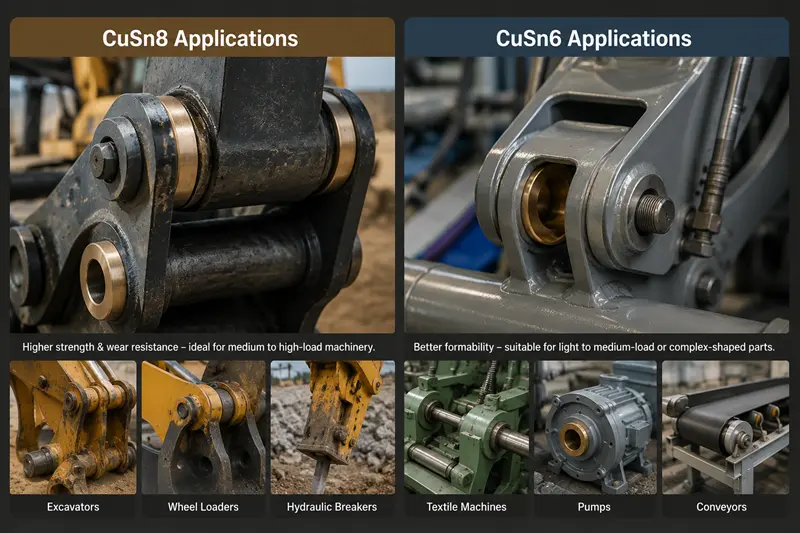
CuSn8 is the go-to choice for wrapped bronze bushings and sliding components in medium-to-high-load industrial equipment. In contrast, CuSn6 is preferred for lighter-duty bushings, electrical connectors, and complex parts that require significant cold forming during production.
I remember a client developing a new piece of agricultural equipment. They initially specified CuSn8 for a complex linkage component because they wanted maximum durability. However, during prototyping, the part kept cracking during the stamping process. The design required tight bends that the harder CuSn8 material just couldn't handle.
We suggested they switch to CuSn6. While its wear resistance was slightly lower, it was more than sufficient for the application's load, and its excellent formability[^3] solved the manufacturing issue completely. This is a perfect example of how the application and process dictate the material choice.
Common CuSn8 Applications
- Wrapped Bronze Bushings: For construction machinery, hydraulic cylinders, and automotive suspensions.
- Industrial Sliding Parts: In gearboxes, presses, and heavy-duty conveyors.
- High-Load Bearings: Where strength and a long, stable service life are critical.
Common CuSn6 Applications
- Light-Load Bushings: In office equipment, consumer appliances, and small electric motors.
- Complex Stamped Parts: Connectors, brackets, and custom-formed components.
- Bearings Requiring Good Embeddability: Where the material needs to absorb small contaminant particles.
What common mistakes do OEMs make when choosing?
You've done the research, but a few simple assumptions can still trip you up. These small mistakes can derail a project, causing production delays and budget overruns that are easily avoided.
The most common mistakes are assuming more tin is always better, ignoring manufacturing process compatibility, and selecting a material without first analyzing the application's specific load, speed, and lubrication conditions.
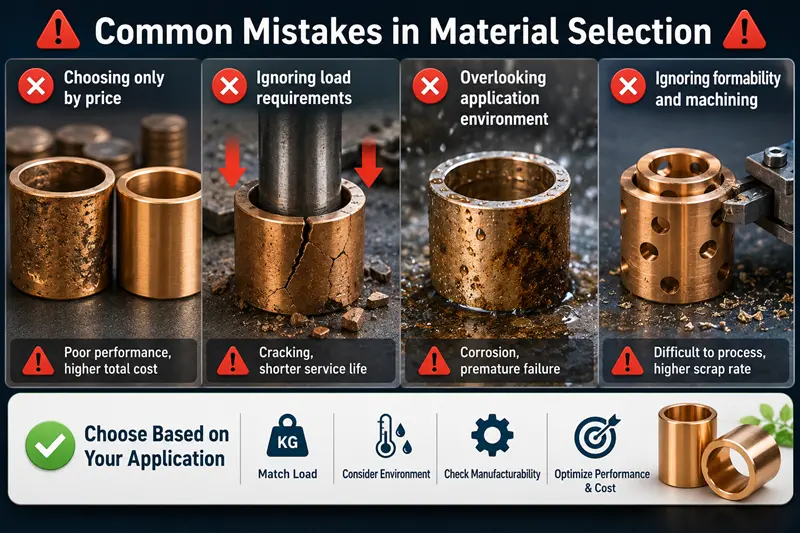
As a factory, we see these issues firsthand. Here are the pitfalls we help our clients navigate.
Mistake 1: "More tin is always better"
This is a dangerous oversimplification. While more tin increases hardness, it also increases brittleness. For applications with high impact or shock loads, an overly hard material can crack. The goal is to find the right balance of strength and toughness for your specific use case, not just to pick the strongest material on paper.
Mistake 2: Ignoring the Manufacturing Process
Engineers sometimes select CuSn8 for its wear properties without consulting the manufacturing team. If the part needs to be extensively cold-formed, CuSn8 can be difficult or impossible to work with, leading to high scrap rates and production headaches. The choice of material must align with how the part will be made. CuSn6 is far more forgiving for processes like stamping and deep drawing.
Mistake 3: Not Starting with the Application
This is the most critical error. The material should be the last thing you finalize. First, you must define the operating conditions:
- What is the maximum load (static and dynamic)?
- What is the rotational speed?
- Will there be lubrication?
- What is the target service life?
Only after you answer these questions can you confidently choose between CuSn8 and CuSn6. The application always dictates the material, never the other way around.
Conclusion
CuSn8 is for performance—strength and wear resistance. CuSn6 is for processability—formability and ease of manufacturing. The right choice always depends on your specific application's load and production needs.
[^1]: Explore the advantages of CuSn8, including its strength and wear resistance, crucial for high-load applications. [^2]: Learn about CuSn6's formability and ductility, making it ideal for lighter-duty and complex components. [^3]: Gain insights into formability and its impact on manufacturing processes for complex parts.