Choosing the right bushing feels complicated. Picking the wrong one leads to premature wear, equipment failure, and unexpected costs. Understanding their core difference is the key to making the right decision.
From a factory perspective, a graphite bushing is not a separate category from a bronze bushing[^1]. It's often a bronze bushing enhanced with graphite to solve specific lubrication problems. They are designed for applications where traditional bronze bushings might fail due to a lack of lubrication.
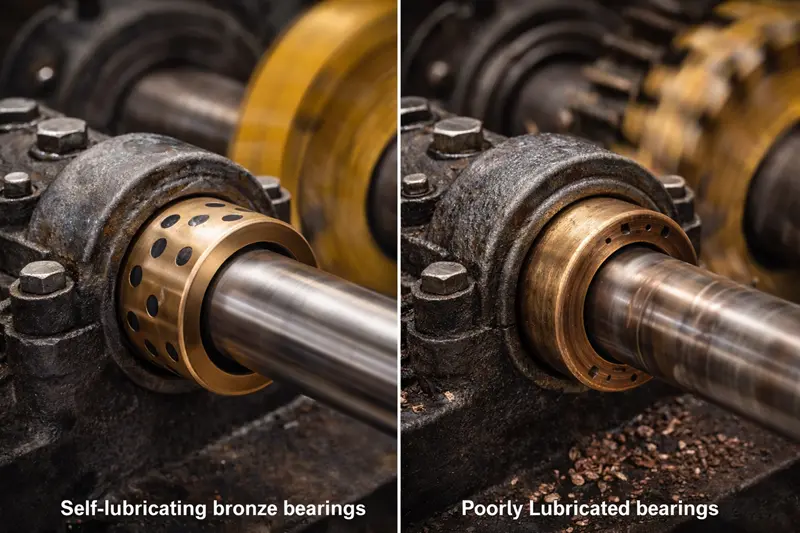
As a manufacturer, I see many buyers compare these two as if they were completely different materials. The truth is much simpler. Think of a graphite bushing as a specialized tool. You wouldn't use a specialized tool for every job, right? The same logic applies here. The real question isn't about which material is "better," but which one is the correct solution for your specific mechanical problem. Let's break down when to use each one so you can choose confidently and cost-effectively.
What Are Bronze Bushings Best For?
You need a strong, reliable bushing for your machine, and you have a good lubrication system in place. Choosing an overly complex bushing can be a waste of money.
Bronze bushings are perfect for applications with stable and consistent lubrication, like oil or grease. They offer excellent strength, wear resistance, and a long service life at a cost-effective price point, making them ideal for many types of industrial and heavy machinery.
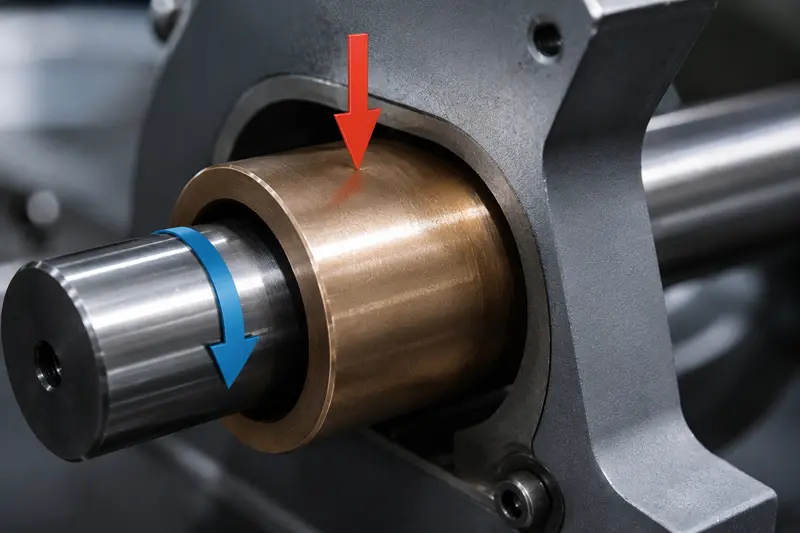
In our factory, we produce tons of standard bronze bushings every year. They are the workhorses of the industry for a good reason. Their strength comes from the solid metal structure. This makes them incredibly durable and able to handle very high loads without deforming. As long as you can keep a thin film of lubricant between the bushing and the shaft, they will last a very long time. This is why they are so common in equipment where regular maintenance and lubrication are part of the standard operating procedure. They provide a predictable and reliable performance that engineers have trusted for decades.
High Load Capacity and Mature Manufacturing
The primary advantage of a bronze bushing is its ability to withstand immense pressure. The solid metal construction provides a stable foundation for heavy shafts and components[^2]. Our manufacturing processes for bronze bushings, whether rolled from a sheet or machined from solid stock, are highly refined. This maturity means we can achieve tight tolerances and consistent quality in large volumes, keeping costs under control for our OEM clients.
The Critical Role of Lubrication
For a bronze bushing to perform correctly, lubrication is not optional; it is essential[^3]. An oil or grease film serves two purposes: it reduces friction and it carries away heat. In applications like gearboxes, hydraulic pumps, and construction machinery, lubrication systems are built-in. In these cases, a plain bronze bushing is often the most logical and economical choice.
| Feature | Description | Best Suited For |
|---|---|---|
| Material | Solid Bronze Alloy (e.g., CuSn8, CuSn6.5) | High-load, well-lubricated conditions |
| Load Capacity | Very High | Heavy machinery, hydraulic cylinders |
| Lubrication | Requires external oil or grease | Equipment with scheduled maintenance |
| Cost | Economical | Cost-sensitive, high-volume projects |
When Should You Choose Graphite Bushings?
Your machine has pivot points that are impossible to grease regularly. A standard bushing would seize up quickly, causing major downtime and expensive repairs. You need a self-lubricating solution.
Graphite bushings are the solution for low-speed, high-load applications where lubrication is difficult, intermittent, or impossible. The embedded graphite acts as a solid lubricant[^4], creating a low-friction surface that prevents metal-to-metal contact and seizure, even in dry conditions.
I remember a client who designed heavy-duty hinges for a water dam. The pivot points were underwater and completely inaccessible for maintenance. A standard bronze bushing would have failed in months. For them, the graphite-plugged bronze bushing was the perfect solution. The bronze base provided the necessary strength to handle the immense weight of the gate, while the graphite plugs ensured the hinge could move smoothly for years without any external lubrication. This is the kind of problem graphite bushings were invented to solve[^5]. They are not for everything, but for the right application, they are invaluable.
The Self-Lubricating Mechanism
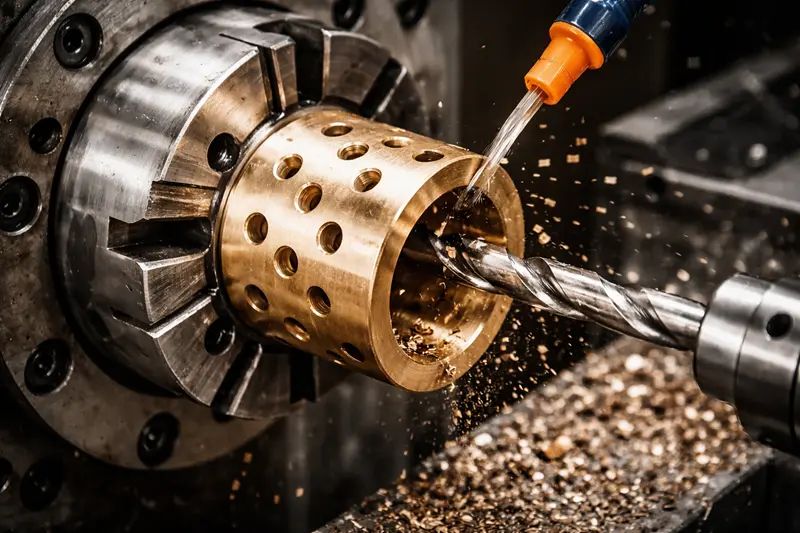
How does it work? The bronze alloy base provides the structural strength. We drill precise holes into the bushing and press solid graphite plugs into them. As the shaft moves, it makes contact with the graphite plugs. A very thin layer of graphite transfers to the shaft, creating a solid lubricating film across the entire contact surface[^6]. This film has a very low coefficient of friction, allowing for smooth movement without needing oil or grease. It's an elegant solution for "set it and forget it" applications.
Ideal Application Scenarios
These bushings shine in specific environments:
- Low Speed, High Load: Perfect for oscillating or slow-moving joints, like the pivot points on excavators, mold guide posts, or bridge bearings.
- Hard-to-Reach Areas: Any joint that is difficult or dangerous to access for regular greasing.
- Extreme Temperatures: Where liquid lubricants might break down or freeze.
However, they are not a magic bullet. They are generally not recommended for high-speed continuous rotation[^7]. At high speeds, the heat buildup can be an issue, and the solid lubricating film may not have time to replenish itself effectively.
| Condition | Why Graphite Bushings Work Well | Example Applications |
|---|---|---|
| Lubrication Difficult | Self-lubricating, no external grease needed | Underwater gates, food processing machinery |
| Low Speed / Oscillation | Solid film prevents stick-slip and wear | Excavator arms, heavy-duty hinges |
| High Load | Bronze base provides high strength | Mold die sets, structural bearings |
| Maintenance-Free Goal | Designed for long life without intervention | Solar panel trackers, remote equipment |
How Do You Choose From an OEM Perspective?
As an equipment manufacturer, you want the best performance without adding unnecessary cost. Upgrading everything to graphite bushings sounds good, but it can hurt your bottom line if it's not needed.
The decision comes down to one key factor: lubrication. If your application has reliable, consistent lubrication, a standard bronze bushing is more economical. Choose a graphite bushing only when you face low speeds, high loads, and difficult or impossible lubrication.
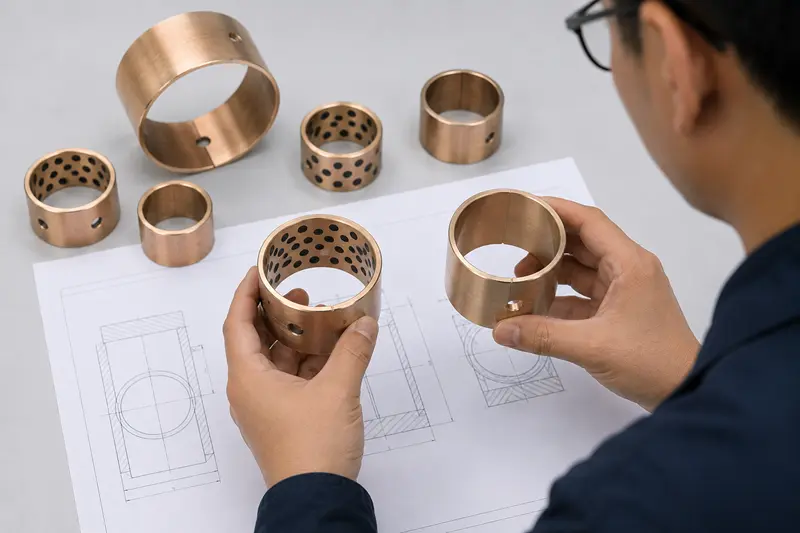
From our factory floor, the message is clear: don't over-engineer your solution. I often speak with purchasing managers who are told they need the "best" and assume that means graphite. But "best" is relative. The best bushing is the one that meets the application's demands reliably for the lowest total cost. A graphite bushing has a higher manufacturing cost because of the extra machining and material involved. Passing that cost to your customer is unnecessary if a standard, well-lubricated bronze bushing would perform just as well or even better over the product's lifespan. The key is to analyze the actual operating conditions[^8], not just follow a trend.
A Practical Decision Framework
To help our B2B clients, I suggest a simple checklist.
- Assess Lubrication Conditions: Can the joint be easily reached for regular greasing? Is there a central lubrication system? If the answer is yes, start with a standard bronze bushing. If the answer is no, a graphite bushing is a strong candidate.
- Evaluate Load and Speed: Is it a high-load, slow-moving pivot? Graphite is great for this. Is it a medium-load, high-speed rotating shaft? A standard bronze bushing with proper lubrication is likely the better, more reliable choice.
- Consider the Environment: Will the bushing be exposed to dirt, debris, or water? Graphite bushings are sealed by nature and don't attract dirt the way grease can, making them advantageous in harsh environments.
- Analyze the Cost: Always weigh the higher initial cost of a graphite bushing[^9] against the long-term cost of maintenance, potential downtime, and warranty claims if a standard bushing fails due to lack of lubrication.
| Factor | Lean Towards Bronze Bushing | Lean Towards Graphite Bushing |
|---|---|---|
| Lubrication | Stable & consistent (oil/grease) | Difficult, intermittent, or impossible |
| Speed | Medium to high speed | Low speed, oscillating |
| Load | High | Very high, static or slow-moving |
| Maintenance | Scheduled & accessible | Inaccessible or maintenance-free design |
| Cost Priority | Lowest initial part cost | Lowest long-term operational cost |
Conclusion
Graphite bushings aren't a superior version of bronze bushings; they are a specialized solution for lubrication-challenged environments. The right choice depends entirely on your specific application's load, speed, and maintenance access.
[^1]: "Exploring the Benefits: Bronze Bushings with Graphite Plugs", https://www.roccarbon.com/bronze-bushings/. This source explains that graphite bushings are typically bronze bushings enhanced with graphite for lubrication purposes. Evidence role: definition; source type: encyclopedia. Supports: Graphite bushings are not a separate category but are bronze bushings enhanced with graphite for lubrication.. [^2]: "Advantages Of Using Solid Bronze Bushings in Industrial Applications", https://www.jxtisens.com/news/advantages-of-using-solid-bronze-bushings-in-i-76219050.html. This source explains how the solid metal construction of bronze bushings contributes to their load-bearing capacity. Evidence role: mechanism; source type: education. Supports: The solid metal construction of bronze bushings provides a stable foundation for heavy shafts and components.. [^3]: "Comprehensive Guide to Lubrication and Maintenance of Bronze ...", https://bushingmfg.com/lubrication-and-maintenance-of-bronze-bushings/. This source discusses the necessity of lubrication for the proper functioning of bronze bushings. Evidence role: mechanism; source type: education. Supports: Lubrication is essential for the proper functioning of bronze bushings.. [^4]: "[PDF] Solid Lubrication Fundamentals and Applications", https://ntrs.nasa.gov/api/citations/20010017158/downloads/20010017158.pdf. This source describes how graphite functions as a solid lubricant in bushings, reducing friction and preventing metal-to-metal contact. Evidence role: mechanism; source type: research. Supports: Graphite acts as a solid lubricant in bushings, reducing friction and preventing metal-to-metal contact.. [^5]: "CLEVITE CORP. | Encyclopedia of Cleveland History", https://case.edu/ech/articles/c/clevite-corp. This source provides historical context on the development of graphite bushings to address lubrication challenges in specific applications. Evidence role: historical_context; source type: research. Supports: Graphite bushings were invented to solve lubrication challenges in specific applications.. [^6]: "[PDF] Solid Lubrication Fundamentals and Applications", https://ntrs.nasa.gov/api/citations/19980218923/downloads/19980218923.pdf. This source explains how graphite plugs in bushings create a solid lubricating film on the contact surface. Evidence role: mechanism; source type: research. Supports: Graphite plugs in bushings create a solid lubricating film on the contact surface.. [^7]: "Exploring the Benefits: Bronze Bushings with Graphite Plugs", https://www.roccarbon.com/bronze-bushings/. This source discusses the limitations of graphite bushings, particularly their unsuitability for high-speed continuous rotation due to heat buildup. Evidence role: expert_consensus; source type: education. Supports: Graphite bushings are not recommended for high-speed continuous rotation due to heat buildup.. [^8]: "Diagnostic testing of bushings | Megger", https://www.megger.com/en/et-online/august-2021/diagnostic-testing-of-bushings. This source emphasizes the importance of analyzing operating conditions to select the appropriate bushing type. Evidence role: expert_consensus; source type: education. Supports: Analyzing actual operating conditions is crucial for selecting the appropriate bushing type.. [^9]: "Exploring the Benefits: Bronze Bushings with Graphite Plugs", https://www.roccarbon.com/bronze-bushings/. This source discusses the higher manufacturing costs of graphite bushings due to additional machining and materials. Evidence role: statistic; source type: research. Supports: Graphite bushings have a higher initial cost due to additional machining and materials required for their production..