Your equipment is down, and a tiny bushing is the culprit. This costs you downtime and money, and you suspect it's just a low-quality part. But the answer is rarely that simple.
Bushings typically fail due to a system-wide mismatch, not just poor material quality.[^1] The most common causes include incorrect material selection, inadequate lubrication, operating beyond design limits, improper installation, a poorly prepared shaft, or contamination entering the friction area. Fixing the problem requires looking at the entire system.
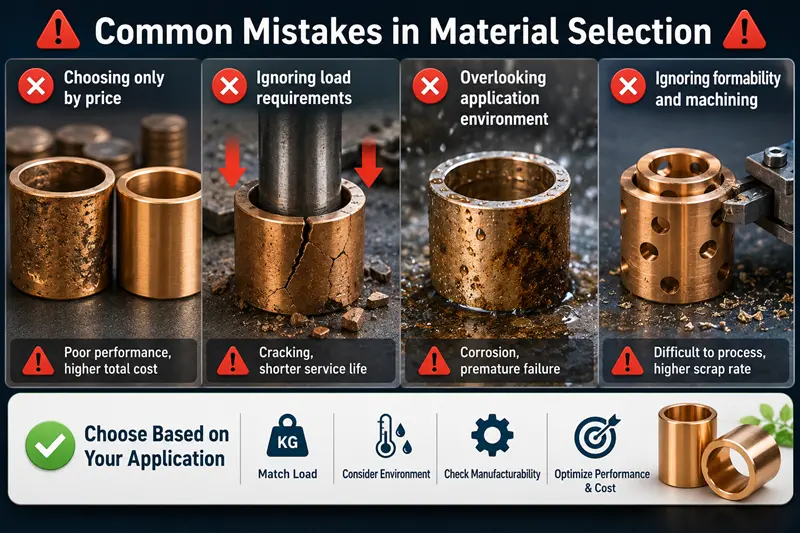
When a bushing fails early, the first instinct for many of our customers is to point a finger at the material quality. As a factory that produces millions of bushings, I can tell you that's rarely the full story. A bushing is part of a system. Its failure is often a symptom of that system not working together correctly. Understanding this is the first step to preventing future breakdowns. Let's look at the real reasons why your bushings might be failing.
Is the bushing material wrong for the job?
Your machine suddenly stops working because of a worn-out bushing. You chose the right size, so why did it fail so quickly? The material itself might be the problem.
Yes, selecting the wrong material is a primary cause of premature bushing failure. A bushing made for light loads will quickly break down under heavy pressure, just as a material not designed for high temperatures will deform. The material must match the specific operational demands of your application.[^2]
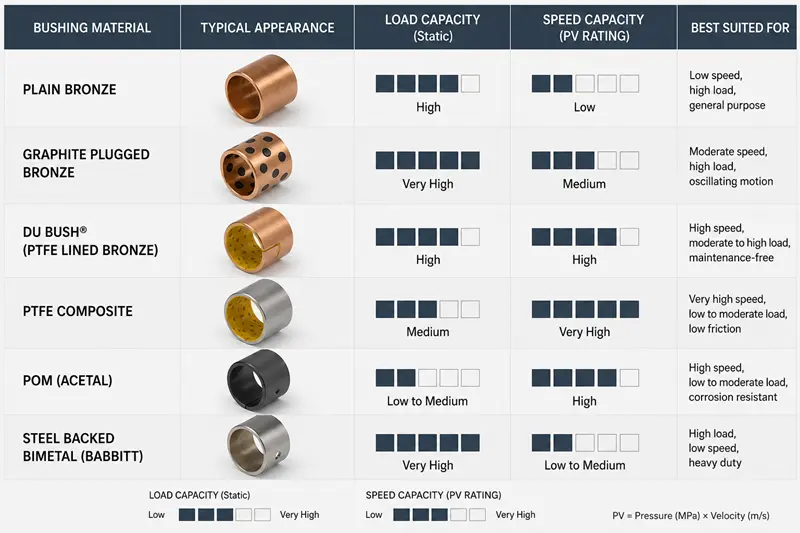
In my experience, material mismatch is one of the top three reasons for failure. It's not about "good" or "bad" material; it's about the right material for the specific context. A buyer might choose a standard steel-backed composite bushing because it's cost-effective, but then install it in equipment used in a wet, corrosive environment like a marine application. The steel backing inevitably rusts, causing the bushing to swell and fail. Similarly, putting a plastic bushing in a high-temperature engine component is a recipe for disaster, as it will soften and deform. To avoid this, you must consider the complete operating environment.
Here is a simple breakdown of common mismatches we see:
| Operating Condition | Incorrect Material Choice | Correct Material Family |
|---|---|---|
| High Load, Low Speed | Polymer Bushings | Bronze, Bi-metal, Metal-polymer |
| High Speed, Low Load | Solid Bronze Bushings | Sintered Bronze, Polymer |
| Wet or Corrosive | Standard Steel-backed (e.g., SF-1) | Stainless Steel, Bronze, Polymer |
| High Temperature (>150°C) | Standard Polymer, DX-type | High-temp Polymers, Graphite-plugged |
Always provide your supplier with the full details of the load, speed, temperature, and environment. This simple step is more effective than anything else in preventing this type of failure.
Are you using the correct lubrication strategy?
You see a seized shaft and a damaged bushing. You know it needed lubrication, but you thought it was serviced recently. Now, you're facing expensive repairs and downtime.
A wrong or missing lubrication strategy is a direct path to bushing failure.[^3] Many bushings, like bronze or bi-metal types, require a consistent oil or grease film to prevent metal-to-metal contact. Without it, friction skyrockets, leading to overheating, seizure, and rapid wear.
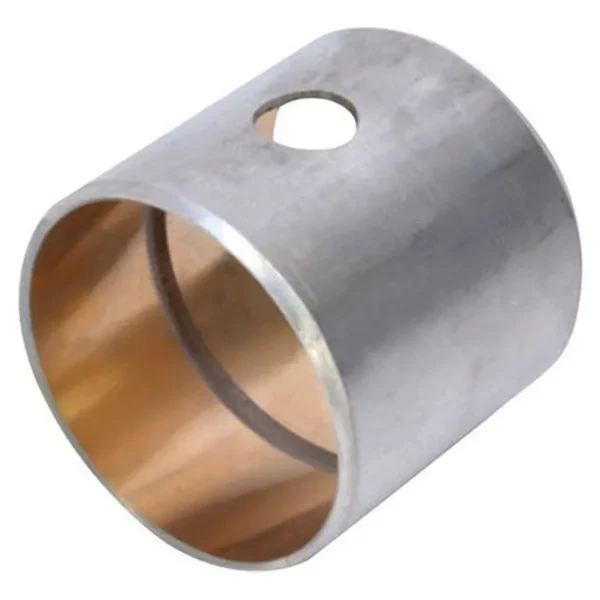
Many of the bronze and bi-metal bushings we manufacture are designed to work with lubrication. They aren't "maintenance-free." The problem is that the lubrication strategy is often an afterthought. We've seen cases where a customer orders a bronze bushing but doesn't specify any oil grooves. The bushing gets installed, and since there's no way for grease to spread across the surface, it only lubricates one small spot. The rest of the surface runs dry, wears out, and fails. The issue wasn't the bushing's quality; it was the lack of a system for delivering lubrication.
Consider these key aspects of lubrication:
- Method: Are you using manual greasing, a central lubrication system, or are you relying on the initial grease pack? The method dictates the design. For manual greasing, you need accessible grease nipples and effective groove patterns (lines, circles, figure-eight) to distribute the grease.
- Frequency: How often is lubrication applied? If the maintenance interval is long, you need larger grease reservoirs or grooves.
- Type: Is the grease or oil appropriate for the temperature and load? Using a low-temperature grease in a hot environment will cause it to liquefy and run out, leaving the bushing dry.
A well-lubricated system runs cool and quiet.[^4] A poorly lubricated one is a failure waiting to happen.
Is the bushing operating beyond its limits?
You replaced a failed bushing with another one of the exact same size. A few weeks later, it failed again in the same way. This is frustrating and makes you question the parts.
Yes, even if the dimensions are identical, a bushing can fail if the load, speed, or temperature exceeds its design limits. Every material has a specific PV rating (Pressure x Velocity), which defines its safe operating window.[^5] Exceeding this causes rapid wear and deformation.
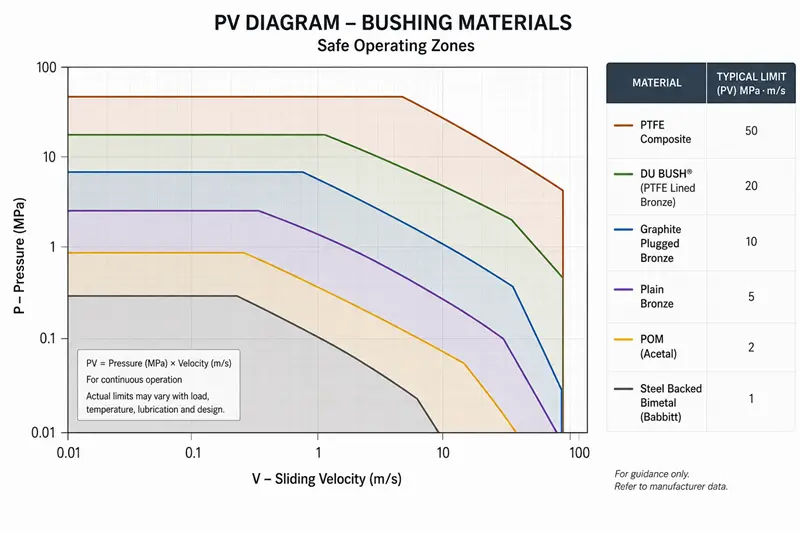
A bushing is not a simple cylinder of metal or plastic. It's an engineered component. Two bushings can look identical but have completely different capabilities. For example, a standard metal-polymer composite bushing might be perfect for a hinge on a piece of construction equipment—a high-load, low-speed, oscillating motion. If you take that same bushing and put it in a high-speed rotating shaft application, it will overheat and fail in hours, even if the load is low. The high velocity generates too much frictional heat for the material to handle.
We call the key metric for this the "PV value."
- P (Pressure): The load on the bushing divided by its projected area.
- V (Velocity): The speed at which the shaft is moving against the bushing surface.
Every bushing material has a maximum PV limit. Pushing it beyond that limit causes the temperature at the friction surface to spike. This can melt the liner, break down lubricants, and cause the bushing to wear out exponentially faster.
| Scenario | Problem | Result |
|---|---|---|
| Load Too High | Exceeds material's compressive strength | Deformation, extrusion, liner damage |
| Speed Too High | Excessive frictional heat generation | Overheating, melting, seizure |
| PV Value Too High | Combined effect of load and speed | Rapid thermal breakdown and wear |
When you replace a bushing, you must replace it with one that meets not just the dimensional requirements, but the performance requirements as well.
Could improper installation be the real problem?
The new bushings you ordered arrived, but after your team installed them, the shafts are tight or won't fit. You blame the supplier for sending out-of-spec parts.
Absolutely. Improper installation is a huge source of bushing failure that often gets mistaken for a quality defect.[^6] Pressing a bushing in too tightly or too loosely, or failing to align it properly, can cause immediate damage and guarantee a short service life.
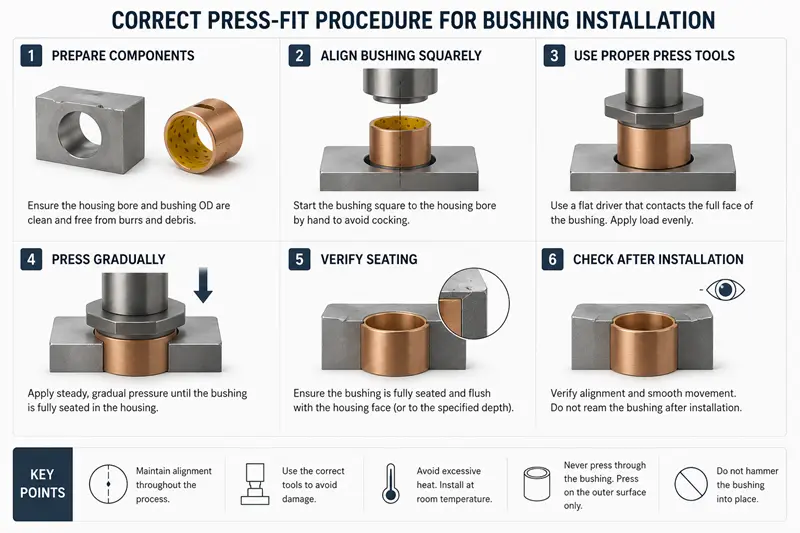
This is something we deal with constantly. A customer will call us, upset that the "hole in the bushing is too small" after they've installed it. But this is often by design. A press-fit bushing is made with a slightly larger outer diameter than the housing bore it goes into.[^7] When you press it in, the elastic properties of the housing and bushing create a secure fit. This compression, however, causes the inner diameter to shrink slightly—we call this "press-fit close-in." If your engineers haven't accounted for this, they'll find the shaft is now too tight.
The problem can go both ways, and both are destructive.
| Installation Error | Description | Consequence |
|---|---|---|
| Fit Too Tight | The housing bore is too small, or too much force was used. | The bushing's inner diameter shrinks too much. It can cause immediate seizure with the shaft, or rapid overheating and wear due to lack of running clearance. |
| Fit Too Loose | The housing bore is too large. | The bushing can move or spin within the housing during operation. This leads to vibration, fretting corrosion, and uneven wear on the bushing's outer surface and the housing itself. |
| Misalignment | The bushing is pressed in crooked. | The load becomes concentrated on the edges of the bushing, causing extreme, rapid edge wear and potential shaft damage. |
Proper installation requires the right tools (e.g., a mandrel), adherence to specified housing and shaft tolerances, and careful alignment. Many post-sale issues are not manufacturing problems; they are assembly problems.
What about the condition of the shaft?
You’ve checked the material, lubrication, and installation, but your bushings are still wearing out too fast. You might be overlooking the other half of the equation: the shaft itself.
The shaft's condition is just as critical as the bushing.[^8] A surface that is too rough, too soft, or has burrs will act like a file, grinding away the bushing material. An out-of-round or misaligned shaft will cause uneven loading and premature failure.
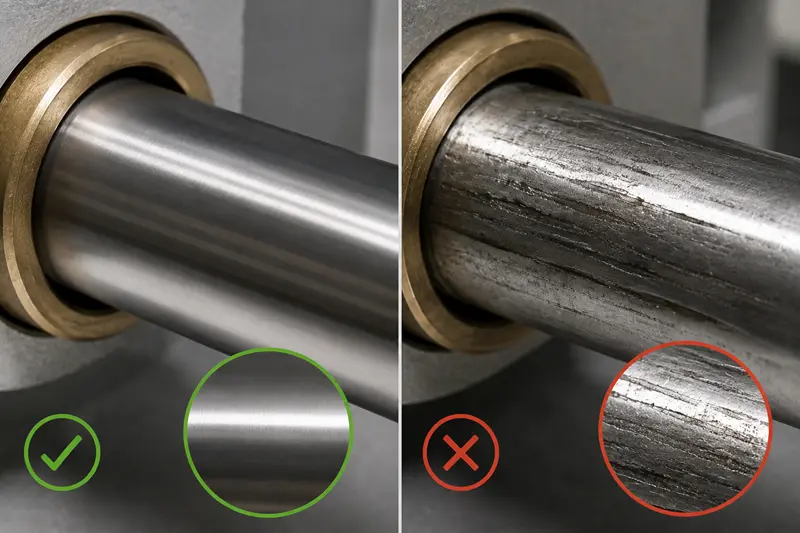
A bushing and a shaft form a "friction pair." They are designed to work together. We can deliver a perfectly manufactured bushing, but if it's installed on a poorly prepared shaft, its life will be short. I once visited a customer who was experiencing rapid wear on bronze bushings in their agricultural machinery. The bushings were fine, but when I inspected their shafts, I could feel sharp ridges and grooves with my fingernail. The shafts had been worn down by previous failures and were never re-polished or replaced. They were essentially using a rough file as their shaft, and no bushing would survive that for long.
Here are the key shaft properties to check:
- Surface Roughness (Ra): This is the most important factor. For most bushings, a smooth, polished surface is required (typically Ra 0.4 to 0.8 µm). Too rough, and it's abrasive. Too smooth (like a mirror finish), and it may not hold a lubricant film properly.
- Hardness: The shaft should generally be significantly harder than the bushing material. A soft shaft can be worn down or scored by debris, which then damages the bushing.
- Geometry: The shaft must be perfectly round and straight. Any ovality or bending will create high-pressure points that lead to localized wear.
- Cleanliness: Before installation, the shaft must be clean and free of any burrs, nicks, or leftover machining debris. A tiny metal chip can get embedded and destroy a bushing from the inside out.
Remember, you are not just buying a bushing; you are maintaining a system. The shaft is half of that system.
How does contamination affect bushing life?
Your equipment operates in a dusty field or a dirty factory. You expect some wear and tear, but bushings seem to be a constant replacement item. Is this just unavoidable?
Contamination is a death sentence for bushings.[^9] When dust, dirt, grit, or moisture gets between the shaft and the bushing, it forms an abrasive paste. This paste grinds away the surfaces, causing severe wear and dramatically shortening the bushing's life.
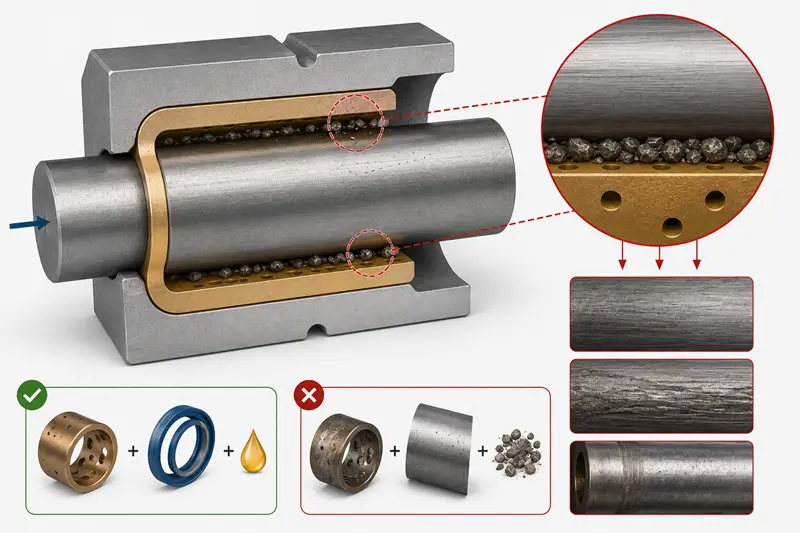
This is a huge issue for our clients in industries like construction, agriculture, and mining. Their machines live in the dirt. The failure we see in these cases is not subtle—it's aggressive. We call it "three-body abrasion." The "two bodies" are the shaft and the bushing. The "third body" is the hard particle of sand or grit that gets in between them. This particle embeds itself into the softer bushing material and acts like a cutting tool, scraping away at the much harder and more expensive shaft. Eventually, the bushing is completely worn away, and the shaft is deeply scored.
Preventing contamination is all about defense:
- Seals: This is the first line of defense. Using effective seals (like O-rings, wipers, or labyrinth seals) at the ends of the housing is critical to block contaminants from entering the bearing area.
- Lubrication as a Barrier: In a grease-lubricated system, periodically purging old grease with new grease can help flush out contaminants that may have gotten past the seals. The collar of old grease that forms around the outside of the seal also acts as an additional barrier.
- Bushing Material Choice: Some materials are more tolerant of contamination than others. For example, a grease-lubricated bronze bushing with grooves can help trap some debris, whereas a metal-polymer bushing with a very thin overlay is highly sensitive to scratching from abrasive particles.
For equipment in harsh environments, designing a robust sealing system is just as important as choosing the right bushing.
Conclusion
Bushing failure is a system issue, not just a part issue. By providing your supplier with complete application details upfront, you can prevent most problems and lower your long-term costs.
[^1]: "[PDF] TESTING AND MAINTENANCE OF HIGH-VOLTAGE BUSHINGS", https://www.usbr.gov/power/data/fist/fist3_2/vol3-2.pdf. This source explains the multifactorial causes of bushing failure, emphasizing system-wide issues such as material selection, lubrication, and contamination. Evidence role: expert_consensus; source type: education. Supports: Bushings fail due to system-wide mismatches rather than solely poor material quality.. [^2]: "[PDF] Tribological Performance of PM400 Bushings in Oscillatory Sliding ...", https://ntrs.nasa.gov/api/citations/20190000817/downloads/20190000817.pdf. This source discusses the importance of material selection in ensuring bushing performance under specific operational conditions. Evidence role: expert_consensus; source type: education. Supports: Material selection is critical for bushing performance under specific operational demands.. Scope note: The source may not address all operational conditions comprehensively. [^3]: "(PDF) A Study of Engine Wear as Influenced by Lubricant Conditions", https://www.academia.edu/52313084/A_Study_of_Engine_Wear_as_Influenced_by_Lubricant_Conditions. This source discusses the role of lubrication in preventing bushing wear and failure, including the importance of proper grease distribution. Evidence role: mechanism; source type: research. Supports: Improper lubrication strategies directly lead to bushing failure.. Scope note: The source may focus on specific types of bushings rather than all possible designs. [^4]: "Impact of lubricant in the performance of variable speed heat pumps ...", https://docs.lib.purdue.edu/mepubs/60/. This source explains how proper lubrication reduces friction and heat, leading to quieter and more efficient operation. Evidence role: mechanism; source type: research. Supports: Proper lubrication leads to cooler and quieter system operation.. Scope note: The source may focus on specific lubrication systems rather than general principles. [^5]: "[PDF] Photovoltaic Module Energy Rating Procedure", https://www.nrel.gov/docs/legosti/old/23942.pdf. This source explains the concept of PV ratings and their importance in determining the operational limits of bushing materials. Evidence role: definition; source type: education. Supports: Every bushing material has a specific PV rating that defines its operational limits.. Scope note: The PV rating may vary depending on the specific material and application. [^6]: "Why Bushings Fail - Millstream Engineering", https://www.millstreamengineering.com/why-bushings-fail/. This source highlights how improper installation techniques can lead to bushing failure, often misattributed to manufacturing defects. Evidence role: mechanism; source type: education. Supports: Improper installation is a major cause of bushing failure, often mistaken for quality issues.. Scope note: The source may not address all installation errors comprehensively. [^7]: "Press Fit Tolerancing for Bushings: The Engineer's Guide to Secure ...", https://mybushing.com/press-fit-tolerancing-for-bushings-the-engineers-guide-to-secure-long-lasting-performance/. This source explains the mechanics of press-fit bushings and how they achieve secure installation through elastic compression. Evidence role: mechanism; source type: education. Supports: Press-fit bushings are designed with a larger outer diameter to achieve secure installation through compression.. Scope note: The source may not address all types of press-fit bushings. [^8]: ""Transient thermomechanical interactions of shaft-bushing pair in ...", https://repository.lsu.edu/gradschool_theses/202/. This source explains the importance of shaft properties like surface roughness and hardness in ensuring bushing longevity. Evidence role: mechanism; source type: research. Supports: The condition of the shaft is crucial for the performance and longevity of bushings.. Scope note: The source may focus on specific shaft conditions rather than all possible factors. [^9]: "A mathematical model for investigation of dry band location on 22 kV ...", https://pmc.ncbi.nlm.nih.gov/articles/PMC10864631/. This source discusses how contamination leads to abrasive wear and significantly reduces bushing lifespan. Evidence role: mechanism; source type: research. Supports: Contamination causes abrasive wear and drastically shortens bushing lifespan.. Scope note: The source may focus on specific types of contamination rather than all possible scenarios.