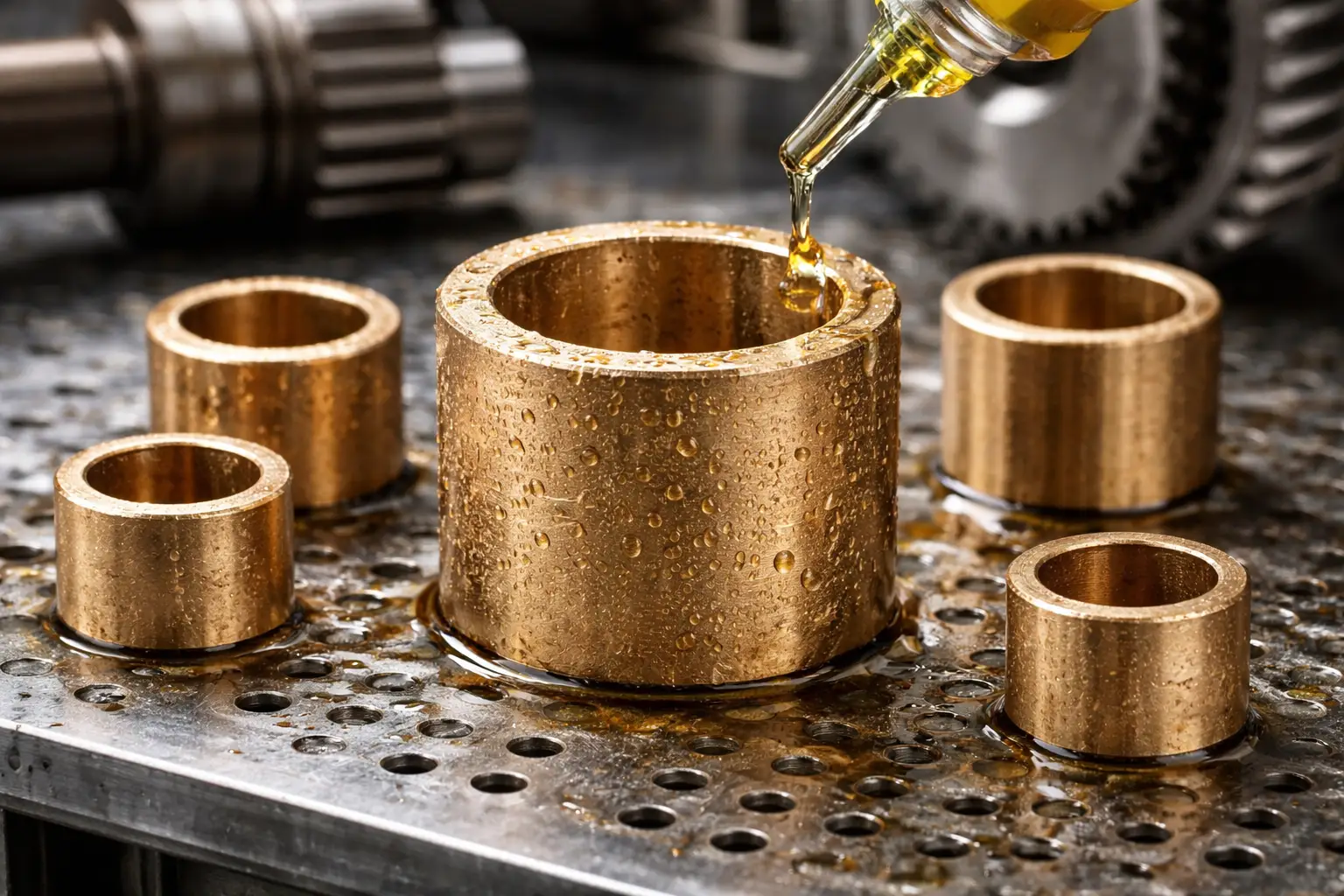
Tired of constant equipment lubrication and costly downtime? Oil-impregnated bushings offer a self-lubricating solution, but the way they are made is key to their performance.
Oil-impregnated bushings are produced using powder metallurgy.[^1] Metal powders are first pressed and then heated (sintered) to form a porous metal body. This porous structure is then placed in a vacuum and filled with lubricating oil, which it stores internally for continuous self-lubrication.
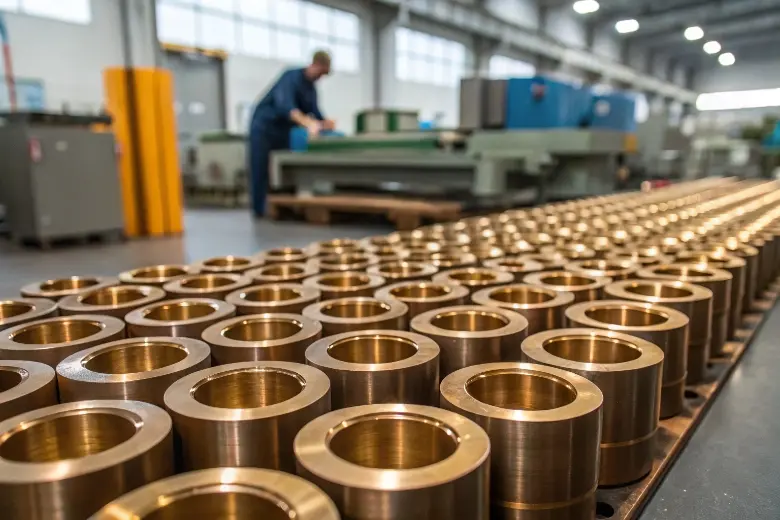
Many of our customers initially believe that an oil-impregnated bushing is just a standard bushing with some oil applied to its surface. From my experience in the factory, I can tell you the reality is much more advanced. The real value is not the oil you can see, but the technology hidden within the material itself. This technology is what separates a truly self-lubricating component from a part that will need maintenance later. Let's dive deeper into how this process works and why it matters for your applications.
What's the real secret behind a self-lubricating oil-impregnated bushing?
You might think the lubrication comes from a surface coating. This can lead to choosing the wrong part for a long-term application. The true value is engineered directly into the material.
The secret is not the oil itself, but the porous metal structure created through powder metallurgy. This network of tiny, interconnected pores holds the lubricant inside the bushing, making it a self-contained lubrication system, not just an oiled part.
The biggest misunderstanding I see is the belief that the oil is just a surface treatment. The real innovation is the manufacturing process that turns a solid material into something like a metallic sponge. This process is called powder metallurgy. The main goal is to create a bushing with a specific, controlled level of porosity. We can engineer the internal structure to have a void space of about 15% to 30% by volume.[^2] This means the material itself becomes an integrated lubrication system. It doesn't just hold a part; it actively maintains the lubricating film that the part needs to run smoothly. This is fundamentally different from a solid bushing that requires an external grease pump or regular oiling.
Key Differences in Bushing Structure
| Feature | Standard Solid Bushing | Oil-Impregnated Bushing |
|---|---|---|
| Lubrication Method | External (grease/oil needed) | Internal (self-contained) |
| Material Structure | Solid, non-porous | Porous, like a sponge |
| Primary Manufacturing | Machining from solid bar | Powder Metallurgy (Sintering) |
| Maintenance Profile | Requires regular re-lubrication | Minimal to no maintenance |
What are the key steps in the manufacturing process?
Wondering how fine metal powder becomes a durable, self-lubricating part? The process can seem complex. Let's break down the key manufacturing steps to make it clear.
The process has five main stages: First, we blend metal powders. Second, we compact the powder under high pressure. Third, we sinter it in a furnace. Fourth, we size it for precision. Finally, we impregnate it with oil under vacuum.
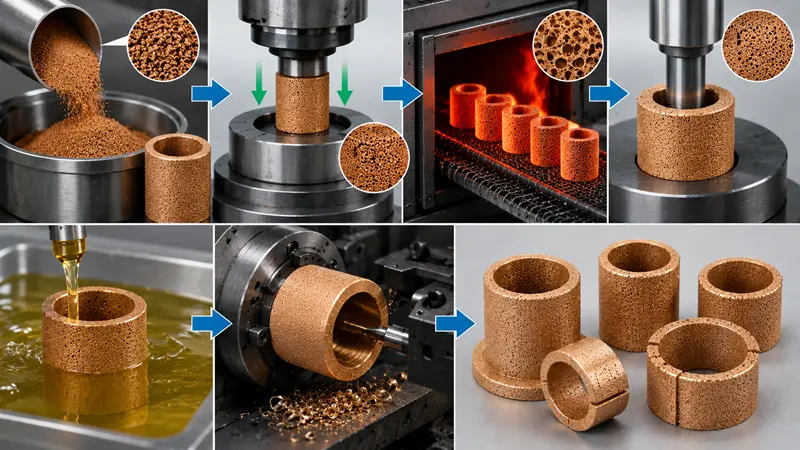
As a manufacturer, we follow a very precise workflow to create these parts. Each step is critical for the final performance.
1. Metal Powder Blending
Everything starts with the raw materials. We mix fine metal powders, usually bronze, iron, or a mix of copper and tin. The specific recipe depends on the application's needs for strength, wear resistance, and cost. I remember a client who needed higher strength for a new motor design, so we adjusted the iron content in the powder blend to meet their specification.
2. High-Pressure Compaction
The blended powder is then poured into a precision die. A press applies immense pressure, compacting the loose powder into the shape of the bushing. This part, called a "green compact," is fragile but holds its shape.
3. Sintering Process
The green compacts are moved into a high-temperature furnace. They are heated in a controlled atmosphere to a point just below their melting point. The metal particles fuse together, forming a strong, solid part while preserving the network of tiny pores.
4. Sizing and Calibration
After sintering, the bushing might have slight dimensional changes. We run it through another die to calibrate its final size, ensuring the inner diameter, outer diameter, and roundness meet strict tolerances.
5. Vacuum Oil Impregnation
This is the final, crucial step. The bushings are placed in a chamber, and a vacuum is pulled to remove all the air from their pores.[^3] Lubricating oil is then introduced, and the pressure difference forces the oil deep into the material's porous network.
How do these bushings achieve continuous self-lubrication?
You need components that work reliably without constant attention. Manually oiling parts is inefficient and costly. So, how does this bushing lubricate itself over and over again without any help?
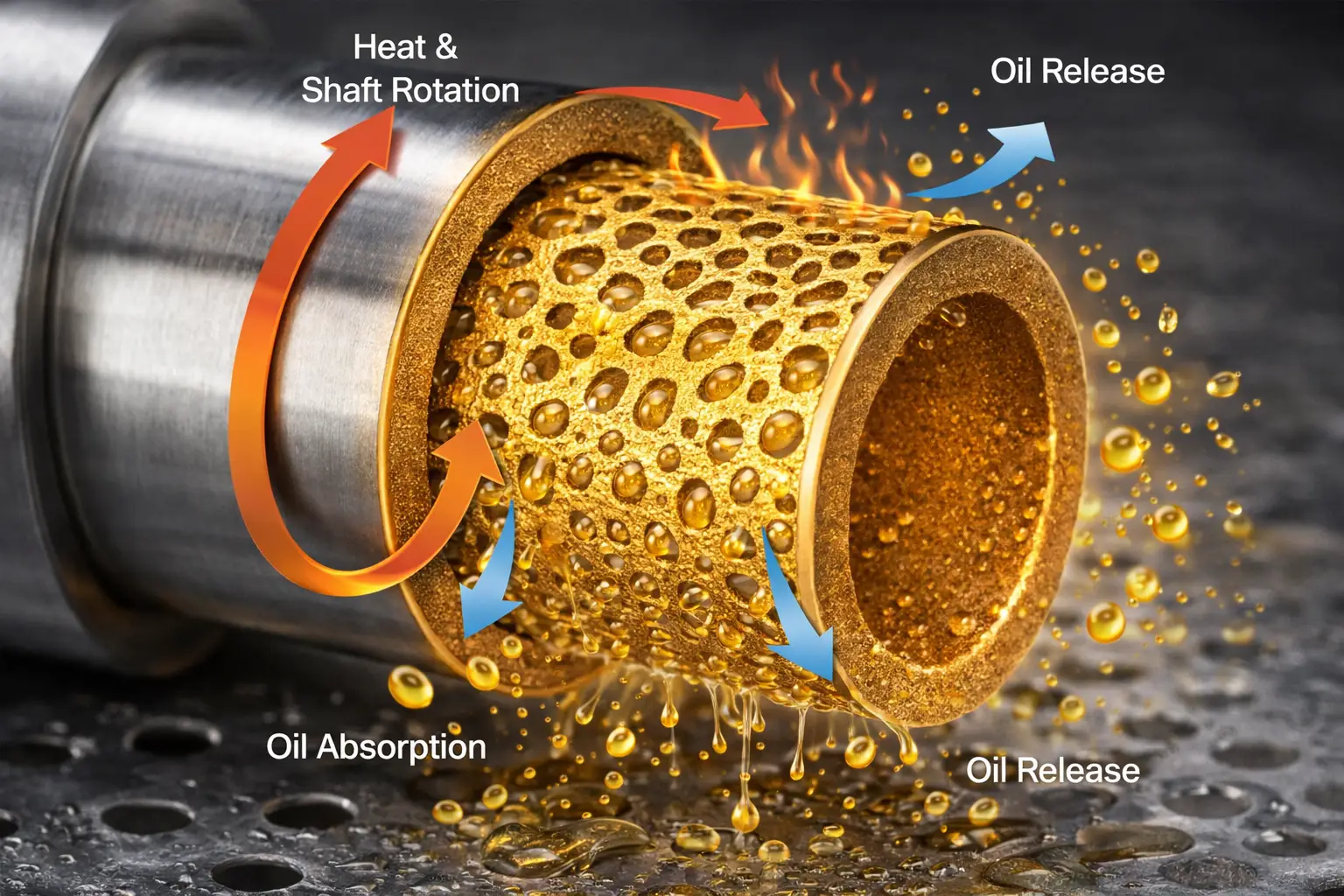
When the shaft rotates, friction creates heat. This heat causes the oil stored in the bushing's pores to expand and flow onto the bearing surface.[^4] When the equipment stops and cools, the oil is drawn back into the pores.
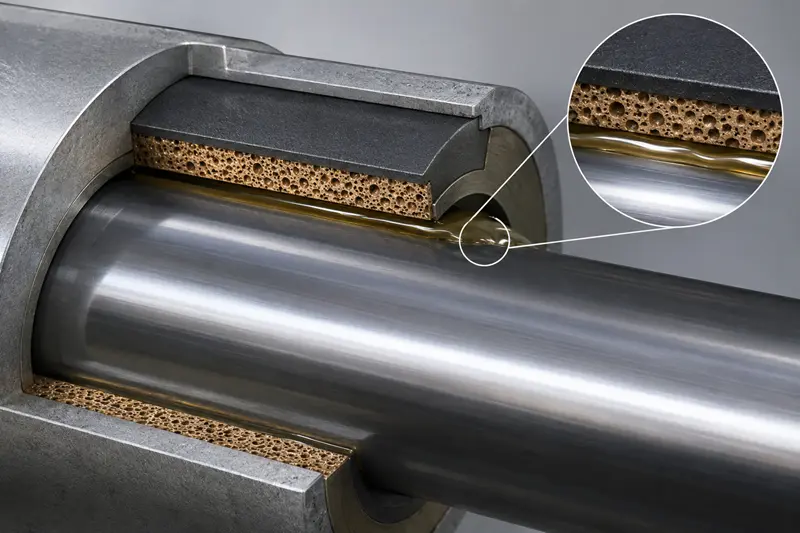
The principle behind the self-lubricating action is simple yet very effective. It relies on thermal expansion and capillary action to create a closed-loop lubrication cycle. It’s a dynamic process that responds to the machine's operating state. When a machine starts, the shaft begins to spin inside the bushing. This movement creates a small amount of friction, which in turn generates heat. This heat is the trigger. As the bushing warms up, the oil held within its millions of tiny pores expands. This expansion pushes a thin, consistent film of lubricant onto the bearing surface, right where it's needed. This film separates the shaft and the bushing, reducing friction and wear. Once the machine is turned off, the process reverses. As the bushing cools down, the oil also cools and contracts. Capillary action, the same force that draws water up a plant stem, pulls the oil from the surface back into the porous network.[^5] The oil is safely stored, ready for the next operating cycle.
The Lubrication Cycle Explained
| State | Temperature | Oil Movement | Result |
|---|---|---|---|
| Running | Increases | Flows out of pores | A lubricating film is formed |
| Stopped | Decreases | Is drawn back into pores | Oil is stored for the next use |
Where are oil-impregnated bushings typically used?
Choosing the right component for your project is critical. Using the wrong part can lead to early failure and damage. So, where do these specific bushings perform best?
They are ideal for applications with moderate loads and speeds where access for maintenance is difficult.[^6] Common uses include electric motors, fans, home appliances, office equipment like printers, and automotive subsystems such as small motors.
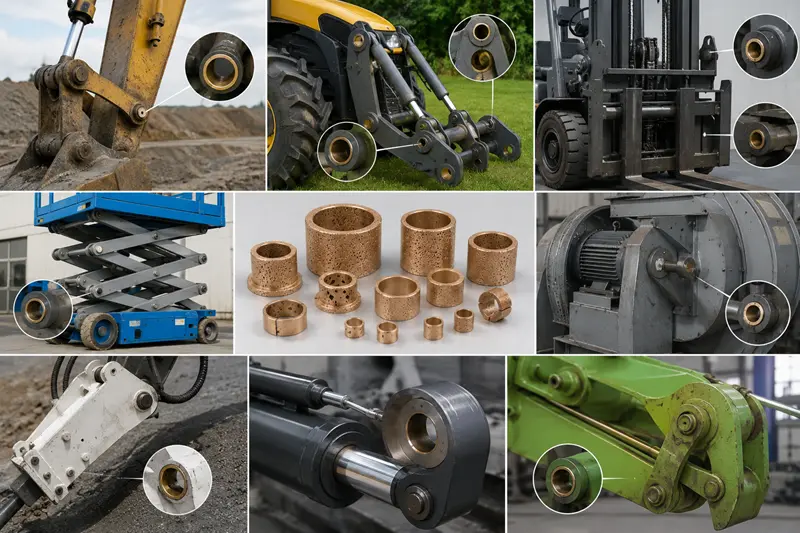
These bushings provide the most value in applications where reliability and low maintenance are more important than extreme load capacity. I've seen our products succeed in a huge range of equipment.
Consumer and Office Electronics
Think about the small fan inside your computer, the motor in a kitchen blender, or the rollers in an office printer. These devices need to run quietly and reliably for years without anyone ever adding a drop of oil. Oil-impregnated bushings are perfect for this.
Automotive Subsystems
Your car is full of small electric motors that use these bushings.[^7] They are in your power seats, electric windows, and windshield wipers. They are chosen because they are compact, cost-effective, and will last for the life of the vehicle without any maintenance.
Light Industrial Machinery
We once worked with a client developing a new line of automated conveyor systems for a warehouse. The rollers needed to run smoothly for thousands of hours. By using our oil-impregnated bushings, they eliminated hundreds of manual lubrication points, drastically reducing their customer's maintenance costs and potential for downtime. They are also common in textile machines and other light-duty factory equipment.
When should you choose a different type of bushing?
This bushing seems like a perfect solution, but using it in the wrong application is a common mistake. Misapplication leads to premature wear, failure, and equipment damage. So, when is this bushing the wrong choice?
Avoid oil-impregnated bushings for applications involving very heavy loads, high-impact forces, or extremely high speeds.[^8] The porous structure that holds the oil also reduces the material's overall mechanical strength, making it unsuitable for heavy-duty work.
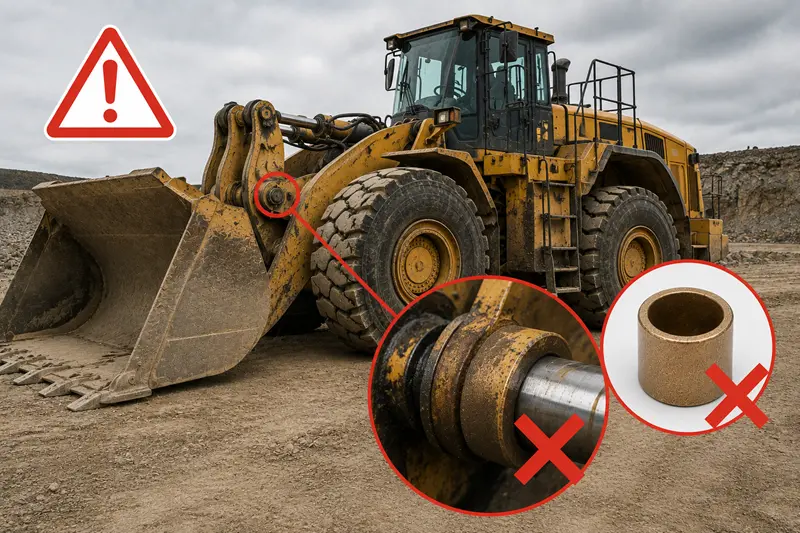
The key limitation of a sintered, oil-impregnated bushing is a direct trade-off for its self-lubricating feature. The pores that hold the oil mean there is less metal to carry a load compared to a solid bushing of the same size. Understanding these limits is crucial for any engineer or buyer.
Scenarios to Avoid
- Heavy Loads: In equipment like a hydraulic press or the arm of a large excavator, the forces are too great. The porous structure could be crushed.
- Shock Loads: Imagine the jarring impacts inside a rock crusher or a jackhammer. These shock loads can fracture the sintered material.
- Extreme Environments: Very high operating temperatures can cause the oil to break down or burn away. In very dirty or dusty environments, contaminants can clog the pores, stopping the flow of oil.
Better Alternatives for Tough Jobs
For these demanding situations, you need a different type of bushing.
- Solid Bronze Bushings: Machined from a solid bar of bronze, they offer excellent strength for high-load, low-speed applications.
- Bimetal Bushings: These have a strong steel backing with a layer of bronze or another bearing material bonded to it. They combine strength with good sliding properties.
- Graphite-Plugged Bushings: These are solid bronze bushings with plugs of solid graphite lubricant embedded in them. They are great for high-temperature and heavy-load applications where liquid lubricants can't be used.
| Condition | Oil-Impregnated Bushing | Better Alternative |
|---|---|---|
| Heavy Static Load | Not Recommended | Solid Bronze Bushing |
| High Shock Load | Not Recommended | Graphite-Plugged Bushing |
| Very High Temperature | Limited | Graphite-Plugged Bushing |
| High Speed with Load | Not Recommended | Bimetal Bushing |
Conclusion
In short, the value of an oil-impregnated bushing comes from its internal porous structure made by powder metallurgy. This makes it a great choice for reducing maintenance in light-to-moderate duty applications.
[^1]: "Impregnation In Powder Metallurgy", https://powdermetallurgy.com/impregnation-in-powder-metallurgy/. Powder metallurgy is a widely recognized manufacturing process for creating porous metal components, including oil-impregnated bushings, as detailed in engineering materials literature. Evidence role: mechanism; source type: education. Supports: Oil-impregnated bushings are produced using powder metallurgy.. [^2]: "06/25/2012 Powder Metallurgy Methods for Producing ...", https://www.nrc.gov/docs/ML1220/ML12200A350.pdf. Studies on powder metallurgy confirm that the porosity of sintered components can be controlled within a range of 15% to 30%, depending on the application. Evidence role: statistic; source type: research. Supports: We can engineer the internal structure to have a void space of about 15% to 30% by volume.. Scope note: The porosity range may vary slightly based on the specific material and manufacturing conditions. [^3]: "Vacuum Impregnation Services & Sealants - Sharretts Plating", https://www.sharrettsplating.com/additional-services/vacuum-impregnation-services/. Vacuum impregnation is a documented technique used in manufacturing porous components to ensure thorough oil penetration. Evidence role: mechanism; source type: education. Supports: The bushings are placed in a chamber, and a vacuum is pulled to remove all the air from their pores.. Scope note: The exact vacuum pressure and oil type may vary by manufacturer. [^4]: "Study reveals new physics of how fluids flow in porous media", https://energy.mit.edu/news/study-reveals-new-physics-fluids-flow-porous-media/. Thermal expansion of lubricants in porous materials is a known phenomenon supported by tribology studies. Evidence role: mechanism; source type: research. Supports: This heat causes the oil stored in the bushing's pores to expand and flow onto the bearing surface.. Scope note: The efficiency of this mechanism may depend on the type of oil and operating conditions. [^5]: "Capillary action - Wikipedia", https://en.wikipedia.org/wiki/Capillary_action. Capillary action in porous materials is a well-documented physical phenomenon, as explained in fluid mechanics literature. Evidence role: mechanism; source type: education. Supports: Capillary action, the same force that draws water up a plant stem, pulls the oil from the surface back into the porous network.. Scope note: The effectiveness of capillary action may vary with pore size and oil viscosity. [^6]: "[PDF] The Tribological Performance of Self-Lubricating Bearings Following ...", https://docs.lib.purdue.edu/cgi/viewcontent.cgi?article=2888&context=icec. Oil-impregnated bushings are commonly recommended for moderate-load, low-maintenance applications, as noted in engineering design guidelines. Evidence role: expert_consensus; source type: education. Supports: They are ideal for applications with moderate loads and speeds where access for maintenance is difficult.. Scope note: Specific load and speed limits may vary by material and design. [^7]: "What is Oil Impregnated Bronze Bushings?", https://mybushing.com/what-is-oil-impregnated-bronze-bushings/. Automotive subsystems, including small electric motors, often utilize oil-impregnated bushings for their self-lubricating properties, as documented in automotive engineering resources. Evidence role: case_reference; source type: education. Supports: Your car is full of small electric motors that use these bushings.. Scope note: The prevalence of these bushings may vary by vehicle model and manufacturer. [^8]: "[PDF] The Tribological Performance of Self-Lubricating Bearings Following ...", https://docs.lib.purdue.edu/cgi/viewcontent.cgi?article=2888&context=icec. Engineering guidelines caution against using oil-impregnated bushings in high-load or high-speed applications due to their reduced mechanical strength. Evidence role: expert_consensus; source type: education. Supports: Avoid oil-impregnated bushings for applications involving very heavy loads, high-impact forces, or extremely high speeds.. Scope note: Specific thresholds for load and speed depend on the material and design of the bushing.