Your machine suddenly grinds to a halt. You suspect a catastrophic bushing failure, costing you time and money. But the real cause is often a gradual process you can prevent.
Bushing seizure is rarely a sudden event.[^1] It's the final stage of a system failure, typically caused by a combination of insufficient lubrication, incorrect clearance, and excessive heat. This creates a vicious cycle where friction increases, eventually locking the components together.
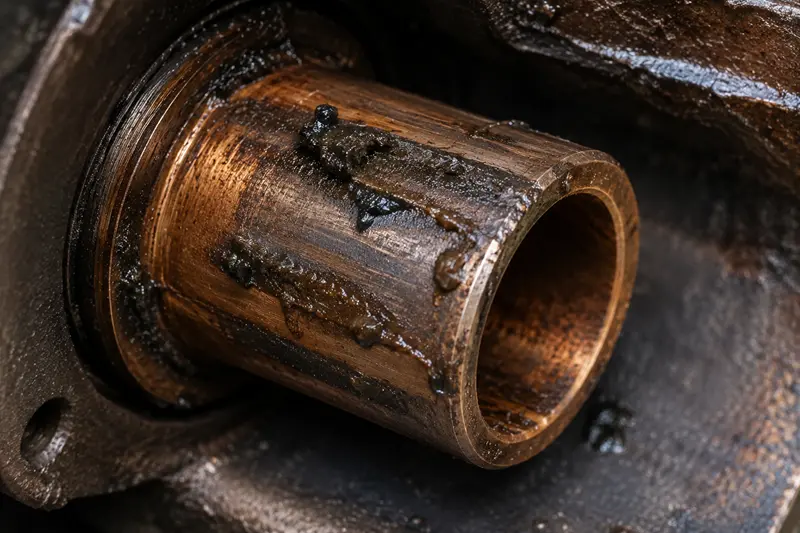
From our factory floor, we see this issue all the time. A customer will call, frustrated, believing the bushing material itself simply failed. They want a "stronger" material. But in my experience, a stronger bushing often just masks the real problem for a little while longer. Seizure isn't a material problem; it's a system problem. It's a chain reaction where one small issue leads to another, until the entire assembly locks up. To truly fix it, you need to look beyond the failed part and investigate the whole system. Let's break down the real culprits one by one.
Is Lack of Lubrication the Real Culprit?
You followed the maintenance schedule and lubricated the joint, but it seized anyway. It's frustrating when you do everything right and parts still break. But lubrication failure is more complex.
Yes, it's the most common trigger. Insufficient lubrication allows direct metal-to-metal contact between the shaft and bushing.[^2] This creates intense friction and heat, breaking down any remaining oil film and starting the chain reaction that leads to complete seizure, especially with bronze bushings.
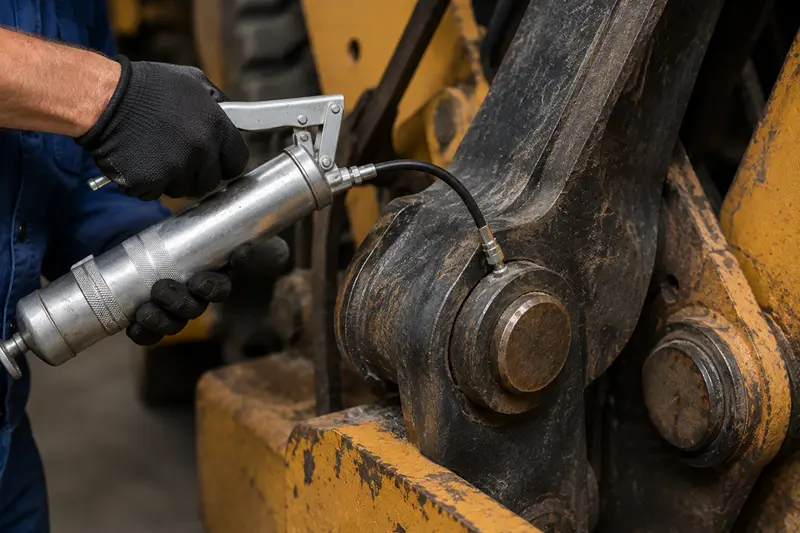
In our factory, we design bushings to work with a thin film of oil or grease separating them from the shaft. This lubricant film does two critical jobs: it reduces friction and it helps carry away heat. When that film breaks down, everything goes wrong very quickly. Direct contact creates friction, and friction creates heat.[^3] The heat makes the oil thinner and less effective, leading to even more direct contact. It's a downward spiral. The problem isn't always a lack of grease; sometimes it's the wrong type of grease, or the lubrication interval is too long for the operating conditions.
Key Lubrication Failure Points
| Failure Point | Description | How to Check |
|---|---|---|
| Insufficient Amount | Not enough lubricant is applied, or it's not reapplied often enough. | Check for dry, discolored surfaces on the shaft or inside the bushing. |
| Wrong Type | The lubricant's viscosity is too low for the load or temperature, causing it to be squeezed out. | Review the equipment's manual for the recommended lubricant specifications. |
| Contamination | Dirt, dust, or metal particles mix with the lubricant, turning it into an abrasive paste. | Inspect the old grease. If it's gritty or dark, it's likely contaminated. |
| Blocked Grooves | Oil grooves or holes in the bushing become clogged, preventing lubricant from reaching the entire surface. | When replacing a bushing, ensure all grooves and holes are clear. |
A customer once told me they were lubricating their equipment daily but still had seizures. It turned out the grease they were using wasn't designed for the high temperatures of their application. It was liquefying and running out almost immediately. We helped them switch to a high-temperature grease, and the problem disappeared.
How Does Installation Affect Bushing Clearance?
The new bushing fit the shaft perfectly on the bench. But after you pressed it into the housing, the machine started binding. Now you're facing a seizure, and it's confusing.
Press-fitting physically compresses the bushing, reducing its inner diameter.[^4] Then, operating heat causes both the shaft and bushing to expand. This thermal expansion further reduces the running clearance, leaving no room for movement or a proper lubricant film, which quickly leads to seizure.
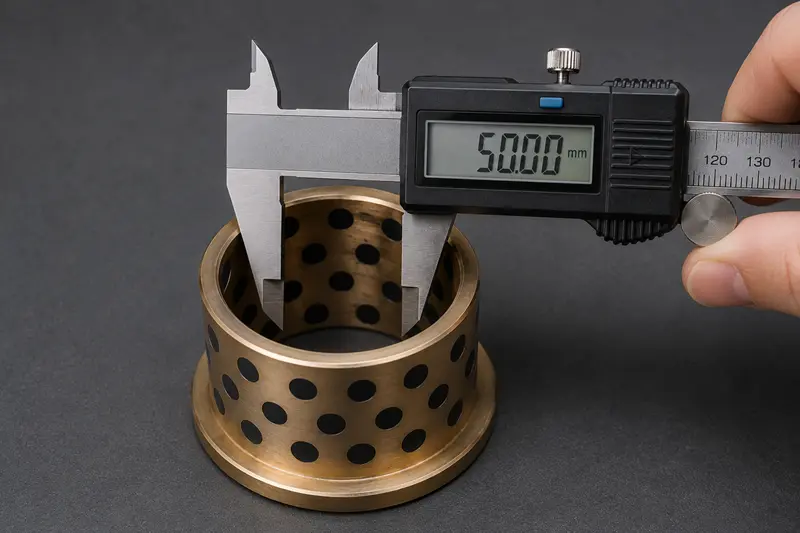
This is one of the most overlooked causes of seizure. We manufacture bushings to precise outer and inner dimensions. However, the final, functional inner diameter is determined after you press it into its housing. The force of the press-fit squeezes the bushing, causing the inner diameter to shrink. We call this "press-fit close-in." If this isn't accounted for, the initial running clearance can be nearly zero. Then, as soon as the machine starts and generates heat, the materials expand. A steel shaft expands, and the bronze or composite bushing expands. Suddenly, there is negative clearance—the bushing is actively squeezing the shaft. At that point, seizure is inevitable. It's critical to measure the bushing's inner diameter after it has been installed in its housing, not before. This is the only way to confirm you have enough running clearance for both thermal expansion and the necessary lubricant film.
The Impact of Press-Fit and Heat
- Initial State: The bushing has a specified inner diameter (ID). The shaft has a slightly smaller outer diameter (OD). The difference is the initial clearance.
- After Press-Fit: The bushing is pressed into the housing. Its ID shrinks. The clearance is now smaller.
- During Operation: The machine runs, generating heat. Both the shaft and the bushing expand.
- Failure Point: The clearance is completely eliminated. Metal-to-metal contact occurs, friction skyrockets, and the components seize.
For OEM buyers, our key advice is this: always specify if the dimensions on your drawing are pre-installation or post-installation. It makes a huge difference in how we manufacture the part.
Could Your Shaft Be Damaging the Bushing?
You keep replacing the same bushing over and over. Each new part fails faster than the last. You're stuck in an endless cycle of costly repairs and downtime, blaming the bushing quality.
Absolutely. A shaft with a rough surface finish, burrs, or insufficient hardness acts like a file against the bushing material.[^5] It grinds away the bearing surface and introduces abrasive particles into the system, causing scoring and rapid failure that leads directly to seizure.
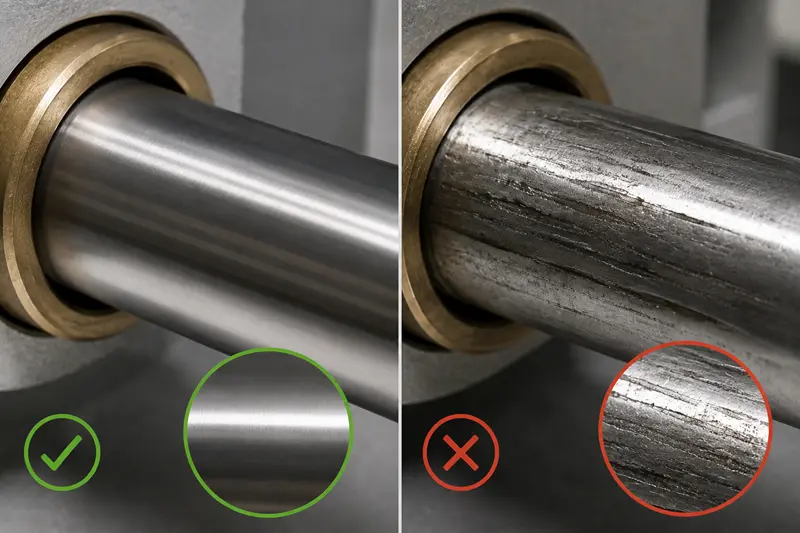
I remember a client in the agricultural machinery sector who was experiencing repeated failures of bronze bushings in a pivot joint. They were convinced our bushings were faulty. I asked them to send me not just the failed bushing, but the shaft as well. The moment I saw the shaft, I knew the problem. It was covered in fine scratches and had a rough, almost matte finish from wear. Every time they installed a new, soft bronze bushing, this rough shaft would immediately start wearing it down. The tiny metal particles from the bushing would then mix with the grease, creating a grinding compound that accelerated the destruction. The bushing never stood a chance. The solution wasn't a different bushing; it was to replace or re-machine the shaft to have a smooth, hardened surface.[^6]
Ideal Shaft Characteristics for Bushings
| Characteristic | Why It's Important | Recommended Specification |
|---|---|---|
| Surface Finish | A smooth surface allows the lubricant film to form and prevents abrasion of the bushing. | Ra 0.4 - 0.8 μm (16 - 32 μin) is typical. |
| Hardness | A hard shaft resists wear and scoring, especially if contaminants get into the joint. | Should be significantly harder than the bushing material. For steel shafts, >45 HRC is good practice. |
| Cleanliness | Debris, dust, or rust on the shaft will act as an abrasive and contaminate the lubricant. | The shaft must be clean and free of burrs before installing the bushing. |
Before you install your next bushing, run your fingernail across the shaft. If you can feel grooves or roughness, that shaft is going to damage the new part. Fixing the shaft first will save you from another failure down the line.
Are You Pushing Your Bushing Beyond Its Limits?
Your equipment is running fine, but you decide to increase its speed or load to improve productivity. Soon after, you start experiencing overheating and unexpected breakdowns from seized bushings.
Very likely. Every bushing is rated for a specific PV value—a limit based on Pressure (load) and Velocity (speed).[^7] Exceeding this limit generates more frictional heat than the bushing and lubricant can dissipate. This heat breaks down the lubricant and causes thermal expansion, creating the perfect storm for seizure.
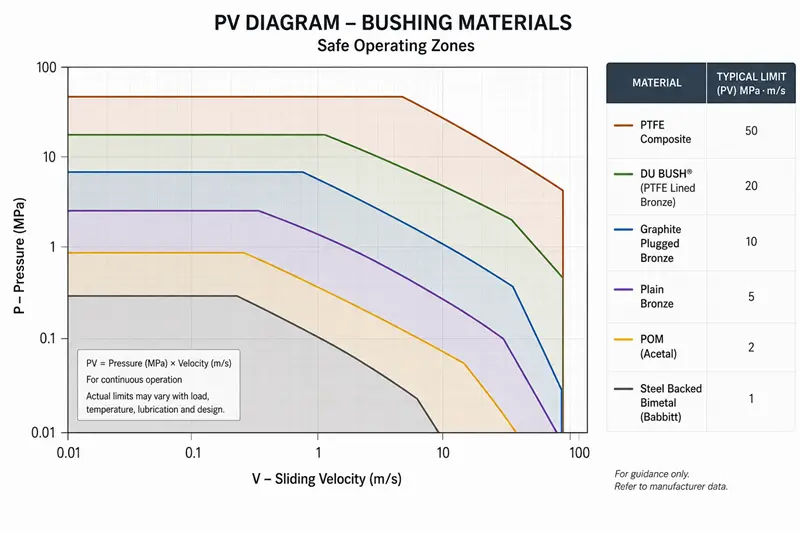
PV value is the secret language of bearings. It's simply Pressure (P) multiplied by Velocity (V). As a manufacturer, we test our materials to determine the maximum PV they can handle before they fail. When you increase the load on a bushing, the 'P' value goes up. When you increase the rotational speed, the 'V' value goes up. Either change will increase the total PV value. If that new value exceeds the material's limit, you're in the danger zone. The system will start generating heat faster than it can get rid of it. This is the point where the lubricant starts to fail and thermal expansion begins to shrink the clearance. I've seen many OEM customers design a machine for one set of conditions, then later offer a "high-performance" version that runs faster without upgrading the bushings. It's a recipe for failure. It's crucial to match the bushing material to the actual, real-world operating conditions, not just the original design specs.
Checking Your Operating Conditions
- Calculate Your Load (P): Determine the force (in pounds or Newtons) acting on the bushing and divide it by the projected area (bushing ID x length).
- Calculate Your Velocity (V): Determine the surface speed of the shaft (in feet/minute or meters/second).
- Calculate the PV Value: Multiply P x V.
- Compare to a Material Chart: Check the manufacturer's data sheet for the bushing material you are using. Is your calculated PV value below the material's maximum limit? If it's close or over, you need to either reduce the P or V, or upgrade to a higher-performance bushing material.
Don't guess. If you're experiencing seizures after changing how you use your equipment, do the math. The PV value will often tell you exactly what went wrong.[^8]
Why Do Bronze Bushings Get Stuck in a "Heat-Tighten" Cycle?
You've noticed that your bronze and bimetal bushings seem to fail more suddenly than other types. One minute they are working fine, the next they are completely seized and have to be cut off.
These bushings rely heavily on a perfect lubricant film. Once that film is compromised, friction causes a rapid temperature spike. The metal expands, tightening the clearance. This increased tightness creates even more friction and more heat, starting a vicious "hotter-tightens-hotter" cycle that leads to catastrophic seizure.
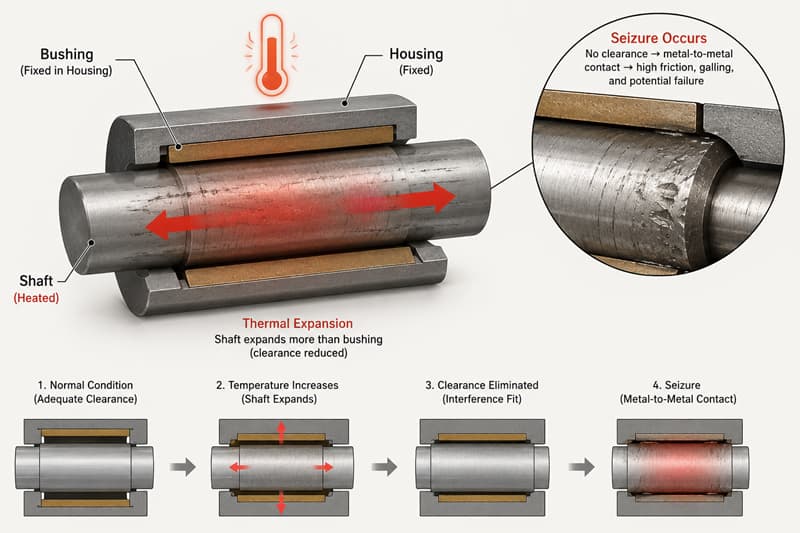
This thermal runaway is the classic failure mode for many metallic bushings, like our wrapped bronze (FB090) or bimetal types. Unlike some composite bushings that can handle a bit of dry running, these materials need a consistent oil film. The moment that film breaks, even for a second, you get direct metal-on-metal contact.[^9] The friction is instantaneous and intense. Bronze is a good conductor of heat, so the temperature shoots up.[^10] This causes the bushing to expand inward, gripping the shaft tighter. This grip increases the friction even more, which in turn generates more heat. It's an aggressive, self-fueling cycle of destruction. Within minutes, the temperature can get high enough to weld the bushing to the shaft. This is why it often looks like a sudden, catastrophic failure, but the trigger was likely a small, earlier problem—a moment of lubricant starvation or a bit too much load.
The Chain Reaction of Seizure
- Trigger Event: The oil film is broken due to overload, contamination, or insufficient lubrication.
- Initial Friction: The shaft and bushing make direct contact. Friction generates a small amount of heat.
- Thermal Expansion: The heat causes the bronze bushing and steel shaft to expand, reducing the running clearance.
- Increased Friction: The tighter clearance increases the contact pressure and friction, which generates much more heat.
- Runaway: The cycle repeats rapidly. More heat leads to more expansion and more friction.
- Seizure: The clearance disappears completely, and the components lock together, often causing a visible blue discoloration from the extreme heat.
Understanding this cycle is key. The solution isn't just a harder bushing; it's ensuring the trigger event never happens. That means focusing on maintaining perfect lubrication and correct clearance at all times.
Conclusion
Bushing seizure is a system failure, not just a part failure. To find the real cause, look beyond the broken bushing and check your clearance, lubrication, shaft condition, and load.
[^1]: "[PDF] TESTING AND MAINTENANCE OF HIGH-VOLTAGE BUSHINGS", https://www.usbr.gov/power/data/fist/fist3_2/vol3-2.pdf. This source explains the gradual nature of bushing seizure, emphasizing the role of lubrication, clearance, and heat in the failure process. Evidence role: mechanism; source type: education. Supports: Bushing seizure typically occurs as the final stage of a system failure rather than as an isolated event.. [^2]: "[PDF] A Computational Study of Metal Contacts to Beyond-Graphene 2D ...", https://djena.engineering.cornell.edu/papers/2012/iedm12_2d_contacts.pdf. This source discusses how insufficient lubrication leads to metal-to-metal contact, increasing friction and heat in mechanical systems. Evidence role: mechanism; source type: research. Supports: Insufficient lubrication is a primary trigger for bushing seizure due to increased friction and heat.. [^3]: "What Causes Friction to Produce Heat? - cs.stanford.edu", https://cs.stanford.edu/people/zjl/pdf/friction.pdf. This source discusses the relationship between friction and heat generation in mechanical systems. Evidence role: mechanism; source type: research. Supports: Friction from direct contact between components generates heat, contributing to mechanical failure.. [^4]: "Bushing Thermal Expansion | Eng-Tips", https://www.eng-tips.com/threads/bushing-thermal-expansion.514019/. This source explains how press-fitting alters the dimensions of bushings, affecting their clearance and performance. Evidence role: mechanism; source type: education. Supports: Press-fitting compresses bushings, reducing their inner diameter and potentially leading to clearance issues.. [^5]: "Abrasion - StatPearls - NCBI Bookshelf - NIH", https://www.ncbi.nlm.nih.gov/books/NBK554465/. This source highlights how shaft surface finish and hardness impact bushing wear and failure. Evidence role: mechanism; source type: research. Supports: Shaft surface finish and hardness are critical factors in preventing bushing wear and failure.. [^6]: "How Does Surface Finish Really Affect Bushing Performance?", https://cnfesoda.com/how-does-surface-finish-really-affect-bushing-performance/. This source emphasizes the importance of shaft surface quality in preventing bushing wear and failure. Evidence role: expert_consensus; source type: education. Supports: Improving shaft surface quality is often more effective than changing bushing material in preventing wear and failure.. [^7]: "Pressure-Velocity Ratings and Bearing Performance", https://mybushing.com/bushing-material-pv-pressure-velocity-ratings-and-bearing-performance/. This source defines PV value and its importance in determining bushing performance under load and speed conditions. Evidence role: definition; source type: encyclopedia. Supports: PV value is a critical parameter for assessing bushing performance under specific operating conditions.. [^8]: "Dynamic pressure - Wikipedia", https://en.wikipedia.org/wiki/Dynamic_pressure. This source explains how PV value analysis can diagnose bushing failure causes. Evidence role: mechanism; source type: education. Supports: PV value analysis is a reliable method for diagnosing bushing failure causes.. [^9]: "[PDF] Oil Effects On Performance Of Automobile A/C System", https://docs.lib.purdue.edu/cgi/viewcontent.cgi?article=2647&context=iracc. This source explains how the loss of lubricant film leads to direct metal contact and mechanical failure. Evidence role: mechanism; source type: research. Supports: Loss of lubricant film results in direct metal contact, accelerating mechanical failure.. [^10]: "[PDF] thermal and electrical conductivity measurements of cda 510 ...", https://ntrs.nasa.gov/api/citations/20090032058/downloads/20090032058.pdf. This source explains the thermal conductivity of bronze and its role in heat generation during mechanical failure. Evidence role: mechanism; source type: education. Supports: Bronze's thermal conductivity contributes to rapid temperature increases during bushing failure..