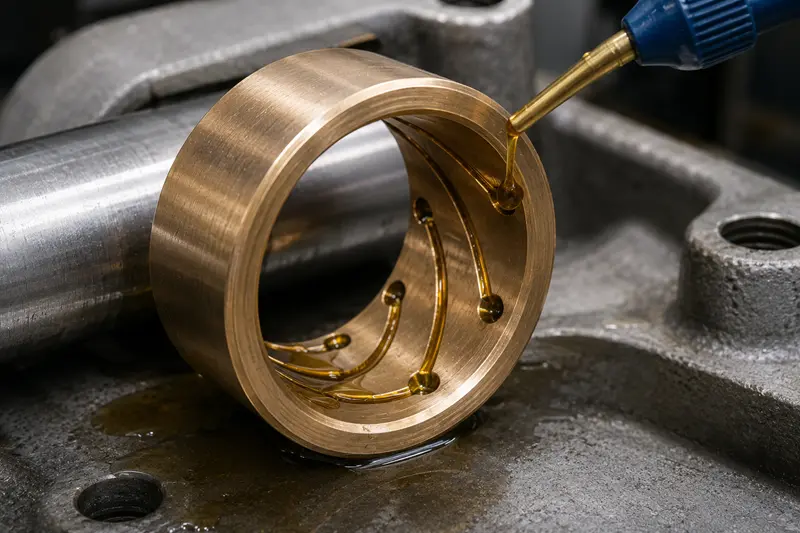
Your project demands reliability, but the bronze bushings keep failing. The specs were right, yet you face costly wear and downtime. The real issue isn't the material name.
Material testing for bronze bushings is crucial because it validates the chemical composition, hardness, mechanical properties, and internal structure. This verification ensures the bushing performs reliably under specific loads and conditions, preventing premature failure and protecting your equipment.
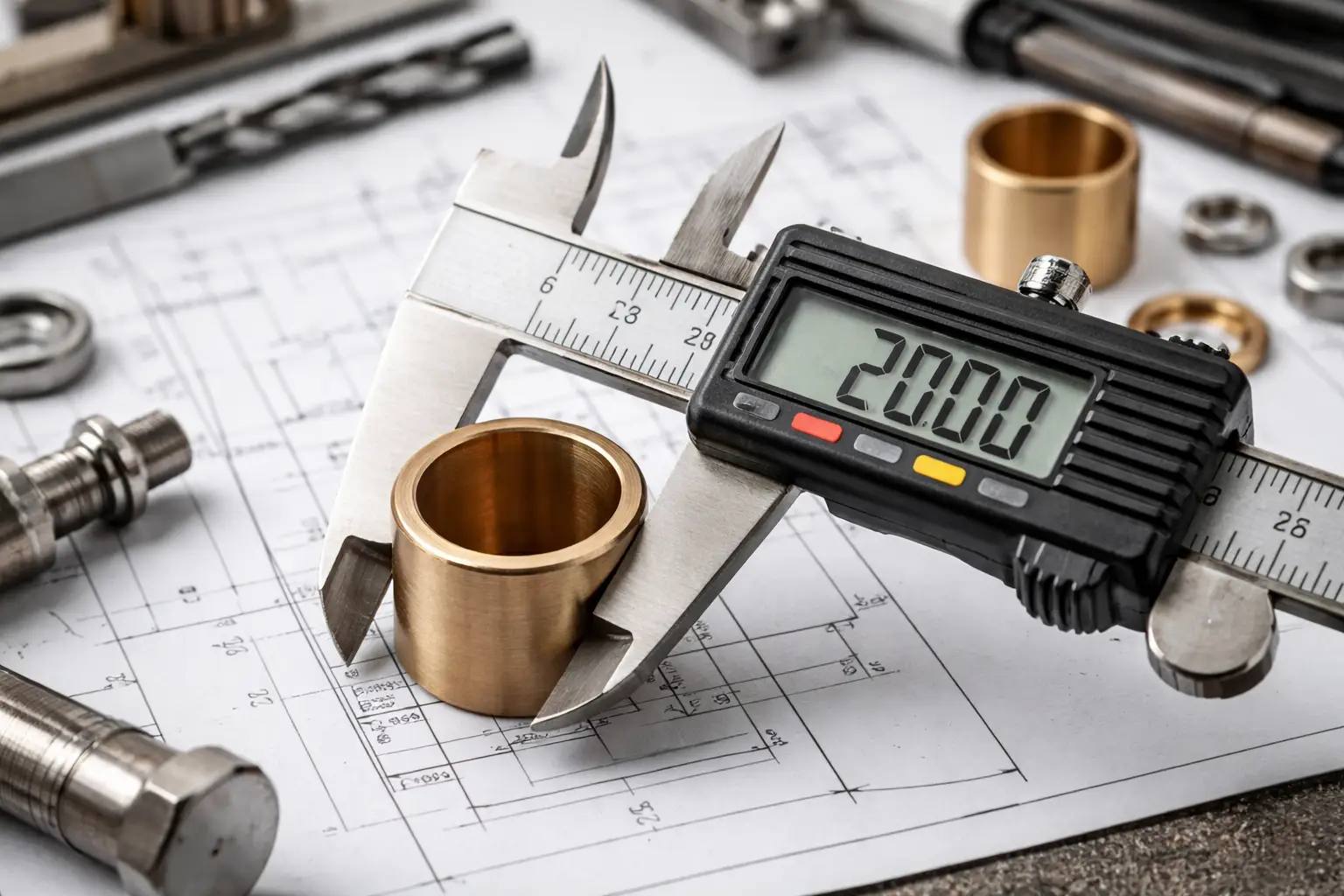
As a manufacturer, I've seen this story play out many times. A client specifies a bronze bushing by its grade, like CuSn8 or C93200, believing it's a guarantee of quality. They receive a part that matches the drawings perfectly. Yet, a few months into operation, the equipment starts showing signs of trouble. The problem isn't usually the design; it's the hidden properties of the material itself. It’s time to look past the material grade and understand what really ensures a bushing's performance.
Is Relying on Just the Material Grade Enough?
You trust the material grade on the spec sheet. But why do parts from different suppliers perform so differently? It's a frustrating and costly puzzle for any procurement manager.
Relying on the material grade alone is risky. Factors like raw material sourcing, casting processes, and quality control create significant performance differences between suppliers, even for the same designated material like CuSn8.[^1]
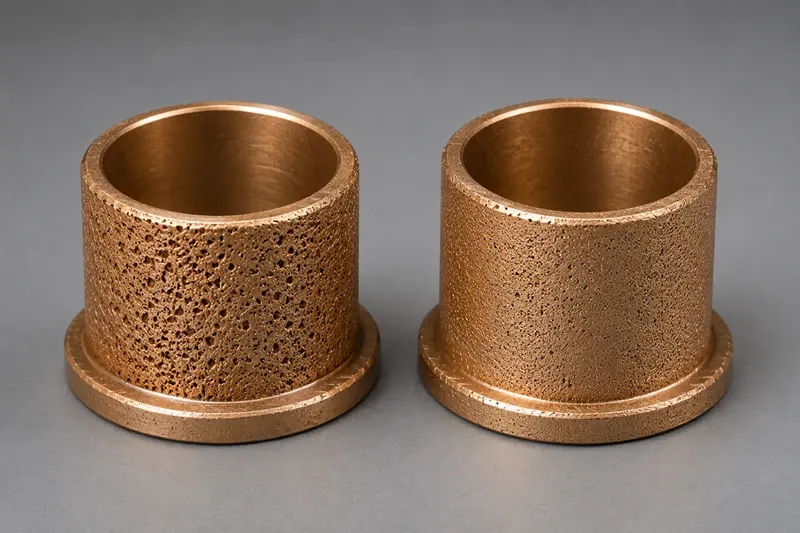
When you order a bushing based only on a grade, you're making a big assumption. You're assuming that every factory's "CuSn8" is the same. In our experience, that is rarely the case. The material grade is just a recipe; it doesn't describe the cooking process. A different raw material source can introduce trace elements that alter performance. A different casting or heat treatment process can create a completely different internal structure. These variations don't show up on a dimensional inspection report, but they will show up in your equipment's performance and maintenance logs.
The Name vs. The Reality
The material designation is only the starting point. It's the comprehensive testing that reveals the full story and ensures the bushing can do the job you need it to do.
| Factor | What the Grade Tells You | What Testing Reveals |
|---|---|---|
| Raw Material | e.g., CuSn8 | Variations in purity and trace elements from different suppliers.[^2] |
| Casting Process | Nothing | Presence of hidden porosity, shrinkage, or material segregation.[^3] |
| Heat Treatment | Nothing | Incorrect grain structure or internal stresses that lead to brittleness.[^4] |
| Final Performance | Theoretical properties | Actual strength, hardness, and true wear resistance. |
What Does Chemical Composition Analysis Really Tell You?
You see a list of chemical elements on a test report. It looks complex and technical. You might wonder if these small percentages really make a big difference in performance.
Chemical composition analysis confirms the exact percentages of elements like copper, tin, lead, and zinc.[^5] This is vital because these ratios directly determine the bushing's fundamental properties, including its strength, wear resistance, and suitability for your specific application.
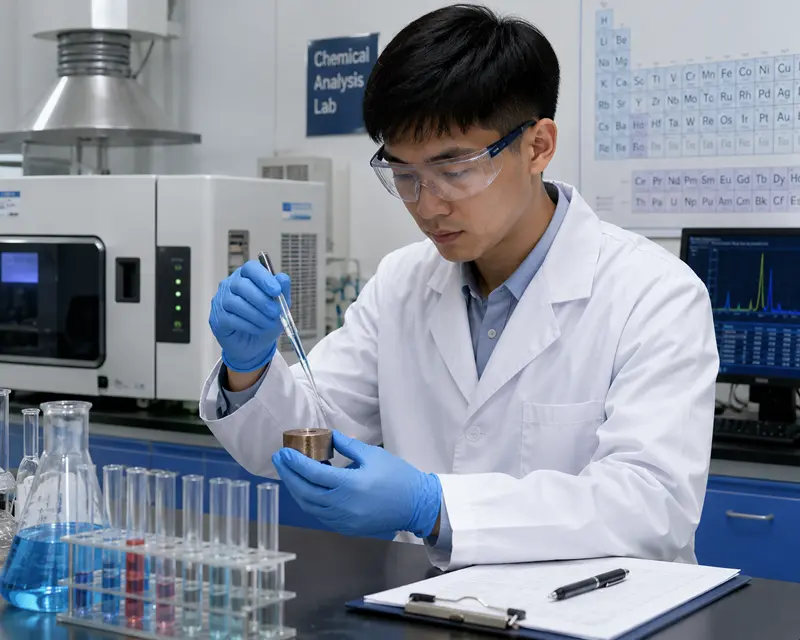
Think of a bronze alloy as a high-performance recipe. If you change the amount of any ingredient, the final dish will be different. It’s the same with bushings. The percentage of tin, for example, directly affects strength and wear resistance. A CuSn8 bronze (with about 8% tin) is generally stronger and more wear-resistant than a CuSn6 (with 6% tin).[^6] If a supplier provides a material that has a lower tin content than specified, the bushing will wear out faster, even if all dimensions are perfect. This is why we use a spectrometer to verify the chemical makeup of every batch of raw material. It’s a non-negotiable first step.
When the Recipe Goes Wrong
Even small deviations from the specified chemical composition can have a big impact on the final product's reliability.
| Element | Primary Function in Bronze | Impact of Incorrect Percentage |
|---|---|---|
| Tin (Sn) | Increases strength and wear resistance. | Too little: Softer, wears faster. Too much: Can become brittle. |
| Lead (Pb) | Improves machinability and anti-seizure properties. | Too much: Reduces strength. Not uniformly distributed: Poor performance. |
| Zinc (Zn) | Acts as a deoxidizer and improves castability. | Excess zinc can reduce corrosion resistance and ductility.[^7] |
Why Do Hardness and Mechanical Properties Matter So Much?
Your new bushing fits perfectly, but under load, it deforms or even cracks. You're left with a failed part and no clear explanation, even though the material grade was correct.
Hardness and mechanical properties, like tensile strength, are critical because they measure the bushing's ability to resist wear, deformation, and fracture under load. Without the right values, a bushing can fail, even if its dimensions and composition are correct.
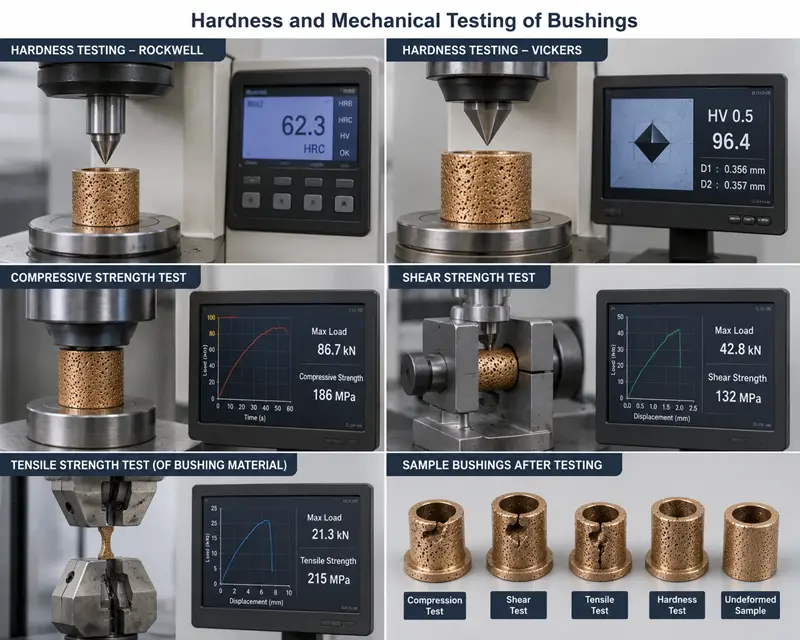
Hardness is a key indicator of wear resistance. If a bushing is too soft, it will deform under pressure, leading to a loss of clearance and eventual seizure. If it's too hard, it can become brittle. A brittle bushing might not wear down, but it could crack or shatter under a sudden impact load, causing catastrophic failure. It’s a delicate balance that must be right for the application. Similarly, mechanical properties like tensile strength and yield strength tell us how much force a material can withstand before it permanently deforms or breaks. For high-load applications, these numbers are not just data points; they are the difference between a reliable machine and an unexpected breakdown. We perform these tests to ensure the material has the muscle to handle the job.
Strength Under Pressure
- Hardness: This is the material's resistance to surface indentation and scratching. It's a primary indicator of how well the bushing will resist abrasive wear.
- Tensile Strength: This measures the maximum pulling force the material can take before breaking.
- Yield Strength: This measures the force at which the material begins to deform permanently. For a bushing, this is often more important than tensile strength.
What Hidden Dangers Does Metallographic Examination Uncover?
The bushing looks perfect on the outside. The dimensions are right, the finish is smooth. But deep inside, hidden flaws could be waiting to cause a catastrophic failure.
Metallographic examination looks at the bushing's internal microstructure.[^8] It can reveal hidden defects like porosity, shrinkage, and impurities that are invisible to the naked eye but can cause cracks and premature wear, severely compromising the part's lifespan.
This is one of the most critical tests we perform, especially for demanding OEM projects. We cut a sample from the bushing, polish it to a mirror finish, and examine it under a high-powered microscope. What we're looking for are the things you can't see. Tiny gas bubbles (porosity) trapped during casting can act as weak spots.[^9] Microscopic voids (shrinkage) can form as the metal cools. Inconsistent distribution of alloying elements (segregation) can create hard and soft spots within the same part. These internal flaws are the starting points for fatigue cracks. A bushing might look fine and pass all other tests, but if its internal structure is compromised, it is a failure waiting to happen.
Defects That Kill Performance
These internal flaws, invisible from the outside, are often the root cause of unexpected field failures.
| Internal Defect | Description | Consequence for the Bushing |
|---|---|---|
| Porosity | Tiny gas bubbles or voids trapped in the metal. | Reduces load-bearing capacity and can act as a stress riser. |
| Shrinkage | Voids formed during metal solidification. | Creates weak spots that can lead to cracking under load. |
| Segregation | Uneven distribution of alloying elements. | Causes inconsistent hardness and strength across the part. |
| Inclusions | Trapped non-metallic particles (e.g., oxides). | Acts as an internal stress point, initiating fatigue cracks. |
Conclusion
Material grade is just the start. True bushing reliability comes from rigorous material testing that validates performance for your specific application, reducing long-term risk and ensuring consistent quality.
[^1]: "Durable Casting Bronze Bushing - Cast Bearing Manufacturer", https://bronzeoilless.com/services/casting-bronze-bushing/. Variations in raw material sourcing, casting processes, and quality control can lead to performance differences in bronze bushings, even for identical material grades. Evidence role: mechanism; source type: research. Supports: Performance differences between suppliers arise from variations in raw material sourcing, casting processes, and quality control.. Scope note: The source may not address CuSn8 specifically but should discuss general material variability. [^2]: "Bronze - Wikipedia", https://en.wikipedia.org/wiki/Bronze. Differences in purity and trace elements among suppliers can alter the mechanical and chemical properties of bronze bushings. Evidence role: mechanism; source type: research. Supports: Variations in purity and trace elements from different suppliers can affect bronze bushing performance.. Scope note: The source may discuss purity and trace elements broadly, not specific to bronze bushings. [^3]: "Blend Segregation in Tablets Manufacturing and Its Effect on Drug ...", https://pmc.ncbi.nlm.nih.gov/articles/PMC8620778/. Hidden defects such as porosity, shrinkage, and material segregation can significantly impact the performance and lifespan of bronze bushings. Evidence role: mechanism; source type: research. Supports: Hidden porosity, shrinkage, or material segregation can affect bronze bushing performance.. Scope note: The source may discuss these defects in metals generally, not exclusively in bronze bushings. [^4]: "Effects of B on the Structure and Properties of Lead-Tin Bronze Alloy ...", https://pmc.ncbi.nlm.nih.gov/articles/PMC8708727/. Improper grain structure and internal stresses can result in brittleness, compromising the reliability of bronze bushings under load. Evidence role: mechanism; source type: research. Supports: Incorrect grain structure or internal stresses can lead to brittleness in bronze bushings.. Scope note: The source may discuss grain structure and stresses in metals broadly, not specifically bronze. [^5]: "Investigating Ancient “Bronzes”: Non-Destructive Analysis of Copper ...", https://www.getty.edu/publications/artistryinbronze/conservation-and-analysis/36-tykot/. Chemical composition analysis determines the precise ratios of elements such as copper, tin, lead, and zinc, which directly affect the properties of bronze alloys. Evidence role: definition; source type: encyclopedia. Supports: Chemical composition analysis confirms the exact percentages of elements like copper, tin, lead, and zinc.. [^6]: "CuSn6 and CuSn8: A Comprehensive Comparison - Lion Metal", https://www.shlionmetal.com/bronze/cusn6-and-cusn8-a-comprehensive-comparison/. The tin content in bronze alloys, such as CuSn8 and CuSn6, directly influences their strength and wear resistance. Evidence role: statistic; source type: research. Supports: CuSn8 bronze is generally stronger and more wear-resistant than CuSn6 due to its higher tin content.. Scope note: The source may provide general data on tin content effects, not specific to CuSn8 and CuSn6. [^7]: "[PDF] Bearing bronzes with and without zinc", https://nvlpubs.nist.gov/nistpubs/jres/2/jresv2n6p1017_A2b.pdf. Excess zinc in bronze alloys can negatively impact corrosion resistance and ductility, altering their suitability for certain applications. Evidence role: mechanism; source type: research. Supports: Excess zinc can reduce corrosion resistance and ductility in bronze alloys.. Scope note: The source may discuss zinc's effects in metals broadly, not specifically bronze. [^8]: "[PDF] metallographic testing - GovInfo", https://www.govinfo.gov/content/pkg/GOVPUB-C13-503d10b0d12a2dcbc0571e0f04eea501/pdf/GOVPUB-C13-503d10b0d12a2dcbc0571e0f04eea501.pdf. Metallographic examination provides insights into the internal microstructure of bronze bushings, revealing defects like porosity and shrinkage that affect performance. Evidence role: mechanism; source type: research. Supports: Metallographic examination looks at the bushing's internal microstructure to uncover hidden defects.. Scope note: The source may discuss metallographic examination broadly, not specific to bronze bushings. [^9]: "[PDF] Some causes for porosity and leakage in non-ferrous castings", https://scholarsmine.mst.edu/cgi/viewcontent.cgi?article=1306&context=professional_theses. Porosity, caused by trapped gas bubbles during casting, creates weak spots in bronze bushings that can lead to stress concentration and failure. Evidence role: mechanism; source type: research. Supports: Porosity trapped during casting can act as weak spots in bronze bushings.. Scope note: The source may discuss porosity in metals generally, not exclusively in bronze bushings.