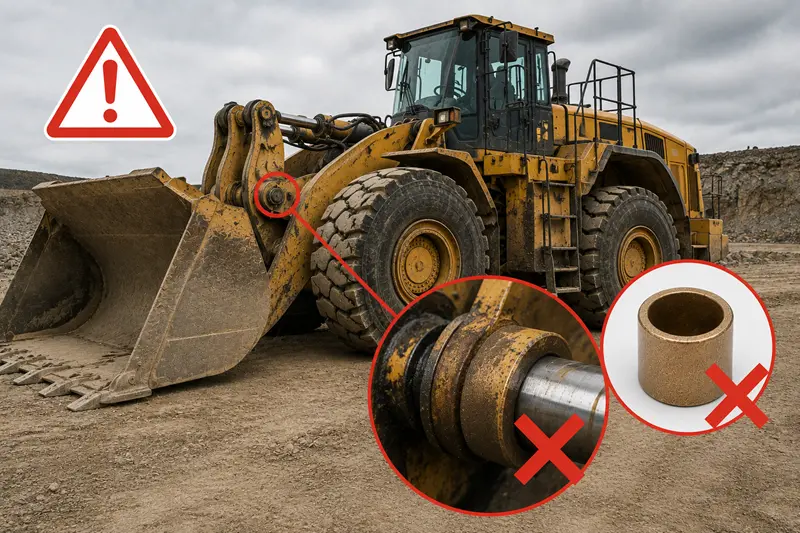
Frustrated by frequent bushing failures in your heavy equipment? These breakdowns cause costly downtime. The problem often isn't the bushing's quality, but a mismatch with its real-world job.
To prevent bushing failure, don't just upgrade the material. Instead, focus on the entire friction system. This means matching the bushing to the true working conditions, ensuring proper shaft properties, designing effective lubrication, and sealing against contamination. This system approach is key.
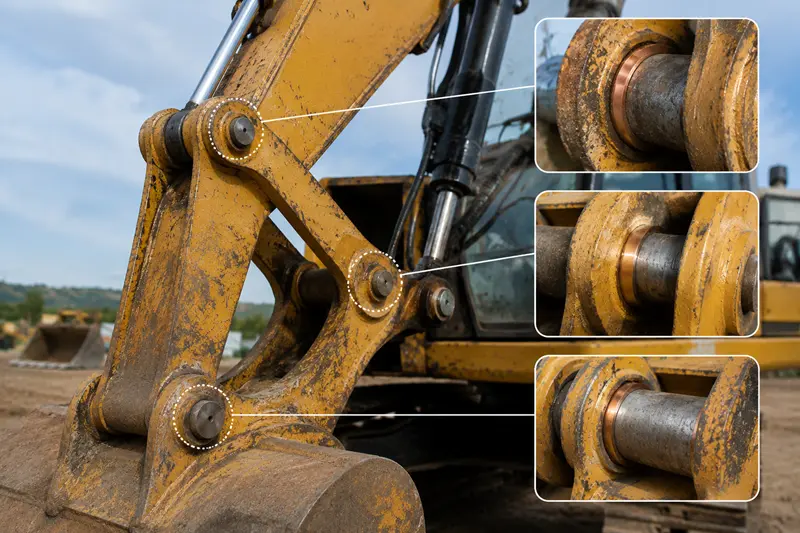
I've seen it countless times in my factory. A customer comes to us, frustrated with a recurring bushing failure. They ask for a stronger material or a thicker wall. But after we talk, they realize the problem lies deeper. The story of one client, a manufacturer of excavators, perfectly illustrates this. They were stuck in a cycle of costly repairs. Understanding why their expensive bushings were failing was the first step to a permanent solution. Let's break down the common mistakes I see.
Are You Choosing Bushings Based on Load Rating Alone?
You check the specs and pick a bushing that handles the load. Yet, it fails early in the field. This happens when catalog data doesn't match real-world operational stress.
Choosing bushings based only on load rating is a common mistake.[^1] Heavy equipment faces shock loads, vibrations, and misalignments not listed in specs. A holistic view of the operational environment—including contamination and temperature—is crucial for selecting a durable bushing that will actually last.
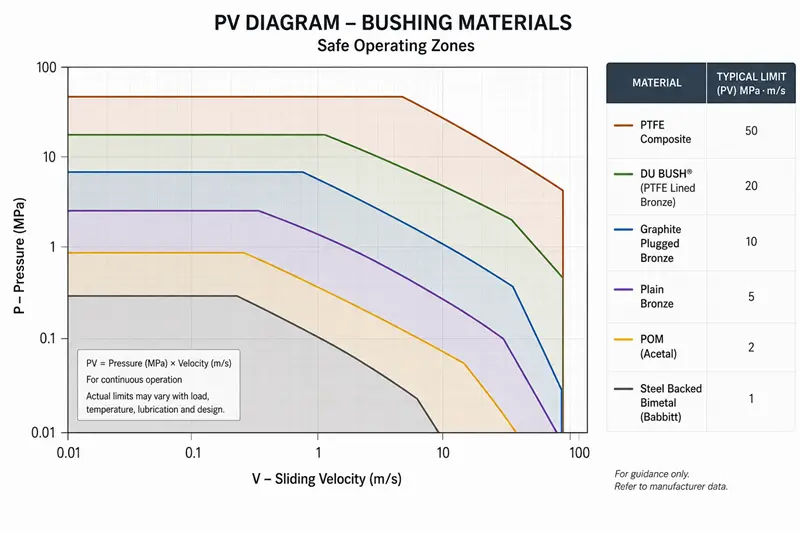
A catalog's load rating is determined under perfect laboratory conditions. Your heavy equipment, however, does not work in a lab. It works in mud, dust, and under unpredictable stress. As a factory, we always ask about the application, not just the pressure value (MPa).
Beyond Static Load
The rated load capacity often refers to a static or slow-moving, evenly applied force. But an excavator arm doesn't move slowly and evenly. It hits rock, creating a massive shock load that can be many times the rated static load. This instantaneous pressure spike can deform or destroy a bushing that looked perfect on paper.
The Impact of Contamination and Alignment
Dust, dirt, and moisture are enemies of any moving joint.[^2] Without proper sealing, abrasive particles get inside and act like sandpaper, grinding away the bushing and the shaft. Furthermore, heavy equipment frames flex under load. This can cause the shaft to misalign, concentrating the entire load onto a small edge of the bushing. This "edge loading" drastically increases pressure and leads to rapid, premature failure.
| Material Consideration | High Static Load | Shock Load Resistance | Contamination Tolerance | Misalignment Forgiveness |
|---|---|---|---|---|
| Metal-Polymer (e.g., DU/DX) | Excellent | Fair | Poor (requires good seals) | Poor |
| Wrapped Bronze (e.g., FB090) | Good | Very Good | Good (grooves hold grease) | Fair |
| Machined Bronze | Very Good | Excellent | Fair (can have graphite plugs) | Fair |
| Fiber-Reinforced Composite | Good | Excellent (dampens vibration) | Very Good (can embed particles) | Good |
Is Your Shaft and Lubrication System Undermining Your Bushings?
You installed a top-grade bushing, but it failed quickly. It's easy to blame the part. But often, the true culprits are the shaft it runs on and poor lubrication.
Yes, a poor-quality shaft or inadequate lubrication can destroy the best bushings. A soft shaft will wear down, releasing abrasive particles. Lack of grease or the wrong type leads to metal-on-metal contact, heat, and seizure. The shaft and lubrication are half of the bearing system.
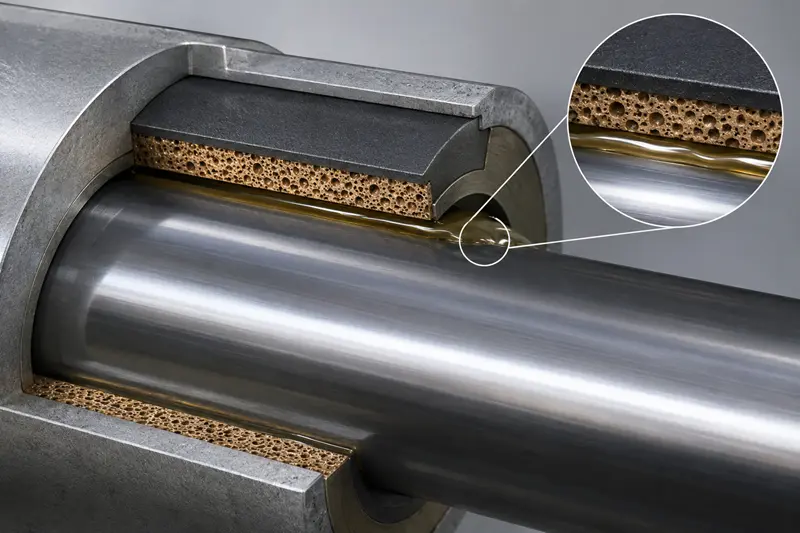
I always tell our OEM partners: a bushing does not work alone. It is part of a system. You can have the most advanced bushing in the world, but if you pair it with a soft, rough shaft and forget to add grease, it will fail. The bushing is often just the first part of the system to show symptoms of a larger problem. Investing in the mating components and maintenance is just as important as selecting the right bushing.[^3]
The Shaft: The Bushing's Partner
The shaft and bushing must be compatible. Think of them as a team.
- Hardness: The shaft should ideally be harder than the bushing material.[^4] If the shaft is too soft, it will wear down first, releasing tiny metal particles that become trapped in the joint and act as an abrasive, destroying the new bushing.
- Surface Finish: A rough shaft surface is like a file.[^5] It will grind away the soft lining of a bushing in no time. A very smooth, polished surface is also bad, as it doesn't hold lubricant well.[^6] There is a "sweet spot" for surface finish (typically Ra 0.4 - 0.8 μm) that maximizes life.
Lubrication and Sealing: The Lifeblood
In heavy equipment, lubrication does more than just reduce friction. It creates a protective film, helps to cool the joint, and can flush out contaminants. A lack of lubrication leads to direct metal-to-metal contact, which generates immense heat, causes material transfer, and ultimately leads to seizure.[^7] Just as important is sealing. A good seal keeps grease in and, more importantly, keeps dirt, water, and grit out.[^8] A failed seal means the bushing's environment has become hostile, and its lifespan will be short.
| System Component | Good Practice | Bad Practice (Causes Failure) |
|---|---|---|
| Shaft Hardness | Match to bushing type (e.g., >45 HRC) | Too soft; wears and creates debris |
| Shaft Finish | Ra 0.4 - 0.8 μm | Too rough (> Ra 1.6 μm) or too smooth (< Ra 0.2 μm) |
| Lubrication | Correct type, correct interval | "Fit and forget," wrong grease, inconsistent schedule |
| Sealing | Effective seals for the environment | Damaged seals, no seals in dirty conditions |
Is Switching to a More Expensive Bushing Always the Right Answer?
When a bushing fails, the easiest fix seems to be a more expensive one. But this raises costs without guaranteeing a longer life, leading to more frustration and expense.
No, a more expensive bushing is not always the solution. Often, a less expensive bushing, correctly matched to the system (shaft, lubrication, seals), will outperform a premium one in the wrong application. The goal is system optimization for the lowest total cost, not just component upgrading.
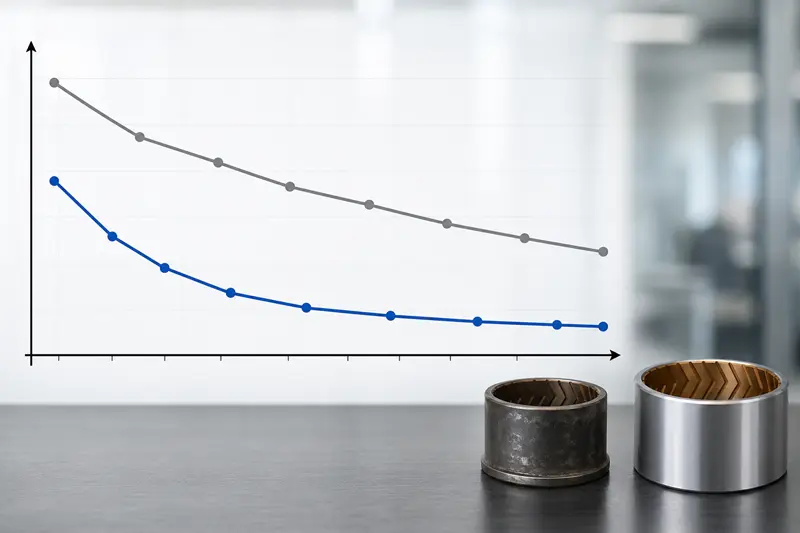
From our factory's perspective, the goal is to solve the customer's problem reliably and cost-effectively. Simply selling the most expensive part is a short-term game. A true manufacturing partner helps you lower your Total Cost of Ownership (TCO). The price of the bushing is a tiny fraction of the cost of machine downtime, labor for replacement, and potential damage to a multi-thousand dollar shaft or housing.[^9] A $5 bushing failure can easily cause $5,000 in losses.[^10]
Thinking in Systems, Not Parts
The core issue in most failures is a "system" failure, not a "part" failure.[^11] The bushing, shaft, lubricant, seals, and operating conditions all form one friction system. Changing only one component—the bushing—without addressing the root cause in the system is like putting a new tire on a car with a bad alignment. The new tire will wear out just as fast. For example, a simple, inexpensive wrapped bronze bushing with good seals and a consistent greasing schedule will often outlast a sophisticated, expensive self-lubricating bushing if that bushing is not sealed and is exposed to abrasive dust.
A Factory's Goal: Your Lowest TCO
Our most successful OEM clients are the ones who work with us to optimize the entire joint. We analyze the loads, speeds, environment, and maintenance practices. Sometimes, the solution is a different material. Other times, it's recommending a change to the shaft's hardness or a better sealing arrangement. By focusing on the whole system, we can often specify a more cost-effective bushing that delivers a longer life. This lowers your TCO by reducing part costs, maintenance labor, and, most importantly, unplanned downtime.
| Solution Approach | Upfront Cost | Long-Term TCO | Best For... |
|---|---|---|---|
| Upgrade Bushing Only | High | Often Still High (due to recurring failures) | When the original bushing was truly under-specced for ideal conditions. |
| System Optimization | Medium | Low (longer life, less downtime) | Almost all heavy equipment applications. |
| Ignore and Replace | Low | Very High (frequent downtime & labor) | No one. This is the most expensive strategy. |
Conclusion
To stop bushing failures, think beyond the part. Optimize the entire system—material, shaft, lubrication, and seals. This system approach reduces downtime and lowers your total cost of ownership.
[^1]: "Basic Dynamic Load Rating Bearing Life vs Stress Based Bearing Life", https://www.regalrexnord.com/regal-rexnord-insights/basic-dynamic-load-rating-bearing-life-vs-stress-based-bearing-life?srsltid=AfmBOoqTlG41_TJOStMVB1uWsbAXfymp74agTOHax5P2BKQA6ueQ_8_t. This source explains how catalog load ratings often fail to account for real-world operational stresses like shock loads and contamination. Evidence role: mechanism; source type: education. Supports: Catalog load ratings do not account for real-world operational stresses like shock loads and contamination.. Scope note: The source may focus on specific industries or equipment types, limiting generalizability. [^2]: "Road dust and its effect on human health: a literature review - PMC", https://pmc.ncbi.nlm.nih.gov/articles/PMC5968206/. This source discusses how environmental contaminants like dust and moisture can degrade moving joints in heavy equipment. Evidence role: mechanism; source type: research. Supports: Environmental contaminants like dust, dirt, and moisture degrade moving joints in heavy equipment.. Scope note: The source may focus on specific contaminants, not all possible environmental factors. [^3]: "Optimization on construction machinery considering sequence ...", https://pmc.ncbi.nlm.nih.gov/articles/PMC12094793/. This source emphasizes the role of mating components and maintenance in extending the lifespan of mechanical systems. Evidence role: expert_consensus; source type: education. Supports: Mating components and maintenance are crucial for extending the lifespan of mechanical systems.. Scope note: The source may focus on specific types of mechanical systems, not universally applicable. [^4]: "What material for bushing on 30hrc shaft? - Facebook", https://www.facebook.com/groups/769782850345135/posts/1914485929208149/. This source explains the importance of matching shaft hardness to bushing material for optimal performance. Evidence role: mechanism; source type: education. Supports: Matching shaft hardness to bushing material is important for optimal performance.. Scope note: The source may focus on specific hardness ranges, limiting general applicability. [^5]: "[PDF] Waviness affects friction and abrasive wear - arXiv", https://arxiv.org/pdf/2211.13060. This source describes how rough shaft surfaces can accelerate wear in bushings by acting abrasively. Evidence role: mechanism; source type: research. Supports: Rough shaft surfaces accelerate wear in bushings by acting abrasively.. Scope note: The source may focus on specific surface roughness ranges, limiting general applicability. [^6]: "Hydrodynamic lubrication effects in textured PEEK surfaces ... - PMC", https://pmc.ncbi.nlm.nih.gov/articles/PMC12479708/. This source explains why overly smooth surfaces can impair lubrication retention in mechanical systems. Evidence role: mechanism; source type: research. Supports: Overly smooth surfaces impair lubrication retention in mechanical systems.. Scope note: The source may focus on specific lubrication types, not universally applicable. [^7]: "Risks related to the lack of lubrication on surface integrity in drilling", https://pmc.ncbi.nlm.nih.gov/articles/PMC6348237/. This source explains the consequences of inadequate lubrication, including heat generation and material transfer in mechanical systems. Evidence role: mechanism; source type: research. Supports: Inadequate lubrication causes heat generation, material transfer, and seizure in mechanical systems.. Scope note: The source may focus on specific types of mechanical systems, not universally applicable. [^8]: "Harbor Seal: Conservation & Management - NOAA Fisheries", https://www.fisheries.noaa.gov/species/harbor-seal/conservation-management. This source explains how effective seals protect mechanical systems by retaining lubrication and excluding contaminants. Evidence role: mechanism; source type: research. Supports: Effective seals protect mechanical systems by retaining lubrication and excluding contaminants.. Scope note: The source may focus on specific sealing technologies, limiting general applicability. [^9]: "Line 25 - Repairs - Center for Agricultural Law and Taxation", https://www.calt.iastate.edu/line-25-repairs. This source discusses the economic impact of component failures, emphasizing the disproportionate costs of downtime and repairs. Evidence role: statistic; source type: institution. Supports: Component failures lead to disproportionate costs in downtime and repairs compared to the part's price.. Scope note: The source may focus on specific industries or equipment types, limiting generalizability. [^10]: "[PDF] Mechanical failure : definition of the problem - GovInfo", https://www.govinfo.gov/content/pkg/GOVPUB-C13-ee03eb1b964a48f5fe41e6ae646cf2e9/pdf/GOVPUB-C13-ee03eb1b964a48f5fe41e6ae646cf2e9.pdf. This source provides examples of how minor component failures can lead to significant financial losses in heavy equipment operations. Evidence role: case_reference; source type: institution. Supports: Minor component failures can lead to significant financial losses in heavy equipment operations.. Scope note: The source may focus on specific industries or scenarios, limiting generalizability. [^11]: "[PDF] Mechanical failure : definition of the problem - GovInfo", https://www.govinfo.gov/content/pkg/GOVPUB-C13-ee03eb1b964a48f5fe41e6ae646cf2e9/pdf/GOVPUB-C13-ee03eb1b964a48f5fe41e6ae646cf2e9.pdf. This source discusses how system-level issues often underlie component failures in mechanical systems. Evidence role: expert_consensus; source type: education. Supports: System-level issues often underlie component failures in mechanical systems.. Scope note: The source may focus on specific types of systems, not universally applicable.