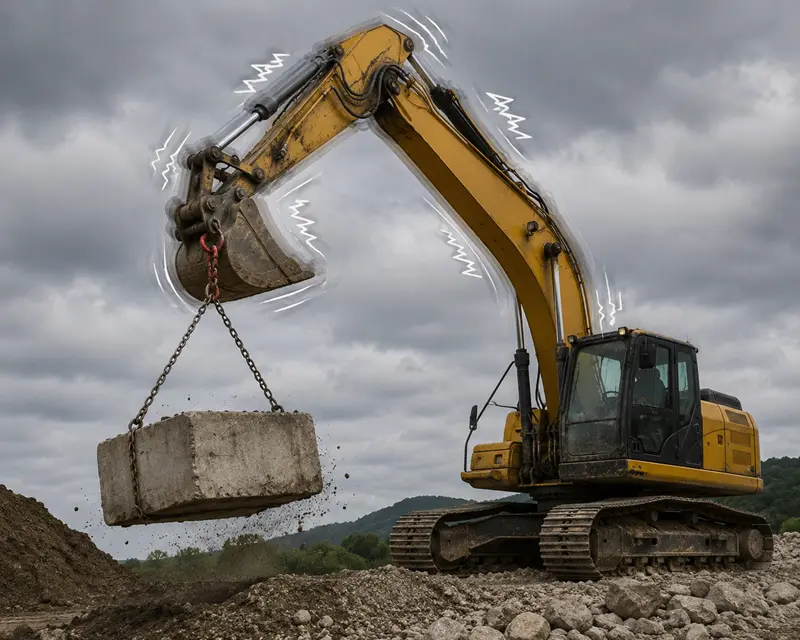
Your heavy-duty equipment stops working, and you find a worn-out bushing. You blame the quality, but the real reason is often hidden in the operating conditions, not the part itself.
High load bushings often fail prematurely not because of poor material quality, but because the actual working environment is much harsher than the design specifications.[^1] The most common culprits are underestimated impact loads, insufficient lubrication under pressure, shaft misalignment, and contamination from dirt or debris.
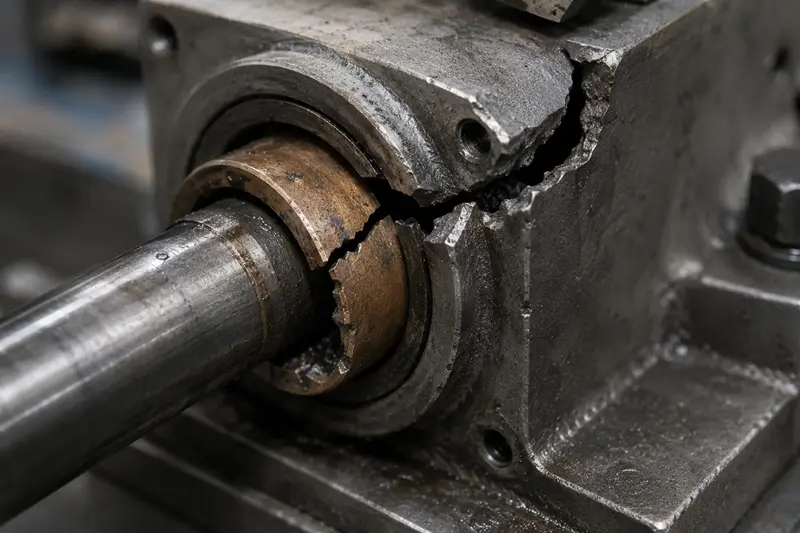
When a bushing fails early, the first instinct for many buyers is to point a finger at the supplier's quality or the material's strength. I've seen it happen many times. As a manufacturer, however, we see a different story. The failure is rarely about the bushing being "too weak." It's almost always a sign that the entire system—the load, the lubrication, the shaft, and the seals—is not working together correctly. To find a real solution, we need to look beyond the failed part and understand what's truly happening inside your machine. Let's break down the real reasons I see every day.
Are You Underestimating the Impact Loads on Your Bushings?
Your spec sheet says the load is within limits, but the bushing is cracking and deforming anyway. This is frustrating and makes you question the parts you bought. The problem is often invisible shocks.
Impact loads from machine starts, sudden stops, or oscillating movements can create pressure spikes far greater than the calculated static load.[^2] These shocks hammer the bushing, leading to fatigue cracks and rapid deformation, causing it to fail long before you'd expect. It’s like a hidden force attacking your equipment.
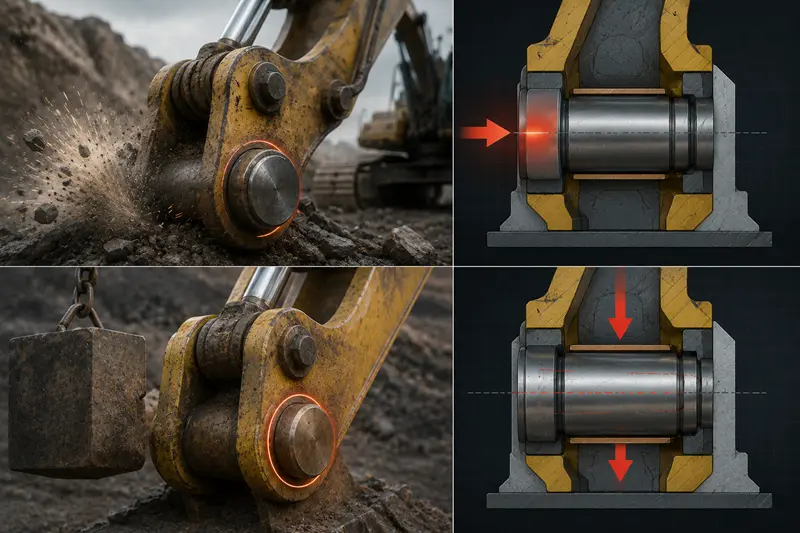
Think about the difference between holding a 50kg weight and having someone drop it into your arms from a short height. The weight is the same, but the force you feel from the dropped weight is much, much higher. This is the difference between a static load and a dynamic, or impact, load. In machinery, these impacts are everywhere. An excavator arm suddenly stopping, a hydraulic press stamping down, or even the vibration from an engine starting up all create these force spikes. Your bushing has to absorb them all.
When you only tell your supplier the static load, you're only giving them part of the story. A material that is perfectly fine for a smooth, consistent load might quickly fail under repeated shocks.
How Different Loads Affect Bushings
| Load Type | Description | Common Effect on Bushing |
|---|---|---|
| Static Load | A constant, unchanging force. | Slow, predictable wear. |
| Oscillating Load | A load that smoothly swings back and forth. | Can cause fretting wear if lubrication is poor. |
| Impact Load | A sudden, high-energy force. | Fatigue cracks, deformation, and rapid failure. |
From our factory floor, the solution is clear communication. Don't just give us a number for the maximum load. Tell us how the machine operates. Does it start and stop aggressively? Does it handle sudden impacts? Knowing this helps us recommend a bushing designed for high-impact environments, perhaps a robust bimetal bearing or a solid bronze bushing, instead of a standard one that can't handle the punches.
Is Poor Lubrication Secretly Destroying Your Heavy-Duty Bushings?
You keep adding grease, but the joint still gets hot, noisy, and eventually seizes. You are wasting time and lubricant on a problem that just gets worse. The root cause is that under heavy loads, the grease is being squeezed out.
In high-load, low-speed applications, it’s extremely difficult to maintain a protective oil film between the shaft and the bushing.[^3] The immense pressure pushes the lubricant out, leading to direct metal-to-metal contact. This causes friction, heat, and galling, which quickly grinds away the bushing's surface.
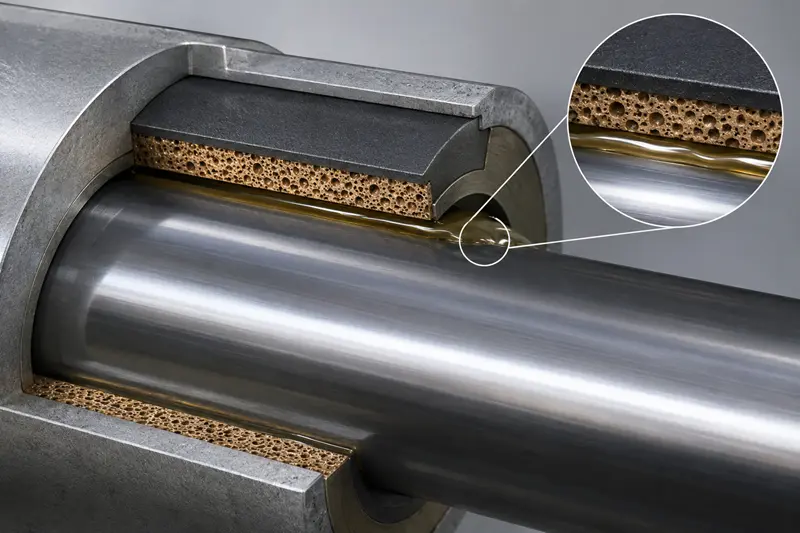
Engineers call this "boundary lubrication." It's a state where there isn't a full, stable film of oil separating the moving parts. Instead, only a microscopic layer of lubricant clings to the surfaces, providing minimal protection. For equipment like cranes, agricultural machinery pivots, and heavy-duty hinges, this is a very common operating condition. The movement is too slow and the pressure is too high to create the "hydrodynamic wedge" of oil that protects parts in a high-speed engine. The result is predictable: heat builds up, surfaces get scored, and the bushing fails.
I once worked with a client building heavy-duty hydraulic cylinders. They kept experiencing bushing seizure despite using a high-quality grease. The problem was the slow, powerful stroke of the cylinder. It was a classic boundary lubrication scenario. The solution wasn't more grease; it was a different kind of bushing. We switched them to a composite bushing with a self-lubricating PTFE layer. This material is designed to work in dry or boundary lubrication conditions. It transfers a thin layer of itself onto the shaft, creating a solid, low-friction surface that doesn't rely on a liquid film. Another option for these cases is using bronze bushings with carefully designed grooves and pockets to hold and distribute grease right where it's needed most.
Could Misalignment and a Bad Shaft Be the Real Villains?
You've picked the right bushing and the lubrication is perfect, but you're still seeing strange, uneven wear. It's confusing and forces you to replace parts that should last for years. The problem may not be the bushing, but what it's touching.
Misalignment forces the entire load onto a tiny edge of the bushing, creating intense pressure that causes rapid, localized wear.[^4] At the same time, a shaft that is too soft, too rough, or has sharp edges will act like a file, grinding away the bushing surface with every movement.
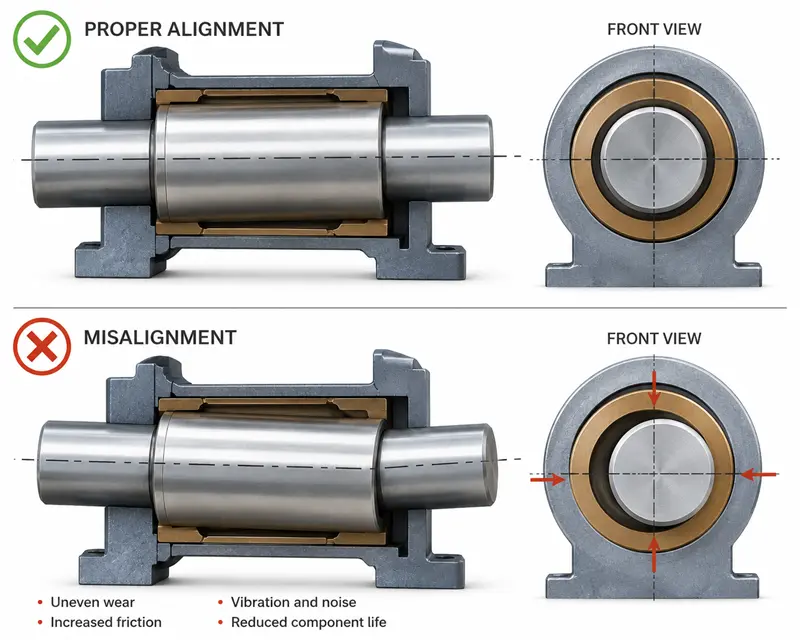
These two issues, misalignment and poor shaft quality, are silent killers of bushings. They often go unnoticed until the damage is done.
The Double Threat to Bushing Life
-
Misalignment and Edge Loading When a shaft is not perfectly parallel to the bushing's center, it doesn't sit flat. Instead, it tilts, and all the machine's force gets concentrated on the very edge of the bushing. No bushing is designed to handle this. The pressure on that small area becomes astronomical, leading to a "bell-mouth" wear pattern where the edges are worn away while the center is untouched. This can be caused by manufacturing tolerances in the housing, or the shaft itself bending under heavy load.
-
The Shaft as a Weapon The shaft is just as important as the bushing. It's the other half of the bearing system. If the shaft's surface isn't right, it will destroy any bushing you install.
Shaft Parameter Why It Matters FESODA's Recommendation Hardness A soft shaft can be scored by debris, which then acts like a tool to cut the bushing.[^5] For metal bushings, the shaft should be significantly harder. A hardened steel shaft is ideal.[^6] Surface Finish (Ra) A rough surface (high Ra) will wear the bushing down quickly. A surface that's too smooth (low Ra) may not hold lubricant well. We typically recommend a ground finish with a Ra of 0.4-0.8 μm for most applications.[^7]
I remember a customer in the agricultural machinery sector who couldn't figure out why their pivot bushings were failing. After a quick call, we asked them to check the shaft. It turned out the shafts were not hardened and had a rough, turned finish. They were essentially using a soft, abrasive file as their pivot pin. Once they switched to a hardened and ground shaft, the bushing life increased tenfold.
Is Dirt and Debris Grinding Your Bushings to Dust?
Your equipment works in a dusty or dirty environment, and the bushings are wearing out incredibly fast. You are constantly replacing parts and dealing with seized joints. The cause is abrasive particles getting inside.
Contaminants like sand, dust, or metal shavings can work their way between the shaft and the bushing.[^8] Once trapped inside, these hard particles act like sandpaper, grinding away at both surfaces with every movement. This process, called three-body abrasion, dramatically accelerates wear and leads to premature failure.
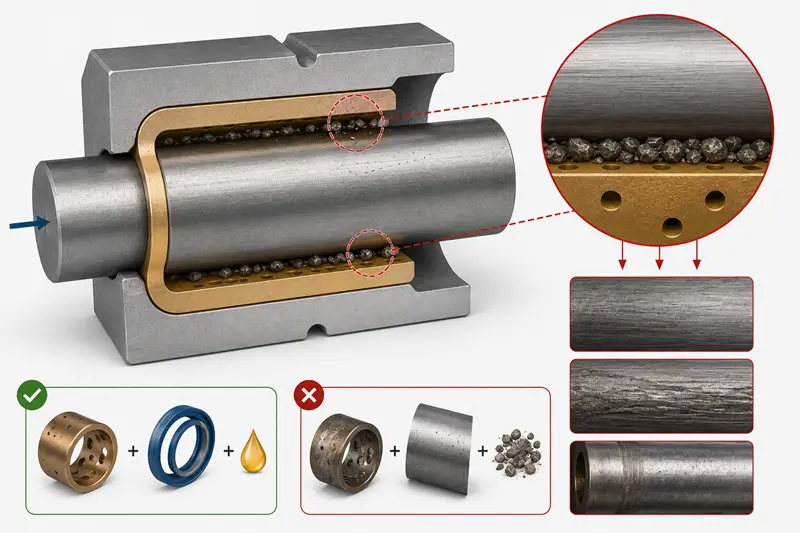
This is one of the biggest challenges for equipment used in construction, mining, and agriculture. The air is full of abrasive dust. Every time a joint moves, it can suck in these tiny, destructive particles. The grease inside can become a grinding paste, a mix of lubricant and abrasive grit that is actively destroying the components it's supposed to protect.[^9] The result is a rapid increase in clearance, which makes the joint feel loose and sloppy. Eventually, the wear is so severe that the bushing fails completely.
The solution here has less to do with the bushing material and more to do with protection. Sealing is critical. A good sealing system is the bushing's best friend. It acts as a barrier, keeping dirt out and clean grease in. When we work with OEM clients for these tough environments, the conversation is always about the entire assembly. We might recommend a flange bushing to provide an extra shield, or a bushing with specific groove patterns designed to help push contaminants out. But the real fix is external. Using high-quality rod wipers, V-rings, or cassette seals is not an optional extra; it is an essential part of the design for long life in dirty conditions.[^10] A few dollars spent on a better seal can save hundreds of dollars in future repairs and downtime.[^11]
Conclusion
High-load bushing failure is rarely a simple material problem. It’s a system problem. Before you order a more expensive bushing, first check the real-world impact loads, lubrication, alignment, and sealing.[^12]
[^1]: "Aging Failure Mechanism of Transformer Bushing Sealing Rings ...", https://pmc.ncbi.nlm.nih.gov/articles/PMC12897839/. This source explains how operating conditions such as impact loads, lubrication issues, and contamination contribute to premature bushing failure, rather than material defects. Evidence role: mechanism; source type: research. Supports: High load bushings fail due to operating conditions rather than material quality.. Scope note: The source may focus on specific industries or types of bushings, limiting generalizability. [^2]: "Loads and Dynamics | NESC Academy Online", https://nescacademy.nasa.gov/catalogs/lnd. This source provides data on how dynamic impact loads exceed static load calculations, leading to mechanical stress and failure. Evidence role: mechanism; source type: education. Supports: Impact loads cause pressure spikes that exceed static load calculations.. Scope note: The evidence may focus on specific types of machinery, limiting its applicability to all cases. [^3]: "[PDF] Boundary Lubrication Mechanisms - A Systems Approach", https://www.eere.energy.gov/vehiclesandfuels/pdfs/hvso_2006/08_ajayi.pdf. This source explains the challenges of maintaining lubrication in high-load, low-speed applications, including boundary lubrication scenarios. Evidence role: mechanism; source type: research. Supports: High-load, low-speed applications struggle to maintain a protective oil film.. Scope note: The source may focus on specific lubrication types, limiting its scope. [^4]: "Edge loading in metal-on-metal hips: low clearance is a new risk factor", https://pmc.ncbi.nlm.nih.gov/articles/PMC4107799/. This source discusses how misalignment leads to edge loading and localized wear in bushings. Evidence role: mechanism; source type: education. Supports: Misalignment causes edge loading and localized wear in bushings.. Scope note: The evidence may focus on specific types of misalignment, limiting its general applicability. [^5]: "Analysis of the Causes of Damage to the Steel Drive Shaft Used in a ...", https://pmc.ncbi.nlm.nih.gov/articles/PMC12566000/. This source explains how debris scoring on soft shafts accelerates bushing wear. Evidence role: mechanism; source type: research. Supports: Soft shafts scored by debris accelerate bushing wear.. Scope note: The evidence may focus on specific shaft materials, limiting its general applicability. [^6]: "The Benefits of Forged Steel Shafts for Global Industries - Rundist", http://rundist.com/blog/forged-steel-shafts-global-advantages/. This source explains why hardened steel shafts are recommended for reducing wear in bushing systems. Evidence role: mechanism; source type: education. Supports: Hardened steel shafts reduce wear in bushing systems.. Scope note: The evidence may focus on specific applications, limiting its general applicability. [^7]: "iglide® Plastic Bushings: Shaft Materials - Igus", https://www.igus.com/plastic-bearings/resources/plain-bearings-iglide-plastic-bushings-shaft-materials-ca?srsltid=AfmBOoqxi_1Vh8b1ZZ2nMyyemWtD5GpbnvQSSfvObNMTgiYMbTReqVFi. This source provides guidelines on recommended surface finishes for shafts in bushing systems. Evidence role: definition; source type: education. Supports: Recommended surface finish for shafts in bushing systems is Ra 0.4-0.8 μm.. Scope note: The evidence may focus on specific finish ranges, limiting its general applicability. [^8]: "Mechanical property analysis and dry sand three-body abrasive ...", https://pmc.ncbi.nlm.nih.gov/articles/PMC10794707/. This source explains how contaminants like sand and dust cause abrasive wear in bushings. Evidence role: mechanism; source type: research. Supports: Contaminants cause abrasive wear in bushings.. Scope note: The evidence may focus on specific environments, limiting its general applicability. [^9]: "Varnish Formation and Removal in Lubrication Systems: A Review", https://pmc.ncbi.nlm.nih.gov/articles/PMC10222146/. This source discusses how contaminated grease accelerates wear in mechanical systems. Evidence role: mechanism; source type: research. Supports: Contaminated grease accelerates wear in mechanical systems.. Scope note: The evidence may focus on specific types of contaminants, limiting its general applicability. [^10]: "How Can Mechanical Sealing Systems Save Energy?", https://www.dxpe.com/how-can-mechanical-sealing-systems-save-energy/. This source explains the importance of seals like rod wipers and V-rings in protecting bushings from contaminants. Evidence role: mechanism; source type: education. Supports: Seals are essential for protecting bushings in dirty conditions.. Scope note: The evidence may focus on specific seal types, limiting its general applicability. [^11]: "Optimal Periods of Conducting Preventive Maintenance to Reduce ...", https://pmc.ncbi.nlm.nih.gov/articles/PMC8913151/. This source provides cost-benefit analysis data on investing in high-quality seals for machinery. Evidence role: statistic; source type: research. Supports: Investing in better seals reduces repair costs and downtime.. Scope note: The evidence may focus on specific industries, limiting its general applicability. [^12]: "What Is a Bushing? Applications, Types & Uses Explained - Lesjöfors", https://www.lesjofors.com/en/technology/insights/what-is-a-bushing/. This source emphasizes the importance of evaluating operating conditions before selecting bushings. Evidence role: expert_consensus; source type: education. Supports: Evaluating operating conditions is crucial before selecting bushings.. Scope note: The evidence may focus on specific types of bushings, limiting its general applicability.