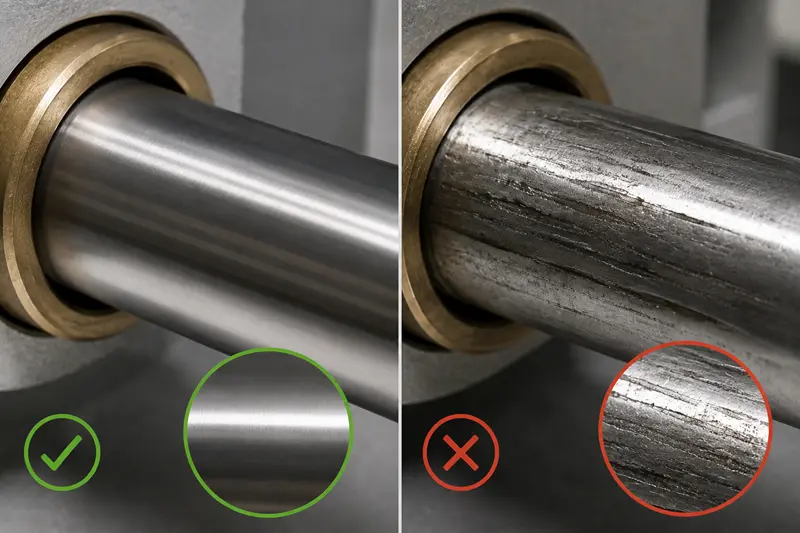
Your equipment is making a strange noise, and you suspect the bushing is failing. This sound signals potential downtime, costly repairs, and project delays, making you worry about quality.
Bushing noise is usually a system problem, not just a faulty part.[^1] The most common causes are insufficient lubrication, excessive clearance, misalignment between the shaft and housing, contamination from dirt or debris, and selecting the wrong bushing material for the application. It's an early warning sign.
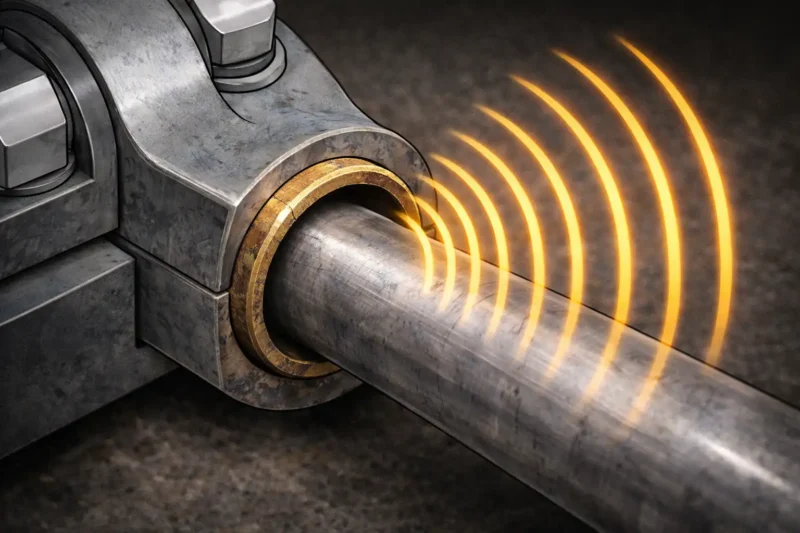
When I hear from a customer about a noisy part, it's a familiar story. The immediate thought is that the bushing itself must be defective. After all, it’s the part making the sound. But in my years of experience as a manufacturer, I’ve learned that a noisy bushing is often a messenger, delivering bad news about a deeper issue within the entire mechanical system. We can test a returned "noisy" bushing and find its dimensions, material, and hardness are perfectly within specification. This tells us we need to look beyond the part and investigate the environment it operates in. Let's break down the most common reasons one by one so you can diagnose the problem correctly.
Is a Lack of Lubrication Making Your Bushings Noisy?
Hear that constant squeaking or grinding from your machine? It's an annoying sound that signals metal is grinding against metal, leading to rapid wear and potential seizure of the joint.
Yes, insufficient lubrication is a top cause of bushing noise.[^2] When the oil or grease film breaks down, the shaft and bushing surfaces make direct contact. This creates squeaking, grinding, and high-pitched friction sounds, especially with bronze or bi-metal bushings that need lubrication to run quietly.
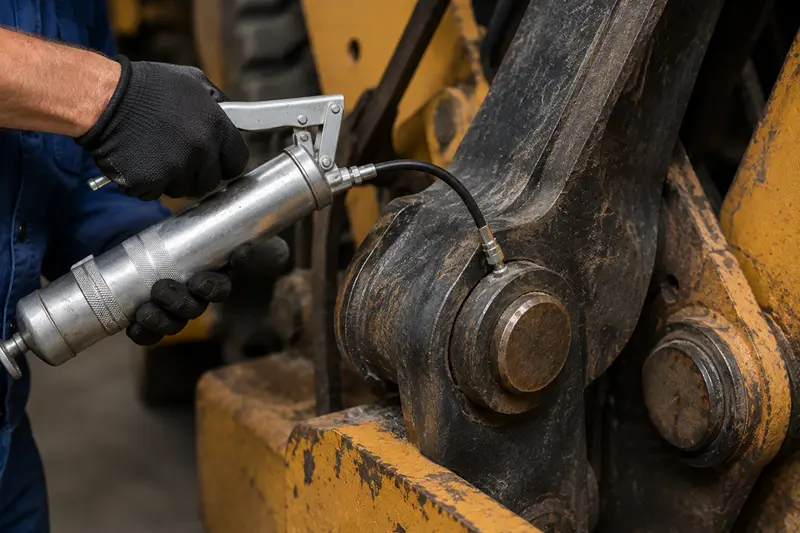
Let's dive deeper into how this happens. The main job of lubrication in a plain bearing system is to create a thin film that separates the moving shaft from the stationary bushing. This film prevents direct metal-to-metal contact, drastically reducing friction and wear. When this film is gone, either because the grease has dried out, leaked away, or was never applied correctly, the surfaces start to rub directly against each other. This is when you start to hear problems. The type of noise can even tell you what's happening. A high-pitched squeal is often caused by a "stick-slip" motion, where the surfaces repeatedly catch and release. A lower-pitched grinding sound suggests that abrasive wear is already happening. From our factory's perspective, this is the first thing we ask about. Many bushings sent back to us under warranty for "noise" are perfectly fine; the issue was an inadequate maintenance schedule or using the wrong type of lubricant for the operating temperature and load.
| Symptom | Technical Cause | Common Bushing Types Affected |
|---|---|---|
| Squeaking/Squealing | Stick-slip friction from dry contact | Bronze Wrapped, Bi-metal, Steel |
| Grinding | Abrasive wear from metal-on-metal | All metal-based bushings |
| Whirring/Whining | High-speed dry friction | Bronze, Steel |
Could Too Much Clearance Be Causing That Knocking Sound?
Do you hear a distinct clicking or knocking sound when your machine starts, stops, or changes direction? This suggests parts are loose, which can lead to impact damage and a loss of precision.
Absolutely. When the gap, or clearance, between the shaft and the bushing is too large, the shaft can move and vibrate inside the bushing.[^3] This movement creates knocking or clicking sounds. This often happens after long-term wear or if the initial assembly tolerances were not controlled properly.
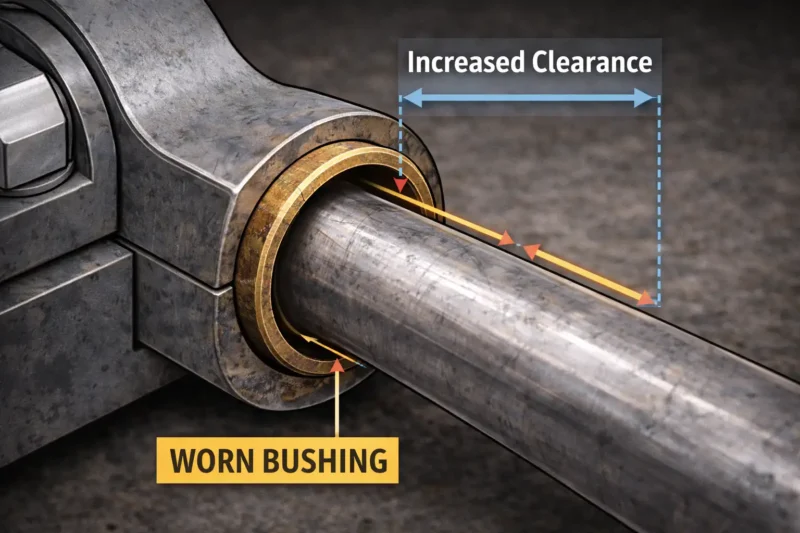
Clearance is a critical but often overlooked factor. It's the tiny space between the shaft and the inside diameter of the bushing, designed to hold a lubricating film. If this space is too large, the shaft isn't held securely. Every time the load changes direction, the shaft physically moves across this gap and impacts the other side of the bushing, creating a "knock" or "click." This isn't just a noise problem; these repeated impacts can damage both the shaft and the bushing, a process called fretting. We see two main reasons for this. First is simple wear over a long service life. Second, and more common in new equipment, is a tolerance mismatch. As a bushing manufacturer, we make our products to precise dimensions, for example, an H7 tolerance. But if the customer's shaft is machined too small (e.g., an f8 tolerance instead of f7) or the housing bore is too large, even a perfect bushing will result in a loose, noisy fit. It's a system problem.
| Fit Condition | Description | Potential Noise Issue |
|---|---|---|
| Too Loose | Large gap, allowing the shaft to rattle and vibrate. | Knocking, Clicking, Rattling |
| Correct Fit | Ideal gap for lubrication film and stable operation. | Quiet, smooth operation |
| Too Tight | No gap, causing high friction and binding. | Squealing, Groaning, Seizure |
Can Misalignment Cause Your Bushings to Vibrate and Fail?
Is your equipment vibrating or making a rhythmic noise that gets worse under load? This uneven stress can cause localized overheating and destroy your bushings much faster than expected.
Yes, misalignment is a major cause of noise and premature failure.[^4] When the shaft and bushing are not perfectly concentric, the load gets concentrated on a small edge of the bushing. This causes rapid, uneven wear, which generates periodic grinding noises, vibration, and localized heat.
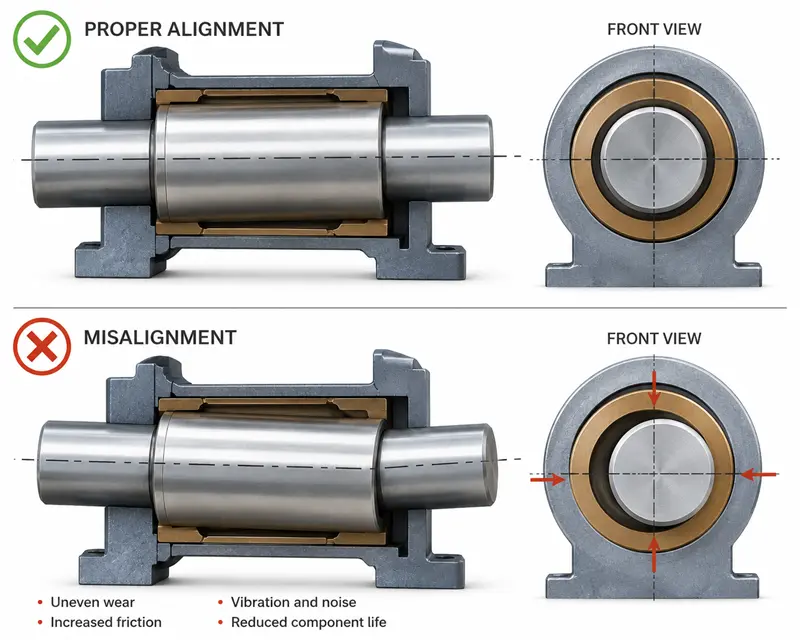
Think of a properly aligned bushing as a tire sitting flat on the road, distributing weight evenly. A misaligned bushing is like a tire running only on its edge. All the force is concentrated in one small area. This is called "edge loading." This intense pressure quickly wears away that single point on the bushing, creating a scraping or grinding sound that often occurs once per revolution of the shaft. It also generates a lot of heat in that one spot, which can burn away lubricant and accelerate failure. This problem is especially common in equipment with long shafts that can flex, or in articulated joints like on an excavator arm or a front loader. I once inspected a failed bushing from a conveyor system that was worn through on one side but looked almost new on the other. It was a classic case of misalignment. The customer's frame was slightly twisted, forcing the shaft to run at an angle to the bushing. The bushing didn't fail on its own; the system forced it to fail.
| Misalignment Type | Effect on Bushing | Resulting Noise |
|---|---|---|
| Angular Misalignment | High pressure on opposite edges of the bushing. | Rhythmic grinding or scraping. |
| Parallel Misalignment | High pressure along one entire side of the bushing. | Constant scraping noise, vibration. |
Is Dirt and Debris Making Your Bushings Grind and Scream?
Your machinery operates in a dirty environment, and now it's making a horrible grinding sound. You think the bushing is worn out, but new replacement parts are failing just as quickly.
Definitely. When dirt, sand, or small metal particles get between the shaft and the bushing, they act like sandpaper.[^5] This process, called three-body abrasion, creates a harsh, irregular grinding or scraping sound. In outdoor equipment for construction and agriculture, this is a very common root cause of noise.
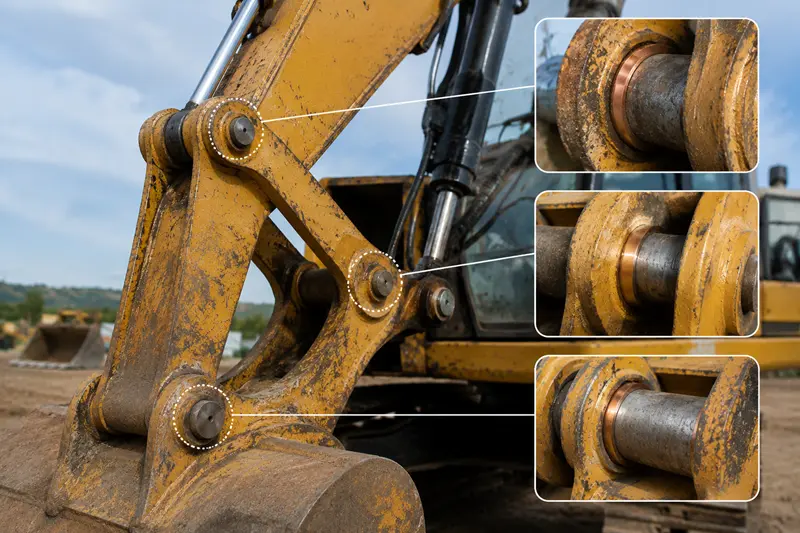
In a clean environment, you have two bodies interacting: the shaft and the bushing. In a dirty one, you add a third body: the contaminant. These tiny, hard particles get trapped in the clearance space and embed themselves into the softer bushing material.[^6] As the shaft rotates, it drags these embedded particles around, scoring and gouging both the shaft and the bushing. The result is a very unpleasant, high-friction grinding noise. The sound is often irregular because it depends on when and where the particles are being crushed. We frequently see this with customers in heavy industries. For example, a client in the mining sector was experiencing rapid failures on their screening equipment. The noise was described as "a horrible screeching." When we analyzed the failed parts, we found them full of fine rock dust. The problem wasn't our bushing's quality; it was the failure of the seals meant to protect the joint. We worked with them to specify a more robust sealing system, and the noise and failure problem was solved.
| Contaminant | Common Source | Damage Type | Typical Noise |
|---|---|---|---|
| Dust, Sand, Dirt | External Environment | Abrasive wear, deep scoring | Grinding, Scraping |
| Metal Particles | Internal wear, debris | Galling, scoring | High-pitched screeching |
| Water/Moisture | Environment, cleaning | Corrosion, pitting | Creaking, Groaning |
Did You Choose the Wrong Bushing Material for Your Application?
You installed brand-new bushings, but the machine is still noisy, maybe even louder than before. You are frustrated because you thought a new part would solve the problem completely.
It is very possible that the material is not a good match for the job. Different bushing materials have very different noise characteristics.[^7] Metal bushings are strong but can be noisy without perfect alignment and lubrication. Plastic or composite bushings are often quieter but may not handle the same loads.
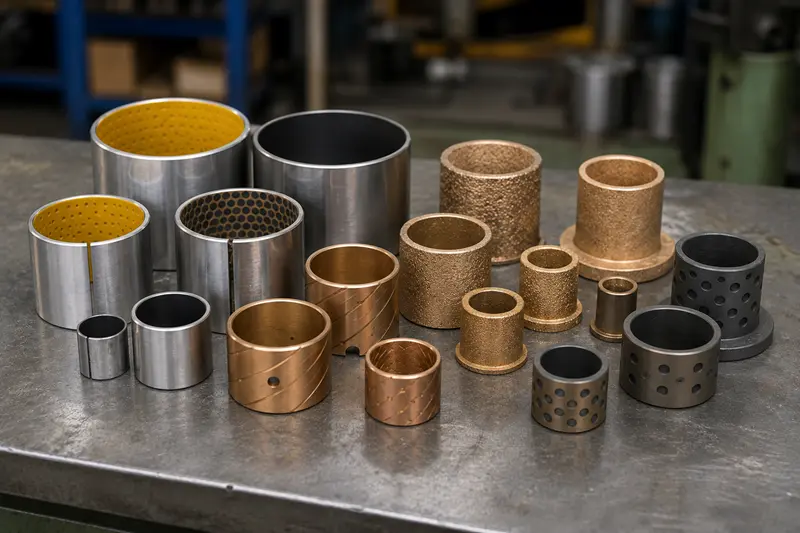
Choosing a bushing material is always a balancing act. You have to consider the load, speed, temperature, and whether lubrication is available. Noise is another critical factor in this equation.[^8] For instance, a solid bronze bushing is incredibly strong and can handle massive loads, but it is unforgiving. If lubrication is even slightly off, it will protest with a loud squeal. In contrast, many engineered plastic bushings are naturally quiet and have good damping properties, meaning they absorb vibration. However, they can't handle the high loads or temperatures that a metal bushing can. This is where we, as manufacturers, can provide a lot of value. I recall a customer who designed high-end fitness equipment. They initially used our standard bronze bushings but got complaints about noise. The loads were not very high, and the environment was clean. We suggested they switch to a metal-polymer composite bushing. This material has a PTFE layer that provides dry, silent operation but is supported by a steel backing for strength. The change solved the noise problem instantly without a major redesign.
| Material Type | Strengths | Noise-Related Weaknesses |
|---|---|---|
| Bronze / Metal | High load capacity, durable | Can be noisy without lubrication |
| Engineered Plastic | Quiet operation, self-lubricating | Lower load capacity, can deform |
| Metal-Polymer Composite | Low friction, quiet, no lube needed | Has specific operating limits |
| Rubber | Excellent vibration absorption | Low precision, not for rotation |
Conclusion
Bushing noise is a warning sign from your equipment.[^9] It points to a system issue, not just a faulty part. The root cause is usually lubrication, clearance, alignment, contamination, or material choice.
[^1]: "[PDF] TESTING AND MAINTENANCE OF HIGH-VOLTAGE BUSHINGS", https://www.usbr.gov/power/data/fist/fist3_2/vol3-2.pdf. This source explains how bushing noise often indicates broader mechanical system issues rather than isolated part defects. Evidence role: mechanism; source type: education. Supports: Bushing noise is often caused by systemic mechanical issues rather than isolated part defects.. [^2]: "Lubrication points on C6 suspension causing squeaks? - Facebook", https://www.facebook.com/groups/462775655409090/posts/537102874643034/. This source provides evidence that lubrication failure is a primary cause of noise in bushing systems. Evidence role: mechanism; source type: research. Supports: Insufficient lubrication is a primary cause of bushing noise.. [^3]: "Understanding Internal Clearances in Bushings and Plain Bearings", https://www.astbearings.com/blog/understanding-internal-clearances-bushings-plain-bearings.html. This source discusses how excessive clearance between a shaft and bushing can lead to noise and mechanical instability. Evidence role: mechanism; source type: education. Supports: Excessive clearance between a shaft and bushing can cause noise and mechanical instability.. [^4]: "Is loud noise and vibration coming from a worn bushing? - Facebook", https://www.facebook.com/groups/1560702921002941/posts/2021943168212245/. This source explains how shaft misalignment can lead to uneven wear and noise in bushing systems. Evidence role: mechanism; source type: research. Supports: Shaft misalignment is a major cause of noise and premature failure in bushing systems.. [^5]: "Abrasive Wear Gear Failures - ONYX Insight", https://onyxinsight.com/resources-support/failure-atlas/abrasive-wear-gear-failure/. This source describes how contaminants like dirt and debris can cause abrasive wear in bushing systems. Evidence role: mechanism; source type: research. Supports: Contaminants like dirt and debris can cause abrasive wear in bushing systems.. [^6]: "Lubrication Contamination and the Effect on Pin Bushings - Graco Inc.", https://www.graco.com/us/en/vehicle-service/solutions/articles/lubrication-contamination-effect-on-pin-bushings.html. This source discusses how contaminants can embed into softer bushing materials, causing wear and noise. Evidence role: mechanism; source type: research. Supports: Contaminants can embed into softer bushing materials, causing wear and noise.. [^7]: "Friction Characteristics Analysis of Rubber Bushing with a Bionic ...", https://pmc.ncbi.nlm.nih.gov/articles/PMC9919655/. This source outlines how material properties influence noise levels in bushing systems. Evidence role: mechanism; source type: education. Supports: Different bushing materials have varying noise characteristics based on their properties.. [^8]: "NAE Website - Noise Control Engineering and Education", https://www.nae.edu/255853/Noise-Control-Engineering-and-Education. This source highlights the importance of noise considerations when selecting bushing materials. Evidence role: general_support; source type: education. Supports: Noise is an important factor to consider when selecting bushing materials.. [^9]: "Sound-Based Unsupervised Fault Diagnosis of Industrial Equipment ...", https://pmc.ncbi.nlm.nih.gov/articles/PMC11598224/. This source explains how bushing noise can serve as an early indicator of mechanical system issues. Evidence role: mechanism; source type: education. Supports: Bushing noise can serve as an early indicator of mechanical system issues..