Loader downtime from worn bushings is costly[^1], and it feels like a never-ending cycle. Each failure stops your project, drains your budget, and hurts your reputation for reliability.
To improve loader bushing life, focus on the entire system. This means selecting the right material for heavy loads, ensuring proper lubrication, using a high-quality pin, preventing contamination with seals, and maintaining correct assembly clearances. It's about total system harmony.
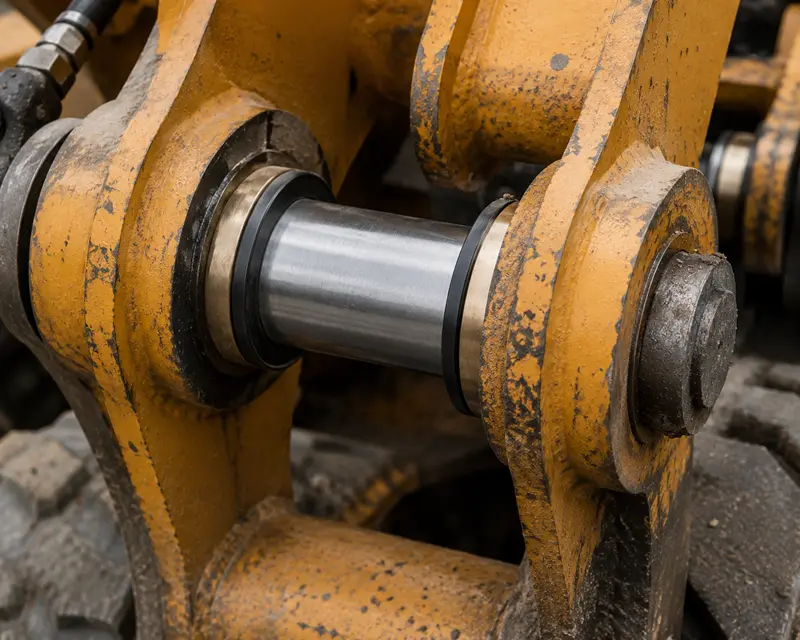
You've probably tried swapping out a worn bushing for a "better" one, only to see it fail again sooner than expected. It's frustrating and makes you question the quality of the parts. But what if the bushing itself isn't the only problem? As a factory, we see this all the time. The real secret to long-lasting loader bushings isn't just about the bushing—it's about how the bushing works with everything around it. Let's break down the key areas you need to focus on to really solve this problem for good.
Is Choosing a More Expensive Material Always the Best Way to Extend Bushing Life?
You assume a more expensive bushing is the answer, but they still wear out quickly. This wastes your budget and leaves you confused about why the "best" material isn't working.
Not always. The best material is the one matched to the specific application's load, speed, and lubrication. For heavy-load pivot points, consider high-strength bronze or graphite-plugged bronze bushings, which offer superior performance in tough, low-speed environments[^2].
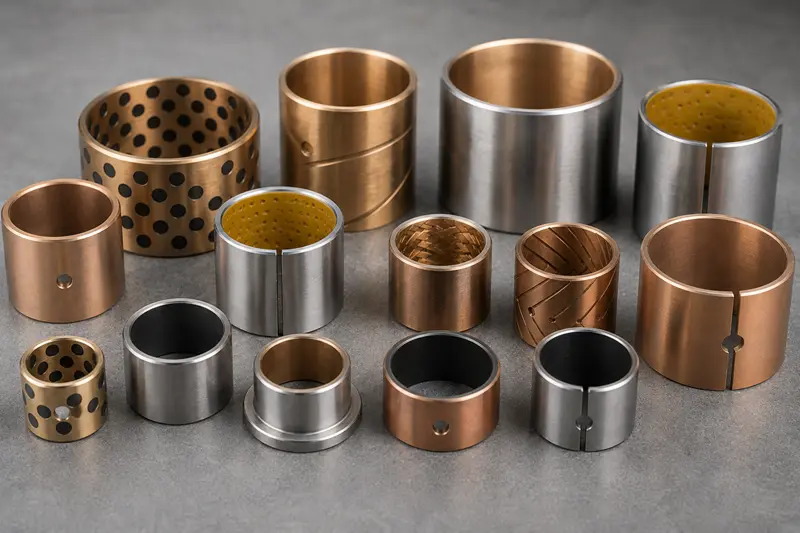
When we look at common failure points on a loader—the boom, rocker arm, and bucket connections—they all share the same challenges: high loads, low speeds, and constant oscillation. Simply choosing the hardest material available isn't the solution. The goal is to match the material's properties to these specific conditions[^3]. From our manufacturing perspective, here’s how we approach it:
Material Selection for Loader Applications
| Material Type | Best For... | Why It Works |
|---|---|---|
| High-Strength Bronze Alloy | General heavy-load pivot points with lubrication | Offers excellent load-carrying capacity and good resistance to shock and wear when properly greased. |
| Graphite Plugged Bronze | Hard-to-lubricate or unmaintained joints | Solid graphite plugs act as a self-lubricating film, providing continuous protection even if grease is absent. |
| Bimetal Bushings | High-load applications with consistent lubrication | A steel backing provides structural strength, while a bronze or other alloy layer offers a low-friction, wearable surface. |
The key takeaway is that material selection is a balancing act. For an OEM project, we don't just ask "What material do you want?" We ask, "What are the load, speed, and lubrication conditions?" This ensures we supply a bushing that is engineered for longevity in its real-world environment, not just one that looks good on a spec sheet.
How Much Does Lubrication Design Really Affect Bushing Wear?
Your team greases the joints regularly, but bushings still seize up and wear unevenly. You're wasting grease and labor, and the lubricant isn't reaching the critical friction surfaces.
It's critical. A bushing will fail from dry friction even with the best material if lubricant can't reach the load zone. The design of oil grooves, holes, and paths dictates whether grease is effectively distributed across the entire friction surface.
Think of lubrication as the lifeblood of a pivot joint. Without it, you get direct metal-to-metal contact, which quickly leads to heat, scoring, and seizure. On a loader, the oscillating motion of a joint—swinging back and forth instead of rotating fully—makes lubrication especially tricky. Grease can be easily pushed out of the high-pressure load zone, leaving it dry[^4]. This is where the internal design of the bushing becomes so important.
The Role of Lubrication Features
As a manufacturer, we can incorporate various features to ensure lubricant gets and stays where it's needed:
- Oil Grooves: Patterns like a figure-eight, double loop, or simple circular grooves act as reservoirs and create pathways for grease to travel across the bushing surface. The right pattern depends on the motion and load.
- Oil Holes: These allow grease pumped from an external zerk fitting to enter the bushing's internal groove system.
- Graphite Plugs: In self-lubricating bushings, these plugs are arranged in a specific pattern to ensure the entire surface is covered by a film of graphite as the joint moves.
For B2B buyers, especially OEMs, specifying the right lubrication design is just as important as specifying the material. A well-designed lubrication system ensures that every machine leaving your production line has a robust and reliable joint[^5], directly reducing warranty claims and improving customer satisfaction.
Could the Pin Be the Real Reason My Bushings Are Failing?
You've upgraded the bushing and you're lubricating it, but it's still showing rapid wear. You feel like you're chasing a ghost, with the problem reappearing no matter what.
Absolutely. A bushing's service life is directly tied to the pin's condition. A pin that is too soft, has a rough surface, or is misaligned will act like a file, rapidly grinding away even the toughest bushing material[^6].
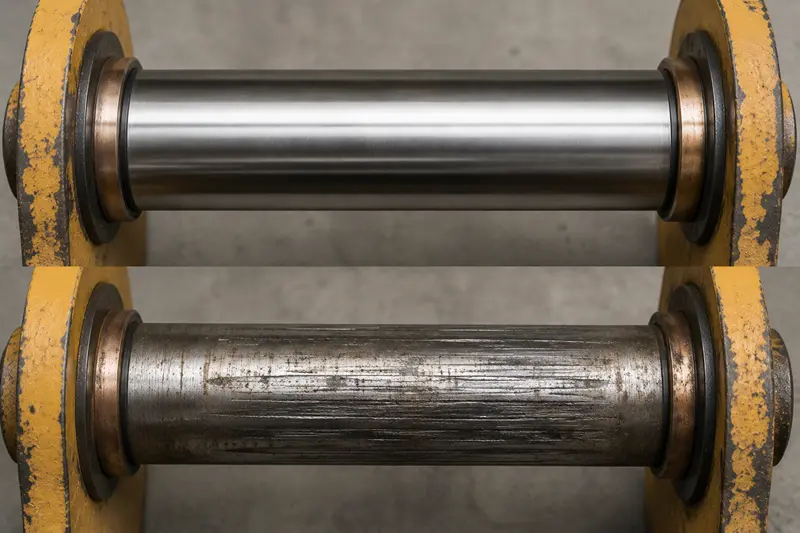
We often see customers focus 100% of their attention on the bushing, but the bushing is only half of the equation. The pin it rotates on is the other half. If the pin is in poor condition, it will destroy any bushing you install, regardless of quality. It's one of the most common and costly oversights in maintenance and even in some production environments.
Key Pin Attributes to Control
To ensure a long service life for your bushings, the mating pin must meet certain criteria. Here’s what we look for when analyzing a system:
| Pin Attribute | The Problem with Poor Quality | The Factory Standard |
|---|---|---|
| Hardness | A soft pin can deform under load or have its surface damaged by debris. This rough, damaged surface then grinds away the bushing. | The pin should be significantly harder than the bushing material to resist deformation and wear. |
| Surface Finish | A rough surface finish (high Ra value) acts like sandpaper. It creates friction and abrasive wear from the very first movement. | A smooth, polished surface (low Ra value) is essential. This allows a lubricant film to form and minimizes friction. |
| Geometry | An out-of-round or tapered pin creates uneven pressure points, leading to localized, accelerated wear and eventual failure. | The pin must be perfectly cylindrical with tight tolerances to ensure an even load distribution across the bushing. |
When you're sourcing parts for a production line or a large-scale repair operation, always consider the pin and bushing as a matched set. Providing a high-quality bushing without ensuring a high-quality pin is only doing half the job[^7]. For our OEM partners, we often provide specifications for the entire assembly to ensure system-wide reliability.
Why Do Bushings on Loaders Fail Faster Than on Indoor Machinery?
Bushings on your loaders wear out much faster than on equipment used in a clean factory. This high replacement rate seems unavoidable, costing you time and money on maintenance.
The primary reason is contamination. Loaders operate in dirt, sand, and mud. These abrasive particles get into the pivot joints and mix with grease, creating a grinding paste that dramatically accelerates wear[^8].
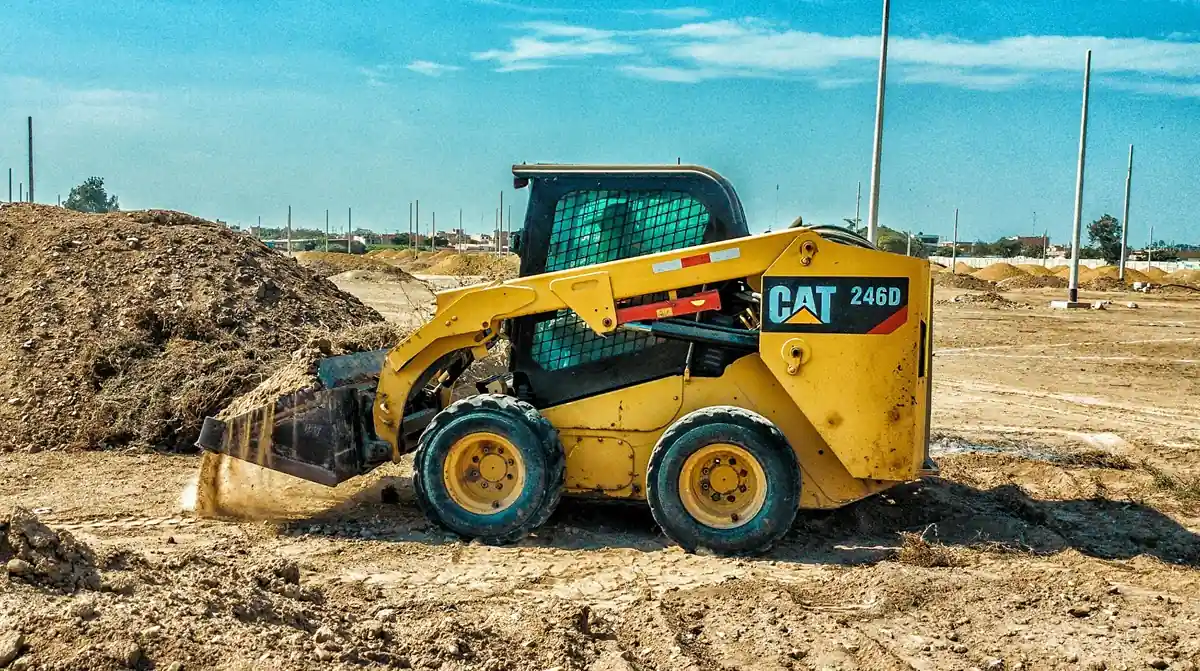
The working environment of a loader is the bushing's worst enemy. Unlike a machine in a clean factory, a loader is constantly exposed to abrasive materials. When fine particles of sand, dirt, or rock dust work their way into a pivot joint, they become embedded in the grease. This mixture no longer acts as a lubricant; it becomes a grinding compound. This phenomenon is known as "three-body abrasion," where the abrasive particle (the third body) gets trapped between the pin and the bushing, scratching and gouging both surfaces.
The First Line of Defense: Sealing
Without an effective way to keep contaminants out, any other improvements you make will have a limited effect. The material can be perfect and the lubrication can be plentiful, but if it's mixed with sand, the joint will fail.
- Seals are Essential: Modern heavy equipment joints are designed with robust seals, such as O-rings or specialized wipers[^9], at the ends of the bushing. These seals form a physical barrier, preventing dirt and water from getting in and keeping clean grease from getting out.
- Maintenance Matters: Regularly cleaning the area around pivot points before greasing can prevent pushing dirt directly into the joint[^10]. Checking and replacing worn or damaged seals is one of the most effective maintenance actions you can take to extend bushing life.
For our OEM clients building new machinery, we stress the importance of designing the seal as an integral part of the joint assembly. A $2 seal can protect a $50 bushing and prevent thousands of dollars in downtime and repairs.
Can the Way We Install Bushings Actually Cause Them to Fail?
You press a new bushing into place, but it's either too tight on the pin or feels loose. A tight fit leads to seizure, while a loose fit causes impact damage.
Yes, improper installation is a major cause of failure. Pressing a bushing in can reduce its inner diameter, eliminating clearance for the pin[^11]. A loose fit allows for hammering and impact, which quickly destroys the bushing.
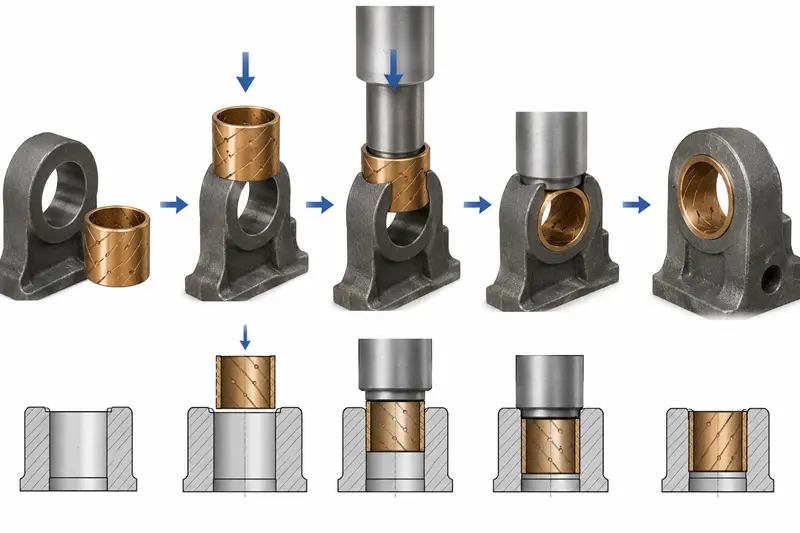
The final step in the process, installation, is where many well-designed systems can fail. The precise dimensions of a bushing are engineered with the installation process in mind. Specifically, we have to manage two critical fits: the press-fit into the housing and the running clearance for the pin.
Getting the Fit Right
A bushing is designed to be slightly larger than the hole it's pressed into (the housing bore). This interference fit holds it securely. However, this pressing process slightly squeezes the bushing, reducing its inside diameter (ID). This reduction must be calculated to achieve the final, correct running clearance with the pin.
| Assembly Step | Description | The Risk of Getting It Wrong |
|---|---|---|
| 1. Press-Fit | The bushing's outer diameter (OD) is pressed into the housing bore. | Too Loose: The bushing can spin in the housing, wearing both parts. Too Tight: Can damage the bushing or housing during installation. |
| 2. ID "Close-In" | The press-fit action reduces the bushing's original ID. | Not accounting for this is a common mistake. The pin will not fit or will be too tight. |
| 3. Running Clearance | The final gap between the installed bushing ID and the pin OD. | Too Little Clearance: No room for lubricant. Leads to seizure. Too Much Clearance: Allows for impact and hammering, leading to noise and rapid wear. |
As a manufacturer for B2B projects, controlling tolerances is our job. We ensure that every bushing in a batch has a consistent OD and ID, so that when you install them on your assembly line, the final running clearance is the same every time. This consistency is the key to predictable performance and reliability, directly impacting your product's quality and your brand's reputation.
Conclusion
Improving loader bushing life isn't about one magic part[^12]. It's about optimizing the entire system—material, lubrication, pin, sealing, and assembly—to work together for maximum reliability and lower total costs.
[^1]: "[PDF] Economics of Manufacturing Machinery Maintenance", https://nvlpubs.nist.gov/nistpubs/ams/NIST.AMS.100-34.pdf. This source provides data on the financial impact of equipment downtime due to bushing wear in heavy machinery applications. Evidence role: statistic; source type: research. Supports: Loader downtime from worn bushings is costly.. [^2]: "[PDF] Selecting Bronze Bearing Materials", https://www.nationalbronze.com/pdfs/Selecting%20Bronze%20Bearing%20Materials.pdf. This source explains the mechanical properties and applications of high-strength bronze and graphite-plugged bronze bushings in heavy machinery. Evidence role: mechanism; source type: education. Supports: High-strength bronze and graphite-plugged bronze bushings offer superior performance in tough, low-speed environments.. [^3]: "Material properties - Mechanical & Aerospace Engineering", https://web.mae.ufl.edu/designlab/Class%20Projects/Background%20Information/Material%20properties.htm. This source explains the importance of material property matching in engineering applications for heavy machinery. Evidence role: mechanism; source type: education. Supports: The goal is to match the material's properties to these specific conditions.. [^4]: "Lubricant design for oscillating rolling bearings: Greases, ionic ...", https://www.sciencedirect.com/science/article/pii/S0301679X25002166. This source discusses the challenges of lubrication retention in oscillating joints under high-pressure conditions. Evidence role: mechanism; source type: research. Supports: Grease can be easily pushed out of the high-pressure load zone, leaving it dry.. [^5]: "Automated Lubrication - Benefits and Design Options", https://www.machinerylubrication.com/Read/175/automated-lubrication. This source discusses the role of lubrication system design in ensuring reliability in heavy machinery. Evidence role: mechanism; source type: institution. Supports: A well-designed lubrication system ensures that every machine leaving your production line has a robust and reliable joint.. [^6]: "Irregular Press Fit Pins | Center for Advanced Life Cycle Engineering", https://calce.umd.edu/irregular-press-fit-pins. This source details the impact of pin quality on bushing wear and failure in mechanical systems. Evidence role: mechanism; source type: education. Supports: A pin that is too soft, has a rough surface, or is misaligned will act like a file, rapidly grinding away even the toughest bushing material.. [^7]: "The Ultimate Guide To Enhancing Equipment Life With Quality Pin ...", https://www.linkedin.com/pulse/ultimate-guide-enhancing-equipment-life-quality-pin-bushings-yeung-f4kec. This source emphasizes the interdependence of bushing and pin quality in mechanical systems. Evidence role: expert_consensus; source type: education. Supports: Providing a high-quality bushing without ensuring a high-quality pin is only doing half the job.. [^8]: "Mechanical property analysis and dry sand three-body abrasive ...", https://pmc.ncbi.nlm.nih.gov/articles/PMC10794707/. This source explains the phenomenon of three-body abrasion caused by contaminants in pivot joints. Evidence role: mechanism; source type: research. Supports: Abrasive particles in pivot joints mix with grease, creating a grinding paste that accelerates wear.. [^9]: "What are o-rings and how do they work? an overview + ... - MechLink", https://www.mechandlink.com/en/news-article/What-are-o-rings-and-how-do-they-work-an-overview-maintenance-tips. This source describes the role of seals like O-rings and wipers in protecting heavy equipment joints from contamination. Evidence role: mechanism; source type: education. Supports: Modern heavy equipment joints are designed with robust seals, such as O-rings or specialized wipers.. [^10]: "Tips for Lubricating Heavy Equipment Components | EquipmentShare", https://www.equipmentshare.com/articles/tips-for-lubrication. This source provides maintenance guidelines for preventing contamination in pivot joints of heavy equipment. Evidence role: general_support; source type: government. Supports: Regularly cleaning the area around pivot points before greasing can prevent pushing dirt directly into the joint.. [^11]: "Tolerence for press fit bushings - Practical Machinist", https://www.practicalmachinist.com/forum/threads/tolerence-for-press-fit-bushings.221293/. This source explains the dimensional changes in bushings during press-fit installation and their impact on clearance. Evidence role: mechanism; source type: education. Supports: Pressing a bushing in can reduce its inner diameter, eliminating clearance for the pin.. [^12]: "Accelerated wear testing shows that thermoplastic bushings could ...", https://pmc.ncbi.nlm.nih.gov/articles/PMC9742721/. This source discusses the importance of system-wide optimization for improving the service life of loader bushings. Evidence role: expert_consensus; source type: institution. Supports: Improving loader bushing life isn't about one magic part..