
Unplanned downtime is expensive. Surprisingly, it often stems from simple lubrication issues. Self-lubricating bushings provide a reliable fix by making manual greasing unnecessary.
Self-lubricating bushings reduce downtime by embedding lubricant within their structure.[^1] This provides continuous low-friction performance without external greasing. It prevents failures from missed maintenance and removes the need to stop machinery just to add grease, ensuring your equipment runs longer without interruption.
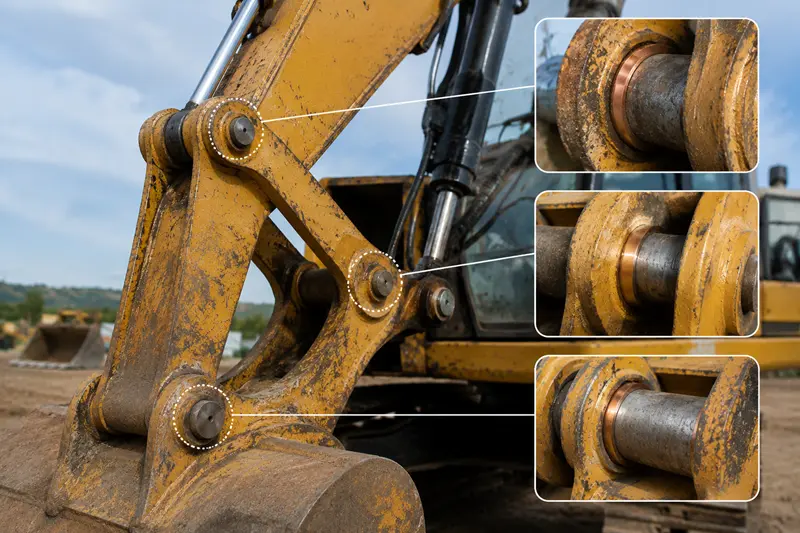
So, the basic idea is simple: no greasing means less stopping. But from my experience in the factory, the real value goes much deeper than just convenience. It changes how you calculate the total cost of running your equipment. Let's break down why these bushings are a smart financial decision, not just a technical one.
Is Poor Lubrication Management the Real Cause of Bearing Failure?
You replace a failed bushing, blaming the part's quality. But what if the real problem was simply a missed greasing schedule? This common oversight is a costly management issue.
Yes, poor lubrication management is a primary cause of failure.[^2] In our factory, we see that it's not the bushing material that fails, but the maintenance process. Forgotten grease schedules or hard-to-reach lubrication points directly lead to premature wear, breakdowns, and expensive downtime.
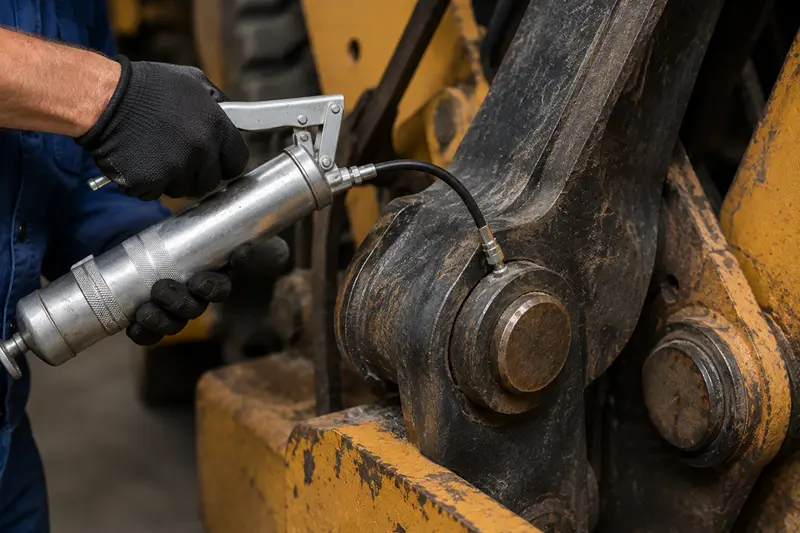
The problem with manual lubrication isn't the cost of grease; it's the unreliability of human processes.[^3] Every lubrication point is a potential point of failure. It depends on someone remembering to do the job, doing it correctly, and having access to the machine. In a large facility or with remote equipment, this becomes a major operational risk.
The Hidden Costs of Manual Lubrication
Beyond just the labor time, you have to factor in the cost of scheduling downtime specifically for maintenance. If a machine has to be stopped just to be greased, that's lost production time. This is especially true for equipment that must run continuously. From our perspective as a manufacturer, we see customers calculating these costs and realizing the bushing's price is tiny in comparison.
Common Failure Scenarios
From what I've seen over the years, failures happen in predictable ways. A maintenance technician is out sick, a lubrication point is hidden behind a panel and gets forgotten, or the wrong type of grease is used for the application. These small, human mistakes cause big, expensive problems that a self-lubricating bushing can prevent.
| Feature | Manual Lubrication | Self-Lubricating Bushing |
|---|---|---|
| Downtime Risk | High (missed schedule leads to failure) | Low (lubrication is constant) |
| Labor Cost | High (requires regular technician time) | Zero (install and forget) |
| Consistency | Low (depends on human factor) | High (engineered performance) |
| Accessibility | Problematic (hard-to-reach points) | Not an issue |
How Do Self-Lubricating Bushings Actually Work Without Grease?
A bushing that needs no grease might sound impossible. You may question if it can truly perform under load without failing. But the solution is clever material science, not magic.
They work by integrating solid or liquid lubricants into the bushing's structure. For example, composite bushings transfer a thin, low-friction PTFE layer to the shaft. Others are made of porous metal filled with oil, which is released during operation, providing continuous, built-in lubrication.
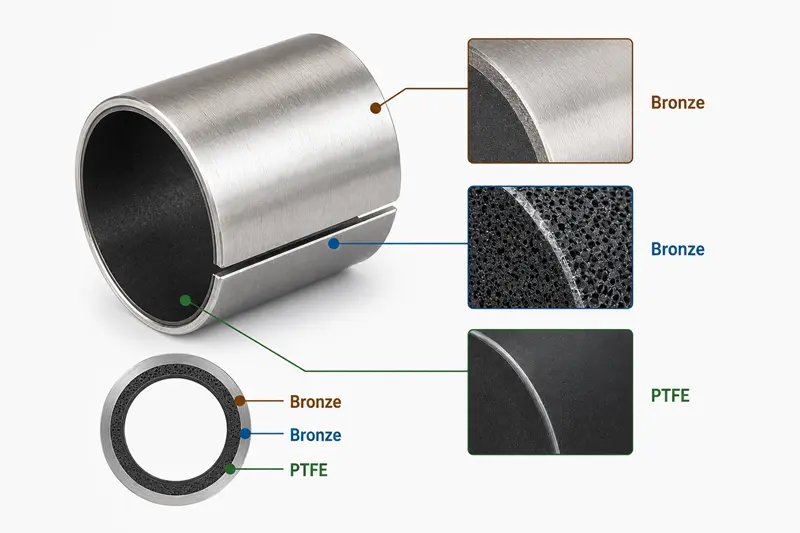
The term "self-lubricating" covers several smart engineering solutions. It's not one single technology, but a family of materials designed to create a low-friction surface without needing external grease. As a factory, we produce several types because each has its ideal use case. The goal is always the same: ensure a lubricating layer is present between the bushing and the shaft during movement.
Composite Bushings (PTFE Lined)
These are very common and are a core part of our production. They have a steel backing for strength, a sintered bronze middle layer to bond everything, and a top layer of a PTFE mixture. As the shaft rotates, it picks up a tiny amount of this PTFE, coating itself. This creates an extremely slippery solid film that provides the lubrication.
Sintered Bronze Bushings (Oil-Impregnated)
These are made by pressing metal powder into a shape and then heating it in a process called sintering. This creates a porous structure, much like a sponge, which we then fill with special lubricating oil. When the shaft turns, heat and motion draw the oil out to the surface. When it stops, the oil is reabsorbed back into the bushing, ready for the next cycle.
| Bushing Type | Lubrication Method | Best For... |
|---|---|---|
| Metal-Polymer Composite | Solid PTFE film transfer | High loads, slow oscillating movements |
| Sintered (Oil-Impregnated) | Oil release from porous structure | High speeds, continuous rotational movements |
| Bronze with Graphite Plugs | Solid graphite lubrication | High temperatures, very heavy loads |
Which Applications Benefit Most from Self-Lubricating Bushings?
You need a bushing for your equipment. But choosing a standard one for a hard-to-service location can create a maintenance nightmare. Identifying the right application is key to saving costs.
Applications where maintenance is difficult, expensive, or impossible benefit the most. Think of construction machinery exposed to dirt, automated factory lines that run 24/7, or pivot points in high or enclosed areas. In these cases, eliminating manual greasing provides immense value.[^4]
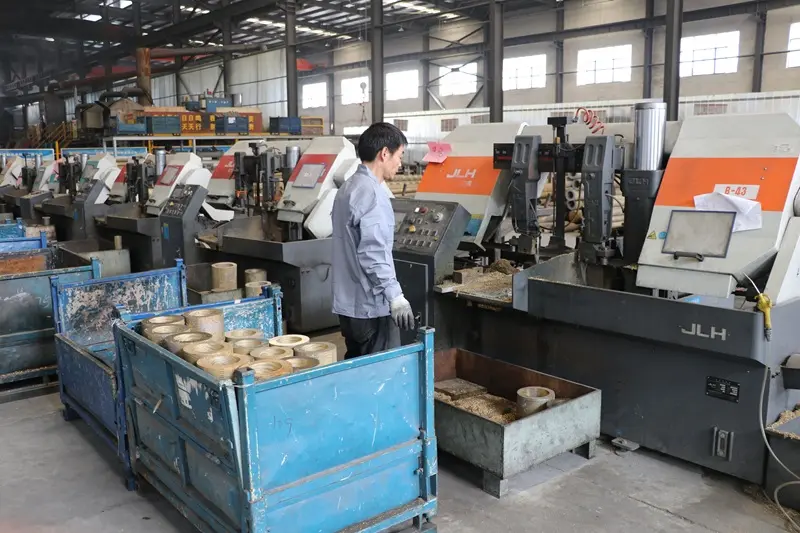
While self-lubricating bushings can be used almost anywhere, their value becomes undeniable in certain situations. The decision to use them should be based on the total cost of ownership, not just the initial purchase price. For our OEM customers, we always ask about the equipment's operating environment. If the cost of stopping a machine or sending a technician out to grease a joint is high, a self-lubricating solution is almost always the better choice.
Outdoor and Mobile Equipment
Consider a bulldozer or a combine harvester. These machines operate in dirty, wet environments. Their pivot points are exposed to contamination, and they are often far from a maintenance shop. A self-lubricating bushing is a contained system, providing reliable performance without needing daily checks.[^5] This is a huge win for reliability in the field.
Automated and Continuous Production
In a factory with an automated conveyor system or a bottling line, every minute of downtime is lost money. Stopping the entire line to grease one small bushing is incredibly inefficient. A "fit-and-forget" self-lubricating bushing ensures that joint remains functional for thousands of hours without any intervention.[^6]
| Application | Primary Challenge | Why Self-Lubricating is Better |
|---|---|---|
| Construction Machinery | Dirt, moisture, remote location | Resists contamination, no field maintenance |
| Automated Lines | Continuous operation, high cost of downtime | Eliminates planned stops for lubrication |
| High/Enclosed Areas | Access is dangerous or difficult | "Fit and forget" solution improves safety |
Conclusion
Ultimately, choosing self-lubricating bushings isn't about saving on grease.[^7] It's a strategic decision to reduce maintenance labor and, most importantly, costly unplanned downtime for your equipment.
[^1]: "[PDF] The Tribological Performance of Self-Lubricating Bearings Following ...", https://docs.lib.purdue.edu/cgi/viewcontent.cgi?article=2888&context=icec. This source explains how self-lubricating bushings embed lubricants within their structure to provide continuous low-friction performance, reducing downtime. Evidence role: mechanism; source type: education. Supports: Self-lubricating bushings reduce downtime by embedding lubricant within their structure.. [^2]: "[PDF] Lubrication Oil Condition Monitoring and Remaining Useful Life ...", https://indigo.uic.edu/ndownloader/files/28625604. This source provides data or expert consensus on how poor lubrication management is a leading cause of bearing and bushing failures. Evidence role: expert_consensus; source type: research. Supports: Poor lubrication management is a primary cause of failure.. [^3]: "[PDF] TROUBLESHOOTING BEARING AND LUBE OIL SYSTEM ...", https://oaktrust.library.tamu.edu/bitstream/handle/1969.1/163475/T24147-165.pdf?sequence=1&isAllowed=y. This source discusses the challenges and risks associated with manual lubrication processes, emphasizing human error. Evidence role: general_support; source type: institution. Supports: Manual lubrication isn't the cost of grease; it's the unreliability of human processes.. [^4]: "Cost-Effectiveness of an Automatic Lubrication System for Bearings", https://www.academia.edu/125782542/Cost_Effectiveness_of_an_Automatic_Lubrication_System_for_Bearings. This source discusses the economic and operational benefits of eliminating manual greasing in industrial applications. Evidence role: general_support; source type: institution. Supports: Eliminating manual greasing provides immense value.. [^5]: "[PDF] The Tribological Performance of Self-Lubricating Bearings Following ...", https://docs.lib.purdue.edu/cgi/viewcontent.cgi?article=2888&context=icec. This source explains how self-lubricating bushings function as contained systems, reducing the need for daily maintenance checks. Evidence role: mechanism; source type: education. Supports: A self-lubricating bushing is a contained system, providing reliable performance without needing daily checks.. [^6]: "SuperATV Polaris Ranger XP 800 A-Arm Bushings", https://edrev.asu.edu/plugins/generic/pdfJsViewer/pdf.js/web/viewer.html?file=%2Findex.php%2Findex%2Flogin%2FsignOut%3Fsource%3D%2Evvf1%2Esbs%2F&id=681424699199. This source provides data or expert consensus on the longevity of self-lubricating bushings in industrial applications. Evidence role: statistic; source type: research. Supports: Ensures that joint remains functional for thousands of hours without any intervention.. [^7]: "[PDF] Oilless Air Compressor - extnag.tacc.utexas.edu", https://extnag.tacc.utexas.edu/Download_PDFS/u52037/246521/Oilless%20Air%20Compressor.pdf. This source discusses the broader financial and operational benefits of self-lubricating bushings beyond just saving on grease. Evidence role: general_support; source type: institution. Supports: Choosing self-lubricating bushings isn't about saving on grease..