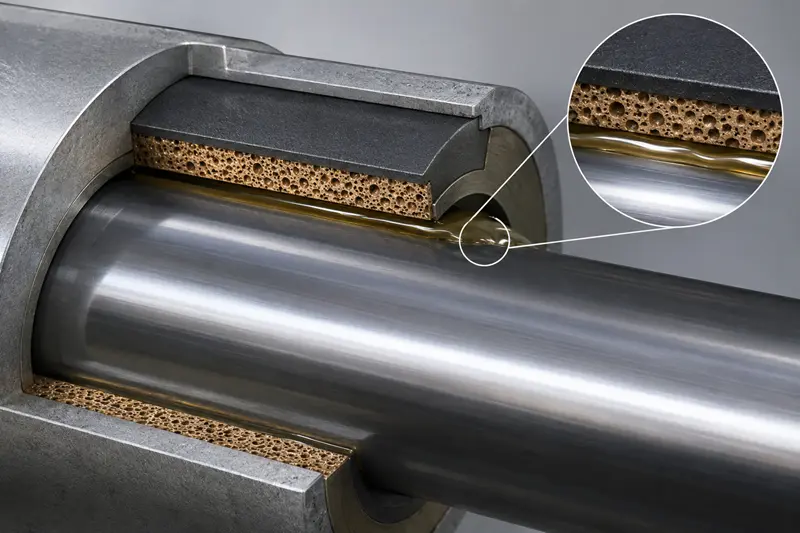
Are you tired of constant machine lubrication schedules and unexpected downtime? What if a bushing could lubricate itself, but fails anyway? Understanding how they truly work is key.
Maintenance-free bushings work by integrating lubrication directly into their material[^1], eliminating the need for external greasing. This is done through methods like PTFE layers, stored oil, or solid lubricants. This design reduces manual maintenance but does not make the bushing immune to wear.
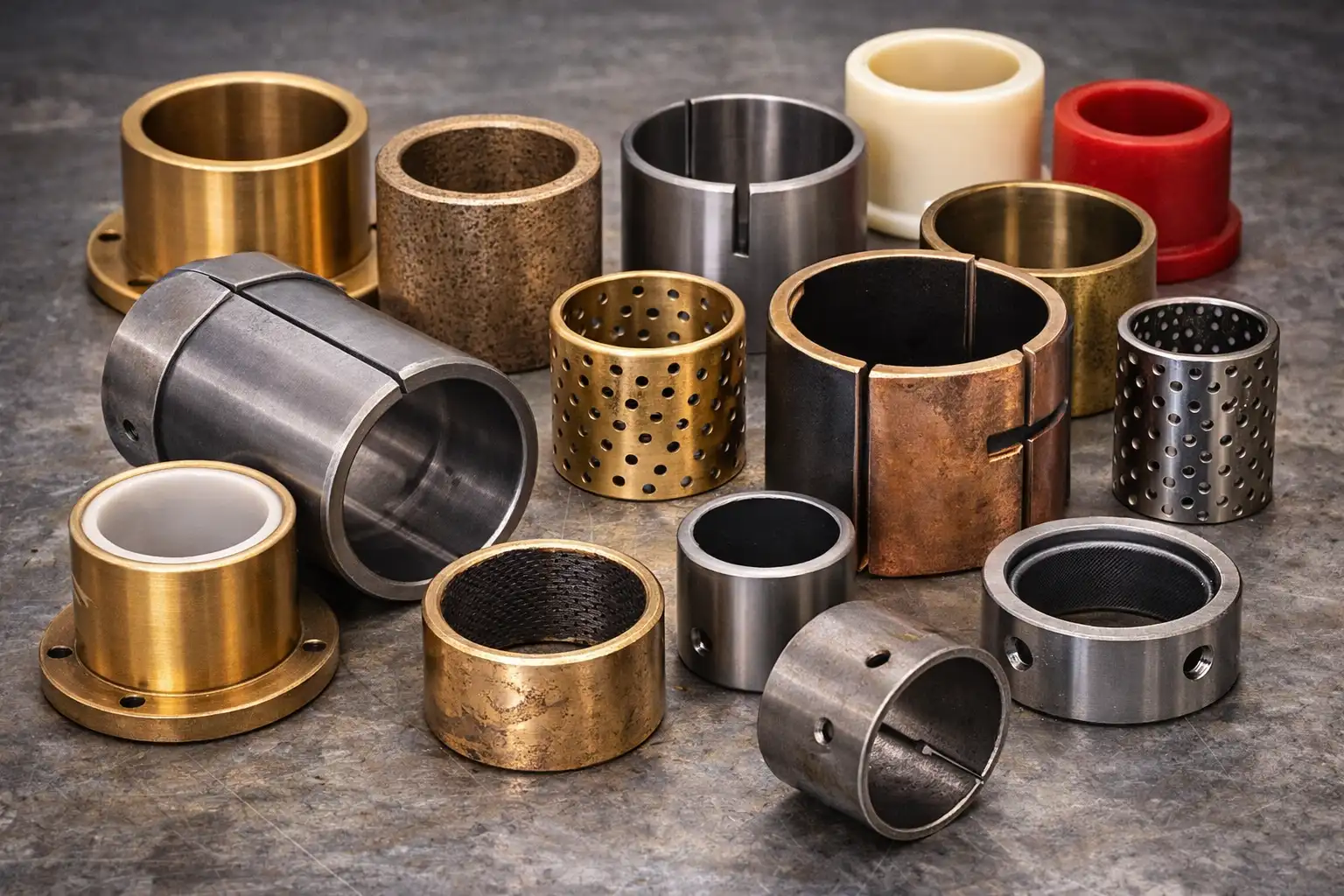
The term "maintenance-free" is a huge draw for anyone managing machinery[^2]. It promises less work, lower costs, and fewer headaches. But as a manufacturer, I've seen the confusion this term can cause. The magic isn't in the name itself, but in the specific technology behind the bushing. Choosing the right one for your application is what truly determines its success and longevity. Let's explore what this really means for your operations.
What Does 'Maintenance-Free' Really Mean for Bushings?
You see the "maintenance-free" label and think your problems are solved. But assuming it's a magic bullet can lead to costly failures. Let's clarify this from a factory's view.
"Maintenance-free" means the bushing has a built-in, self-lubricating system that removes the need for manual greasing. It saves you lubrication labor, but it does not mean the bushing has an infinite lifespan or is immune to wear.
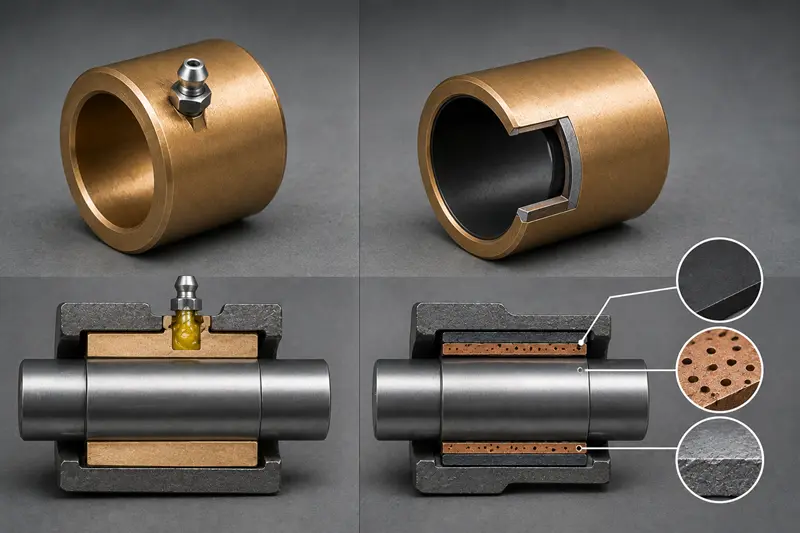
From our factory floor, the distinction is simple. A traditional bushing is just a passive component[^3]. It relies on you to create a lubrication schedule and stick to it. If someone forgets to apply grease, the system fails. A maintenance-free bushing, however, has its lubrication system integrated into its own structure. It actively provides lubrication during operation. This is a crucial shift. You are not buying a part that never wears out; you are buying a smart component that handles its own lubrication. This is why we say it saves you on "lubrication costs," not "selection costs." The initial work of matching the bushing to the machine's demands is more important than ever[^4].
| Aspect | Traditional Bushing | Maintenance-Free Bushing |
|---|---|---|
| Lubrication | Requires external, periodic greasing | Self-lubricating; no external grease needed |
| Maintenance | High; relies on manual labor schedule | Low; focused on monitoring, not adding grease |
| Failure Risk | High risk from missed lubrication | Risk shifts to incorrect application/selection |
| Core Value | Low initial part cost | Lower total cost of ownership (TCO) |
How Do Different Types of Self-Lubricating Bushings Work?
Choosing the right self-lubricating bushing can feel overwhelming. Making the wrong choice could lead to seizure or rapid wear, defeating the purpose of using one in the first place.
Self-lubricating bushings work in several ways. PTFE composite types use a low-friction surface[^5], sintered ones release stored oil, graphite-plugged bushings create a solid film[^6], and engineering plastic ones rely on their material properties[^7].
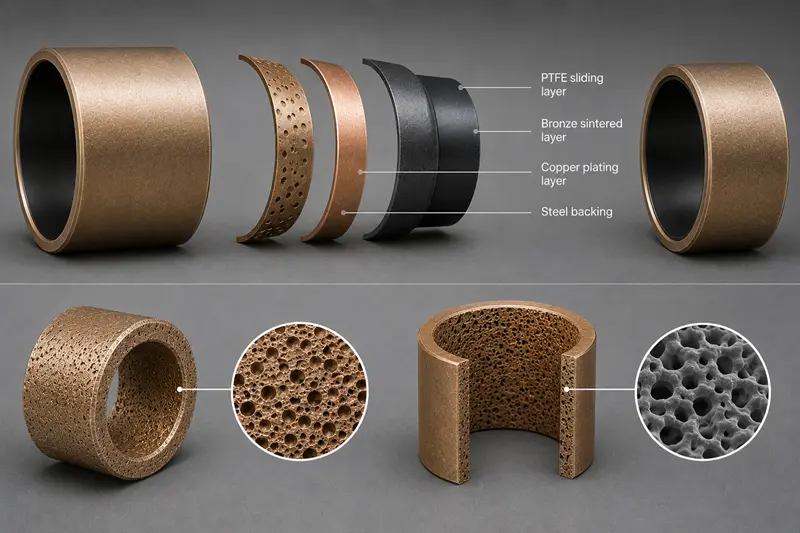
The real genius of maintenance-free bushings is in their material science. Each type is engineered for a different challenge. As a manufacturer, we work with these technologies every day. The goal is to embed a lubrication mechanism directly into the bushing's structure so it can perform reliably without outside help. Let's break down the most common methods we produce.
PTFE Composite Bushings
These are often called DU or DP4 bushings. They have a steel backing for strength, a porous bronze middle layer, and a top layer of a PTFE/filler mixture. The bronze layer holds the PTFE, and as the shaft moves, it draws out a tiny amount of this low-friction material to create a slick, self-lubricating film.
Sintered Oil-Impregnated Bushings
We make these by compressing metal powder (usually bronze or iron) into a shape and then heating it. This process, called sintering, creates a part that is about 20-30% porous. We then soak these bushings in a specialized oil, which fills all the tiny pores. During operation, heat and motion cause the oil to come to the surface and lubricate the shaft.
| Bushing Type | Lubrication Mechanism | Best For... |
|---|---|---|
| PTFE Composite | A solid transfer film of low-friction PTFE. | High load, low speed, dry running. |
| Sintered (Oil-Impregnated) | Oil stored in material pores is released. | High speed, low load, quiet operation (e.g., small motors). |
| Graphite-Plugged Bronze | Solid graphite plugs create a lubricating film. | High temperatures, dirty environments, high loads. |
| Engineering Plastic | Inherent low-friction properties of the material. | Light loads, corrosion resistance, complex shapes. |
Why Do Maintenance-Free Bushings Still Fail?
You installed a brand-new maintenance-free bushing, but it wore out or seized up way too soon. This unexpected downtime is frustrating and makes you question the technology itself.
Maintenance-free bushings fail when operating conditions like load, speed, temperature, or contamination exceed their designed limits[^8]. The most common reason for premature failure is choosing the wrong type of bushing for the application.
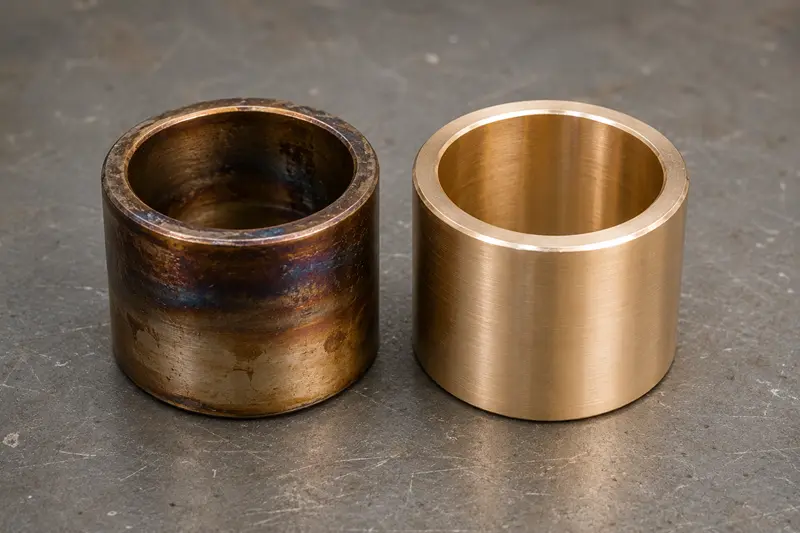
In my experience, almost every premature failure I've investigated comes back to one thing: a mismatch between the application and the bushing. A maintenance-free bushing isn't a universal solution[^9]; it's a precision-engineered component. If you put a bushing designed for low loads into a high-load environment, it will fail. If you use a type with a low temperature limit in a high-heat application, it will fail. This is the "selection cost" I mentioned earlier. The upfront engineering and analysis are non-negotiable[^10]. You must account for all the forces at play. Your supplier should be asking you about these factors. If they are not, they are not doing their job. A good manufacturer is a partner in making sure you get a part that will actually last.
| Operating Parameter | Impact on Bushing Life if Exceeded |
|---|---|
| Load (Pressure) | Can deform the bushing or accelerate wear of the lubricating layer. |
| Speed (Velocity) | Can generate excessive heat, breaking down the lubricant or material. |
| Temperature | Can cause material to soften, melt, or the lubricant to degrade. |
| Contamination | Abrasive particles (dirt, dust) can damage the soft lubricating layer. |
Conclusion
Maintenance-free bushings integrate lubrication to reduce labor and risk[^11]. However, their success depends entirely on proper selection based on load, speed, and environment to prevent premature failure.
[^1]: "Polygon's Maintenance-Free, Greaseless Composite Bushings ...", https://polygoncomposites.com/resources/maintenance-free-greaseless-composite-bushings-eliminate-corrosion-in-marine-motor-application/. This source explains the mechanisms behind maintenance-free bushings, including PTFE layers, stored oil, and solid lubricants. Evidence role: mechanism; source type: education. Supports: Maintenance-free bushings integrate lubrication directly into their material, eliminating the need for external greasing.. [^2]: "Polygon's Maintenance-Free, Greaseless Composite Bushings ...", https://polygoncomposites.com/resources/maintenance-free-greaseless-composite-bushings-eliminate-corrosion-in-marine-motor-application/. This source discusses the appeal of maintenance-free bushings for machinery managers. Evidence role: general_support; source type: education. Supports: The term "maintenance-free" is appealing to machinery managers due to its implications of reduced maintenance.. [^3]: "iglide® Plastic Bushings: The Self-Lubricating Effect | igus®", https://www.igus.com/company/self-lubrication-for-bearings?srsltid=AfmBOoqHkMrCsxV6wA_r1ynMDdI09Zzhb9K6Zaaq1-lekwmZgeKzAGbC. This source explains the differences between traditional and maintenance-free bushings, emphasizing the passive nature of traditional bushings. Evidence role: definition; source type: education. Supports: Traditional bushings are passive components that rely on external lubrication schedules.. [^4]: "Understanding Bushings: A Comprehensive Guide - SC Industries, Inc.", https://www.scindustriesinc.com/blog/understanding-bushings-a-comprehensive-guide/. This source supports the claim that matching bushings to machine demands is critical for their success. Evidence role: expert_consensus; source type: education. Supports: Matching bushings to machine demands is critical for their success.. [^5]: "[PDF] Performance of PTFE-Lined Composite Journal Bearings", https://ntrs.nasa.gov/api/citations/19820009389/downloads/19820009389.pdf. This source provides details on how PTFE composite bushings use a low-friction surface for self-lubrication. Evidence role: mechanism; source type: education. Supports: PTFE composite bushings use a low-friction surface for self-lubrication.. [^6]: "[PDF] Solid Lubrication Fundamentals and Applications", https://ntrs.nasa.gov/api/citations/19980218923/downloads/19980218923.pdf. This source discusses how graphite-plugged bushings create a solid lubricating film and their suitability for high-temperature environments. Evidence role: mechanism; source type: education. Supports: Graphite-plugged bushings create a solid lubricating film during operation.. [^7]: "Machining up the new bushings using polyurethane plastic ...", https://www.facebook.com/cuttingedgeengineeringaustralia/videos/machining-up-the-new-bushings-using-polyurethane-plastic-machinist-cuttingedgeen/1283743786924537/. This source explains how engineering plastic bushings use inherent material properties for self-lubrication. Evidence role: mechanism; source type: education. Supports: Engineering plastic bushings rely on their material properties for self-lubrication.. [^8]: "Why Bushings Fail - Millstream Engineering", https://www.millstreamengineering.com/why-bushings-fail/. This source outlines the factors that lead to the failure of maintenance-free bushings, including load, speed, temperature, and contamination. Evidence role: mechanism; source type: education. Supports: Maintenance-free bushings fail when operating conditions exceed their designed limits.. [^9]: "What are the benefits and drawbacks of bushings vs bearings?", https://www.facebook.com/groups/cr18p/posts/1413661140018625/. This source explains why maintenance-free bushings are not universal solutions and must be matched to specific applications. Evidence role: expert_consensus; source type: education. Supports: Maintenance-free bushings are not universal solutions and must be matched to specific applications.. [^10]: "Shape Optimization of Rubber Bushing Using Differential Evolution ...", https://pmc.ncbi.nlm.nih.gov/articles/PMC4168157/. This source emphasizes the importance of upfront engineering and analysis in selecting maintenance-free bushings. Evidence role: expert_consensus; source type: education. Supports: Upfront engineering and analysis are critical for selecting maintenance-free bushings.. [^11]: "The Benefits of Self-Lubricating Bushings for Maintenance-Free ...", https://www.zjbushing.com/the-benefits-of-self-lubricating-bushings-for-maintenance-free-operation/. This source supports the claim that maintenance-free bushings reduce labor and risk by integrating lubrication. Evidence role: general_support; source type: education. Supports: Maintenance-free bushings reduce labor and risk by integrating lubrication..