You carefully select materials and get a great price for your bushings. But in assembly, parts seize up or fail early. The hidden cause is often poor tolerance control, which truly decides if a part works.
For OEM bushings, precise tolerance control is essential to guarantee consistent assembly[^1], the correct operating clearance after press-fitting, and reliable long-term performance. Without it, even bushings made from the right material can cause machine seizure, excessive noise, and premature wear, disrupting production and increasing costs.
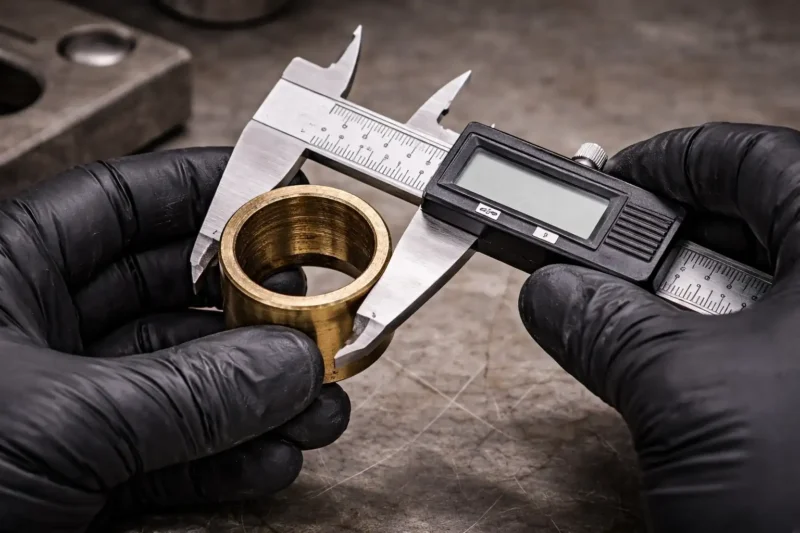
A bushing is never a standalone component. It has to work perfectly with a shaft and a housing. Its entire job depends on the tiny space—the clearance—between these parts. If that space is wrong because the dimensions are off, problems are inevitable. From my years in manufacturing, I’ve seen this happen time and again. It's the small details in dimensions that make the biggest difference in performance. Let’s dig into why this is so critical for your production.
What Happens When Bushing Dimensions Change After Press-Fitting?
You get a new batch of bushings, and they measure perfectly. But when your team presses them into the housing, the shaft suddenly won't fit. This frustrating problem comes from not planning for how a bushing changes shape during installation.
When a bushing is press-fit into a housing, its inner diameter (ID) naturally gets smaller[^2]. If the manufacturer doesn't account for this shrinkage, the final operating clearance will be too tight. This leads directly to higher friction, heat, shaft seizure, or very fast wear.
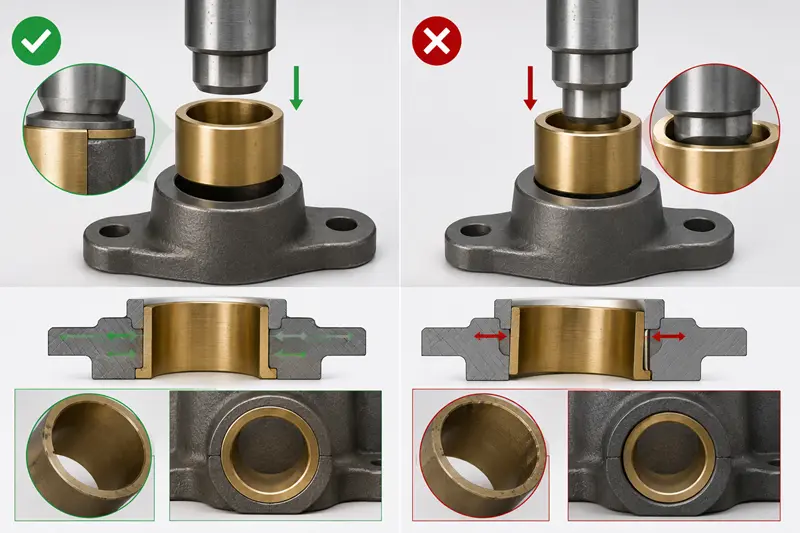
Think of a bushing as a springy metal ring. When you force it into a slightly smaller hole (the housing bore), the bushing gets squeezed. This pressure causes the inner hole of the bushing to shrink. As a manufacturer, our job is to predict exactly how much it will shrink. We have to make the bushing's free-state ID slightly larger than the final target dimension. This way, after it's pressed in and shrinks, it ends up at the perfect size to accept the shaft with the correct operating clearance.
I remember a client in the agricultural machinery sector who faced constant field failures. Their bushings were seizing up. We found their previous supplier was making parts that were perfect in a free state but failed to account for a 0.05mm reduction in the ID after press-fitting. This tiny error was enough to eliminate the running clearance completely.
| Parameter | Free State (As Delivered) | Post-Press-Fit (In Housing) | Outcome |
|---|---|---|---|
| Bushing ID (Incorrect) | 50.025 mm (In Spec) | 49.975 mm | Shaft (50.000 mm) seizes |
| Bushing ID (Correct) | 50.075 mm (Intentionally larger) | 50.025 mm | Correct clearance, smooth operation |
This isn't just about high precision; it's about understanding the physics of assembly[^3]. A reliable supplier doesn't just machine a dimension; they engineer a part that works in its final assembled state.
Why Are Concentricity and Roundness So Critical for Bushing Performance?
Your machine is making a strange noise, and you find the bushings are wearing out on just one side. You check the material and the basic diameters, and they seem fine. The problem is likely hidden in the bushing's geometry: poor concentricity or roundness.
Poor concentricity or roundness creates uneven contact between the bushing and the shaft. This focuses the entire load onto a small spot, causing high pressure and rapid, one-sided wear. For precision equipment like motors or hydraulic pumps, this directly harms performance, creates noise, and shortens the machine's life.
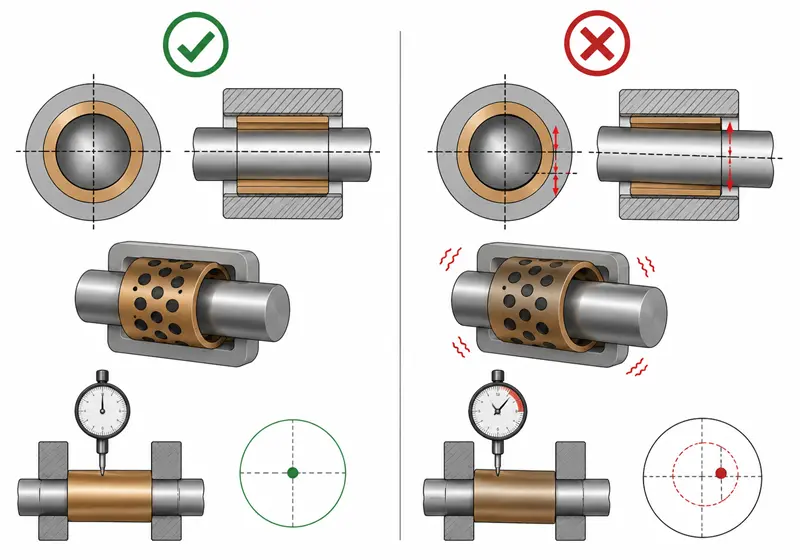
Let's break these two terms down.
- Roundness means how perfectly circular the bushing's hole is.
- Concentricity means the center of the inner hole is perfectly aligned with the center of the outer diameter.
If either is off, the wall thickness becomes uneven. When the shaft spins, it won't be supported evenly around its full circumference. Instead, it will press hard against the thickest part of the bushing wall. This is like a car tire being out of balance—it creates vibration and uneven wear. In a bushing, this "point loading" can quickly destroy the self-lubricating layer[^4] or wear down the metal, leading to failure. For OEM projects in automotive, hydraulics, or electric motors, this is a major concern because it directly affects noise levels (NVH - Noise, Vibration, and Harshness[^5]) and overall product quality.
| Geometry Quality | Load Distribution | Wear Pattern | Result for Machine |
|---|---|---|---|
| Good | Evenly spread across the surface | Uniform and slow | Quiet, reliable, long life |
| Poor | Concentrated on one point/edge | Rapid and uneven | Noisy, vibration, premature failure |
Achieving good concentricity and roundness isn't an accident. It requires mature manufacturing processes and strict quality control[^6]. It's a key indicator that you're working with a factory that understands how to produce reliable, high-performance parts, not just simple metal rings.
How Does Inconsistent Tolerance Affect Your OEM Production Line?
Your automated assembly line is built for speed. But it keeps stopping because some bushings from a batch are too tight, while others are too loose. Your team has to step in for manual rework, destroying your efficiency. This is a direct result of a supplier's poor batch-to-batch consistency.
For OEM mass production, consistent tolerance is about every part being a reliable copy of the last[^7]. Dimensional changes across a batch can shut down automated lines, drive up labor costs for manual fitting, and increase your total cost of ownership far beyond any initial price savings.
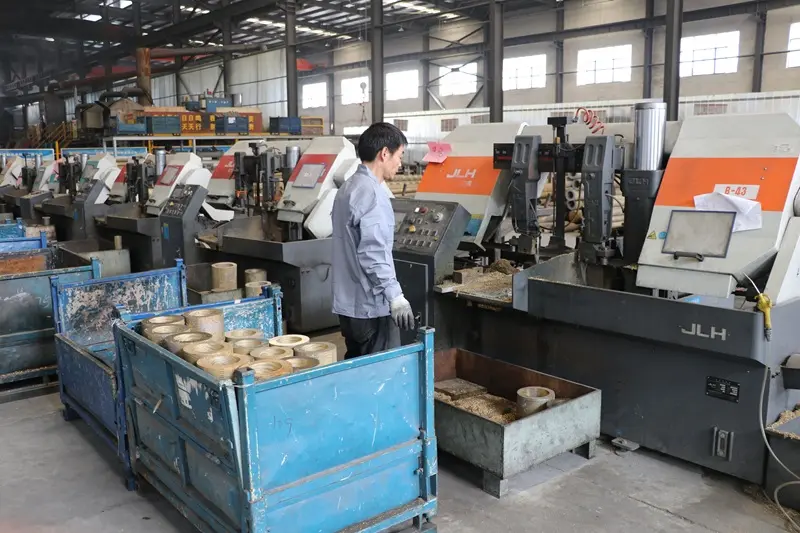
In B2B manufacturing, the cost of a single bushing is tiny compared to the cost of production downtime[^8]. If an assembly robot stops because a bushing won't press in correctly[^9], you lose money every second the line is idle. This is why, from a factory perspective, our focus is on repeatability. A single "perfect" sample is meaningless if the 10,000th piece is out of spec. We manage this by tightly controlling key parameters for every batch[^10].
Key controlled parameters for batch consistency include:
- Inner Diameter (ID) & Outer Diameter (OD)
- Length & Wall Thickness
- Roundness & Concentricity
- Surface Roughness
- Flange dimensions and oil groove positions
A few cents saved on a cheaper bushing can end up costing you hundreds or thousands of dollars in lost productivity and rework.
| Risk of Inconsistent Tolerances | Direct Impact on OEM Production |
|---|---|
| Assembly Line Stoppage | Lost output, idle machinery, schedule delays. |
| Manual Rework | Increased labor costs, lower efficiency, risk of assembly errors. |
| Inconsistent Final Product | Higher warranty claims, customer complaints, damage to brand reputation. |
A true manufacturing partner understands this risk. We see tolerance control not as a goal in itself, but as a method to guarantee your production runs smoothly and your final product is dependable.
Conclusion
Ultimately, bushing tolerance control is not just a technical detail. It ensures your parts assemble correctly, perform reliably, and support efficient production, making it fundamental to your success.
[^1]: "Why are Tolerances Important in Manufacturing?", https://www.pacific-research.com/why-are-tolerances-important-in-manufacturing-prl/. Precise tolerance control ensures that bushings fit correctly during assembly, maintaining the required operating clearance and preventing mechanical issues such as seizure or wear. Evidence role: mechanism; source type: education. Supports: Precise tolerance control is essential for consistent assembly and reliable long-term performance of bushings.. [^2]: "Interference fit - Wikipedia", https://en.wikipedia.org/wiki/Interference_fit. Press-fitting a bushing into a housing typically reduces its inner diameter due to material compression, which must be accounted for during design. Evidence role: mechanism; source type: research. Supports: Press-fitting a bushing into a housing causes its inner diameter to shrink, affecting operating clearance.. Scope note: The degree of ID reduction may vary depending on material properties and press-fit conditions. [^3]: "Educational Resources: Physics - U.S. National Science Foundation", https://www.nsf.gov/focus-areas/physics/educational-resources. Understanding the physics of assembly is crucial for designing components like bushings that perform reliably in their final assembled state. Evidence role: expert_consensus; source type: education. Supports: Understanding the physics of assembly is essential for designing reliable bushings.. Scope note: The application of assembly physics may vary depending on the specific engineering context. [^4]: "Self-Lubricating Materials for Extreme Condition Applications - PMC", https://pmc.ncbi.nlm.nih.gov/articles/PMC8510052/. The self-lubricating layer in bushings reduces friction and wear, enhancing their performance and lifespan. Evidence role: mechanism; source type: research. Supports: The self-lubricating layer in bushings reduces friction and wear, improving performance.. Scope note: The effectiveness of the self-lubricating layer may depend on the material and operating conditions. [^5]: "Noise, vibration, and harshness - Wikipedia", https://en.wikipedia.org/wiki/Noise,_vibration,_and_harshness. Noise, Vibration, and Harshness (NVH) are critical factors in evaluating the performance of mechanical components, including bushings. Evidence role: definition; source type: encyclopedia. Supports: NVH is a key metric for assessing the performance of bushings in precision equipment.. Scope note: The relevance of NVH may vary depending on the specific application of the bushing. [^6]: "5 Things You Need to Know About OD/ID Concentricity", https://metalcutting.com/knowledge-center/5-things-you-need-to-know-about-odid-concentricity/. Mature manufacturing processes and strict quality control are essential for achieving high concentricity and roundness in bushings. Evidence role: expert_consensus; source type: education. Supports: Mature manufacturing processes and strict quality control ensure high concentricity and roundness in bushings.. Scope note: The effectiveness of these processes may depend on the specific manufacturing technology used. [^7]: "Understanding Process Tolerance And Its Importance", https://www.crossco.com/resources/technical/understanding-process-tolerance-and-its-importance/. Consistent tolerance ensures that each manufactured part meets the same specifications, which is critical for automated assembly lines. Evidence role: mechanism; source type: education. Supports: Consistent tolerance is crucial for reliable mass production and automated assembly lines.. Scope note: The importance of tolerance consistency may vary depending on the complexity of the assembly process. [^8]: "The Cost of Downtime in Manufacturing", https://fourjaw.com/blog/the-cost-of-downtime-in-manufacturing. Production downtime due to tolerance issues can lead to significant financial losses, especially in automated manufacturing environments. Evidence role: statistic; source type: institution. Supports: Production downtime caused by tolerance issues results in financial losses for manufacturers.. Scope note: The financial impact may vary depending on the scale and industry of the production line. [^9]: "Failure Is an Option: How the Severity of Robot Errors Affects Human ...", https://publications.ri.cmu.edu/failure-is-an-option-how-the-severity-of-robot-errors-affects-human-robot-interaction. Assembly robots can halt production if components like bushings fail to meet tolerance specifications, disrupting automated processes. Evidence role: case_reference; source type: institution. Supports: Tolerance issues in bushings can cause assembly robots to stop, disrupting production.. Scope note: The specific impact depends on the type of assembly robot and production setup. [^10]: "Batch-to-Batch Consistency in Manufacturing - Hockmeyer", https://hockmeyer.com/blog/articles/batch-to-batch-consistency-challenge/. Controlling key parameters like ID, OD, and roundness ensures batch consistency in bushing manufacturing, critical for OEM production. Evidence role: mechanism; source type: education. Supports: Controlling key parameters ensures batch consistency in bushing manufacturing for OEM production.. Scope note: The specific parameters may vary depending on the bushing design and application.