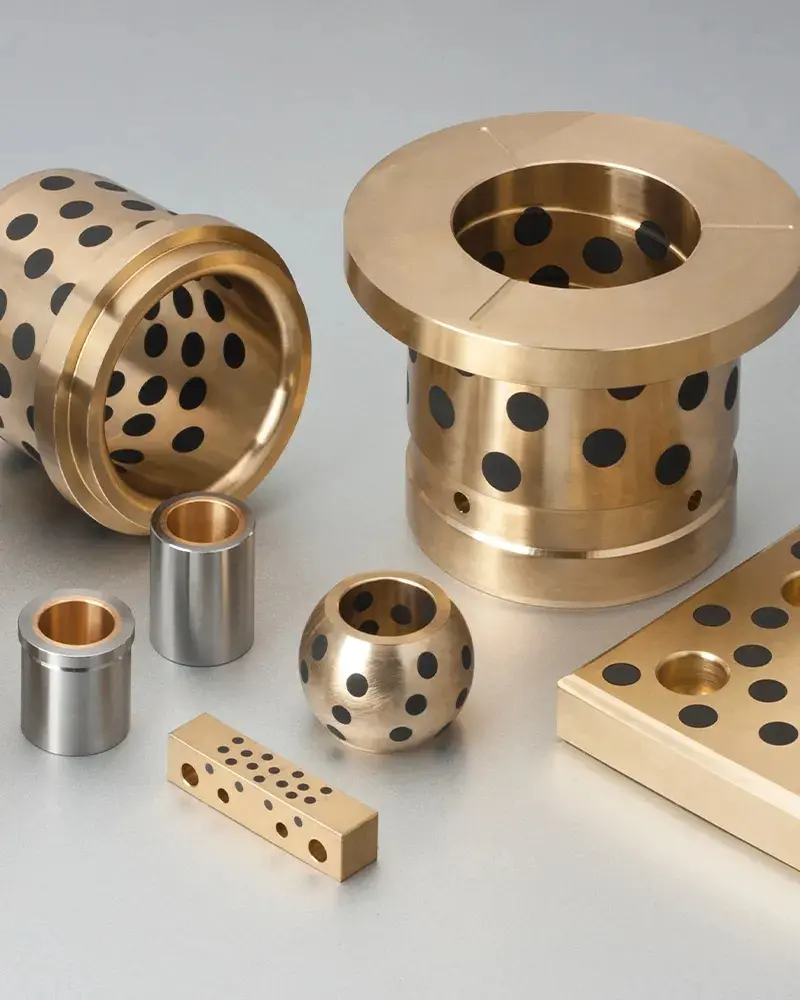
Choosing the right bushing feels simple, but a mistake leads to equipment failure or wasted money. You need a reliable part, but the wrong choice can cause unexpected downtime or budget overruns.
The fundamental difference is function, not just shape. Sleeve bushings are for radial loads only.[^1] Flanged bushings handle both radial loads and provide axial location, making them suitable for applications with thrust forces.
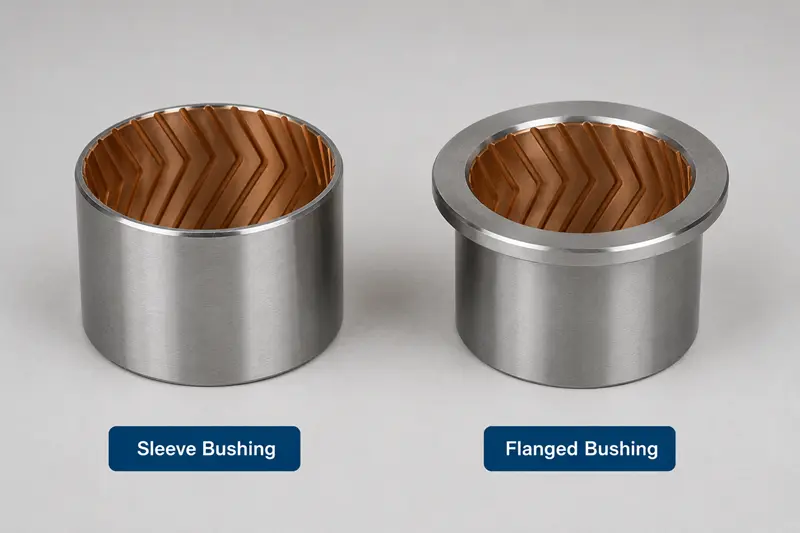
From the outside, the difference seems obvious. One has a flange, the other doesn't. But as a manufacturer, I can tell you the most important distinction isn't what you can see. It's about the forces you can't see. Understanding this difference is crucial for any OEM buyer or engineer looking for long-term reliability.[^2] Let's break down what really matters when you're making a choice between these two components, so you can get the performance you need without overpaying.
When Should You Choose a Simple Sleeve Bushing?
You need a solid bearing for a rotating shaft, but your budget is tight and space is limited. Over-engineering with a complex part feels wasteful, but you worry a simpler one might fail.
Choose a sleeve bushing when your application primarily involves radial loads, meaning the force is perpendicular to the shaft. They are ideal for compact designs, cost-sensitive projects, and high-volume production where axial movement is minimal.
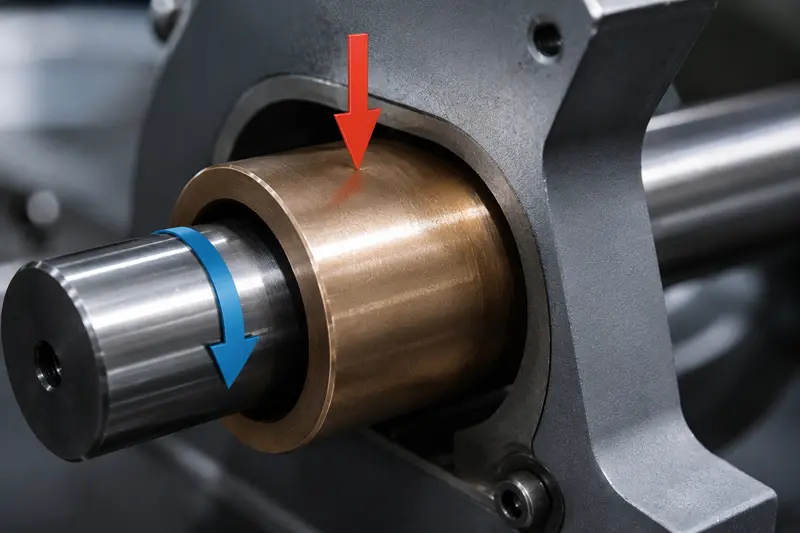
A sleeve bushing, also known as a plain sleeve or journal bearing, is designed for one primary job: to support a rotating shaft and handle forces that are applied radially. Think of a force pushing down on the side of the shaft. This is a radial load. Sleeve bushings excel here because their entire cylindrical surface area works to distribute this pressure, reducing friction and wear.[^3]
Focusing on Radial Support
The simple, cylindrical shape is its biggest strength. There is no complex geometry, which makes it incredibly efficient for its specific purpose. It provides a smooth, consistent surface for the shaft to rotate within. This is why you see them everywhere in applications where the main movement is pure rotation.
Cost and Space Efficiency
From a manufacturing standpoint, simplicity equals cost-effectiveness.[^4] Sleeve bushings require less material and fewer manufacturing steps than their flanged counterparts. This makes them the perfect choice for high-volume production and projects where every cent counts. Their compact, straight profile also means they fit into tight spaces where a flange would get in the way.
| Sleeve Bushing Characteristics | Ideal Use Cases |
|---|---|
| Simple cylindrical shape | Electric Motors & Pumps |
| Handles radial loads only | Gearboxes |
| Cost-effective in high volumes | General machinery pivots |
| Compact, space-saving design | Conveyor rollers |
What Problems Does a Flanged Bushing Solve?
Your shaft not only rotates but also tends to shift sideways, causing wear on the housing. This axial movement creates noise, misalignment, and can lead to the premature failure of the entire joint.
A flanged bushing solves two problems at once. It provides radial support for rotation and uses its flange as a thrust surface to prevent axial movement. It is essential for applications with combined loads.
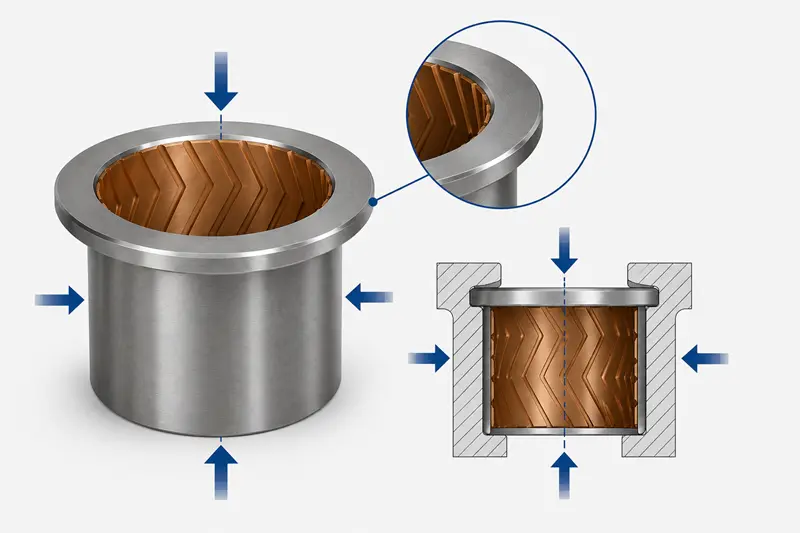
The flange is more than just an add-on; it fundamentally changes the bushing's capability. It allows the component to manage forces in two different directions. While the cylindrical body of the bushing handles the radial load just like a sleeve bushing, the flange takes on any axial, or thrust, loads. This is the force that tries to push the shaft along its length.
Combining Radial and Axial Support
The flange acts as a built-in thrust washer.[^5] When the shaft or connected components try to move sideways, they push against the face of the flange. This prevents axial drift, protects the housing from wear, and keeps the entire assembly in its correct position. This dual-functionality is critical in many types of machinery where movement isn't just simple rotation.[^6]
The Importance of Positive Location
The flange also provides a huge benefit during assembly. It creates a positive stop, ensuring the bushing is installed to the correct depth every time.[^7] This prevents the bushing from being pushed too far into the housing or migrating out of position during operation, which is a common failure mode in applications with vibration or intermittent thrust loads.
| Flanged Bushing Function | Solved Problem |
|---|---|
| Cylindrical Body | Provides radial support for rotation. |
| Flange Face | Acts as a thrust surface, handling axial loads. |
| Flange Edge | Provides positive location during assembly. |
| Prevents Migration | Stops the bushing from moving inside the housing. |
This makes flanged bushings essential for construction equipment hinges, hydraulic cylinder pivots, and automotive linkages where forces come from multiple directions.
How Do OEM Buyers Avoid Common Selection Mistakes?
It’s easy to assume a flanged bushing is an "upgrade" or that a sleeve bushing is always the cheaper, lesser option. These assumptions can lead to over-specifying parts or, worse, under-specifying them and causing failures.
Avoid mistakes by analyzing your application's forces. If there is no axial force, a flanged bushing adds cost and takes up space for no reason. If axial forces exist, using a sleeve bushing will lead to rapid wear and failure.
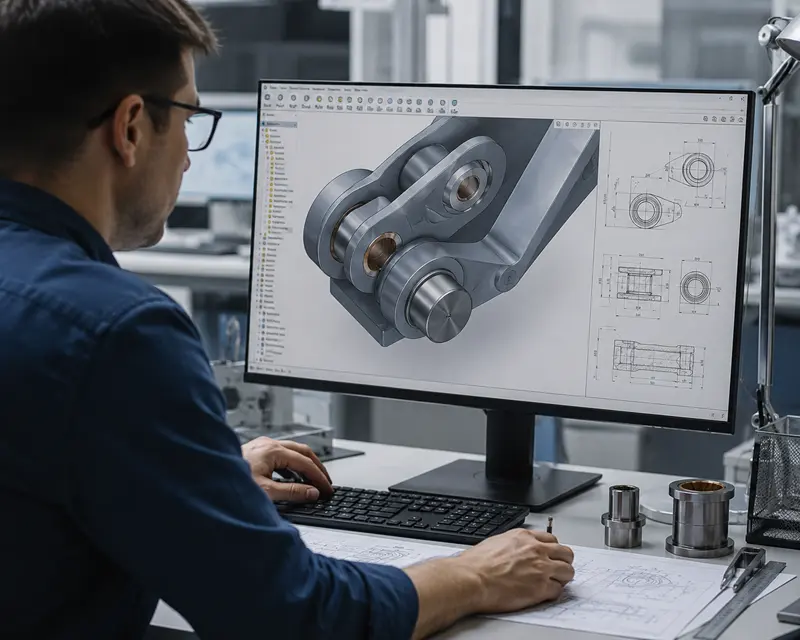
From our factory floor, the right choice is always the one that matches the application's true needs. It's not about "good" vs. "better"; it's about "fit for purpose." Choosing the wrong one has direct consequences on cost, performance, and reliability.[^8] Over-engineering by using a flanged bushing where it's not needed wastes material and budget.[^9] Under-engineering by using a sleeve bushing where an axial load exists is a guarantee for a future warranty claim.[^10]
A Simple Decision Framework
As a buyer, you can make the right call by asking three simple questions about your application:
-
Is there a significant axial force or thrust load? (e.g., from helical gears, linkages, or gravity on a vertical axis)
- Yes: A flanged bushing is almost certainly required.
- No: A sleeve bushing is likely sufficient.
-
Do I need a hard stop for precise axial positioning during assembly?
- Yes: The flange provides excellent positive location.
- No: A sleeve bushing can be press-fit to the correct position.
-
Is the design extremely space-constrained or cost-sensitive, with only radial loads?
- Yes: The sleeve bushing is the optimal choice.
The Cost of a Mismatch
Let's be clear about the consequences. It helps to visualize what goes wrong.
| Mismatch Scenario | Consequence |
|---|---|
| Flanged Bushing in a Radial-Only Application | Wasted material, higher part cost, increased space requirement, no performance benefit. |
| Sleeve Bushing in a Combined-Load Application | End-face of the shaft grinds against the housing, bushing migrates out of the hole, noise, increased friction, and eventual joint failure. |
Your decision should be driven by engineering reality. Look at the forces in your system.[^11] This analysis is the key to sourcing the most reliable and cost-effective component for your equipment.
Conclusion
The choice between sleeve and flanged bushings is not about complexity. It's about matching the bushing's function—radial support vs. radial plus axial—to your equipment's specific load requirements.
[^1]: "Essential Components for Mechanical Engineers - Five Flute", https://www.fiveflute.com/guide/bearings-and-bushings-essential-components-for-mechanical-engineers/. This source explains the mechanical design and load-handling capabilities of sleeve bushings, confirming their suitability for radial loads. Evidence role: mechanism; source type: education. Supports: Sleeve bushings are designed to handle radial loads exclusively.. [^2]: "High-Reliability Switchgear Bushing – Design, Types, Materials ...", https://chinadegatech.com/high-reliability-switchgear-bushing-design-types-materials-applications-guide/. This source highlights the importance of selecting the correct bushing type for reliability in mechanical systems. Evidence role: expert_consensus; source type: institution. Supports: Choosing the correct bushing type is essential for ensuring long-term reliability in mechanical systems.. Scope note: The source may focus on specific industries or applications rather than general reliability concerns. [^3]: "All You Need to Know About Bushing Sleeves - CNRL-Fastener", https://www.rlfasteners.com/blog/automotive-fastener/bushing-sleeves/all-you-need-to-know-about-bushing-sleeve/. This source explains how the cylindrical design of sleeve bushings reduces friction and wear under radial loads. Evidence role: mechanism; source type: education. Supports: The cylindrical design of sleeve bushings helps distribute pressure, reducing friction and wear under radial loads.. [^4]: "How can you design mechanical systems that are both cost-effective ...", https://www.linkedin.com/advice/0/how-can-you-design-mechanical-systems-both-amtre. This source discusses how simpler manufacturing processes reduce costs in mechanical component production. Evidence role: mechanism; source type: education. Supports: Simpler manufacturing processes make sleeve bushings cost-effective.. Scope note: The cost-effectiveness may vary depending on material and production scale. [^5]: "Custom Steel & Brass Flange Bushings - Bushing Manufacturers USA", https://norwoodscrewmachine.com/product/flange-bushings/. This source explains how the flange in flanged bushings functions as a thrust washer to handle axial loads. Evidence role: mechanism; source type: education. Supports: The flange in flanged bushings functions as a built-in thrust washer to handle axial loads.. [^6]: "Understanding Bushings - YouTube", https://www.youtube.com/watch?v=IbvNhSrI_A0. This source highlights the importance of dual-functionality in bushings for machinery with complex movements. Evidence role: general_support; source type: institution. Supports: Dual-functionality in bushings is essential for machinery with complex movements.. Scope note: The source may focus on specific machinery types rather than general applications. [^7]: "[PDF] High Pressure Flange Design - ucf stars", https://stars.library.ucf.edu/context/rtd/article/1000/viewcontent/24352.pdf. This source explains how the flange design ensures correct installation depth in mechanical assemblies. Evidence role: mechanism; source type: education. Supports: The flange design ensures correct installation depth in mechanical assemblies.. [^8]: "More Than Just a Broken Part: Analysis of Mechanical Failures", https://forensicdjs.com/more-than-just-a-broken-part-analysis-of-mechanical-failures/. This source discusses the impact of incorrect component selection on cost, performance, and reliability in mechanical systems. Evidence role: general_support; source type: institution. Supports: Incorrect component selection directly affects cost, performance, and reliability in mechanical systems.. Scope note: The source may focus on specific industries or applications rather than general consequences. [^9]: "Research may curb economic losses to electrical power plants after ...", https://engineering.tamu.edu/news/2020/09/research-may-curb-economic-losses-to-electrical-power-plants-after-earthquakes.html. This source discusses the economic and material inefficiencies of over-engineering mechanical components. Evidence role: general_support; source type: institution. Supports: Over-engineering by using unnecessary flanged bushings leads to material and budget inefficiencies.. Scope note: The source may focus on specific industries or applications rather than general over-engineering concerns. [^10]: "Thermal failure of rubber bushing of a Positive Displacement Motor", https://www.sciencedirect.com/science/article/abs/pii/S135943111400252X. This source explains how under-engineering bushings for axial loads can lead to mechanical failures and warranty claims. Evidence role: case_reference; source type: institution. Supports: Under-engineering bushings for axial loads can lead to mechanical failures and warranty claims.. Scope note: The source may provide examples from specific industries rather than general cases. [^11]: "1 Introduction to Machine Design", https://www.purdue.edu/freeform/me354/wp-content/uploads/sites/28/2022/06/220607_ME354_LectureNotes_BHess.pdf. This source emphasizes the importance of force analysis in mechanical system design. Evidence role: expert_consensus; source type: education. Supports: Force analysis is crucial for selecting the correct mechanical components.. Scope note: The source may focus on specific types of mechanical systems rather than general force analysis principles.