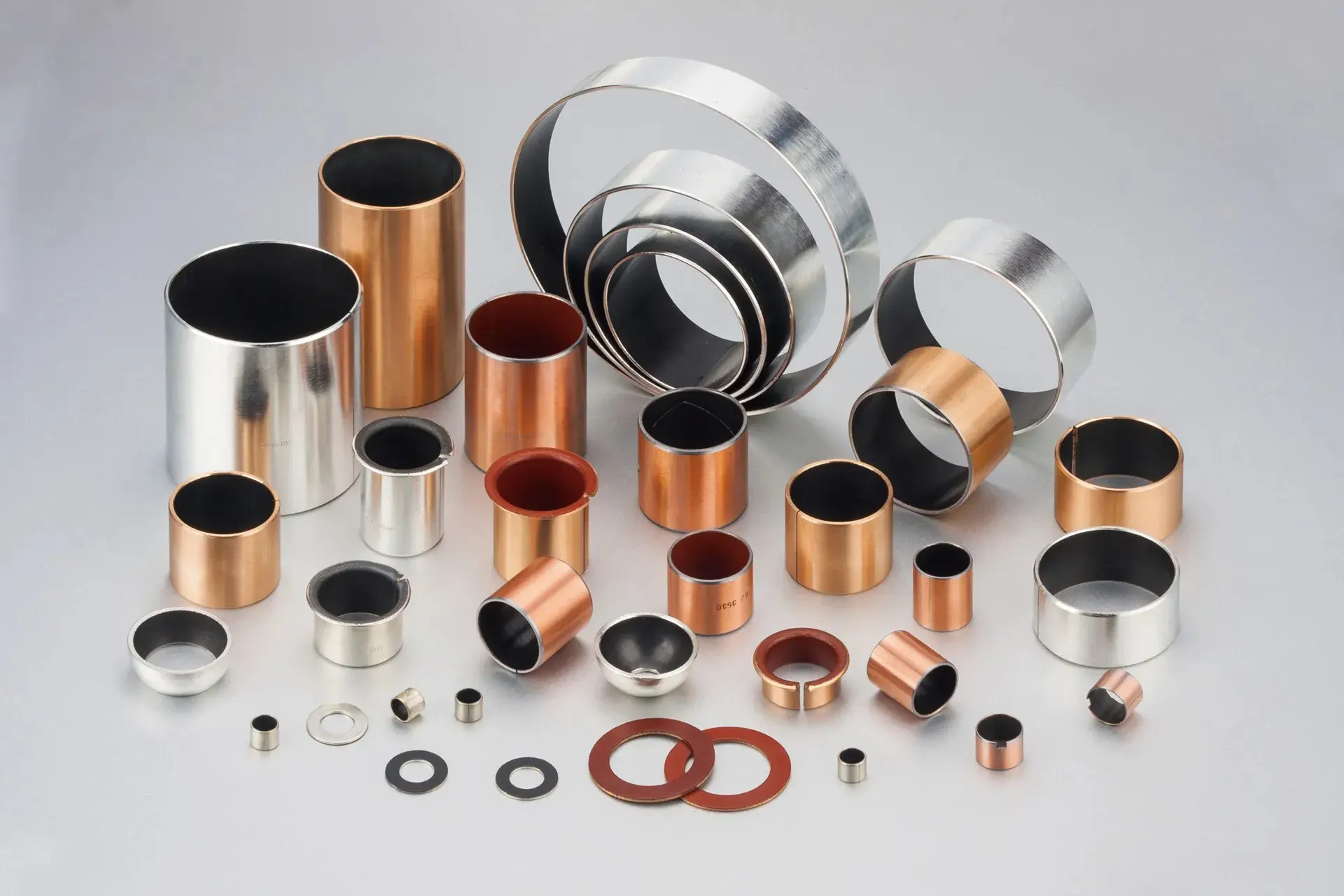
Struggling with PTFE bushings that wear out in the heat? You expect durability, but they fail fast, costing you time and money in replacements and downtime.
PTFE bushings often fail at high temperatures because the heat exceeds the stable range of their composite structure.[^1] The PTFE layer softens, thermal expansion reduces clearance, and the bonding layer can degrade. This leads to rapid wear and seizure, especially under high loads.
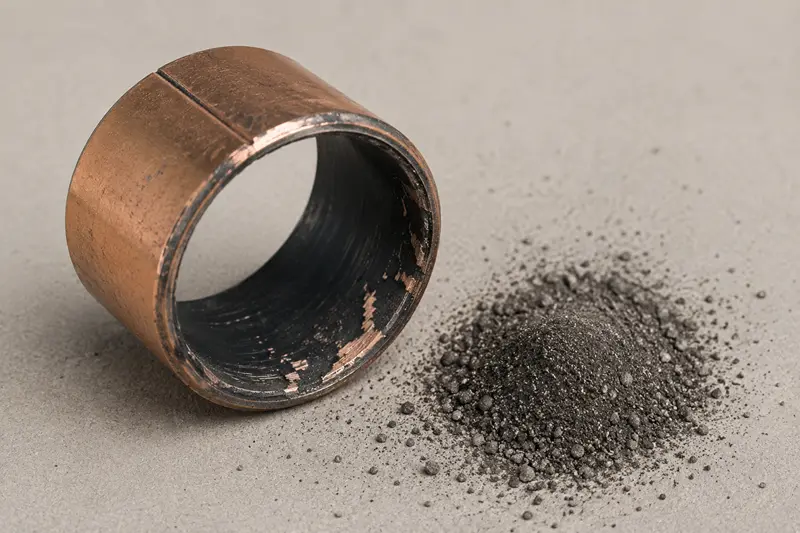
Many of our OEM clients come to us with this exact problem. They choose PTFE bushings for their self-lubricating properties but are surprised when they don't hold up in hot environments. As a factory, we see this all the time. The key is understanding that the failure isn't random; it's a predictable result of pushing the material beyond its limits. Understanding how it fails is the first step to choosing the right bushing for your application. Let's break down the specific reasons this happens.
How Does Heat Directly Damage the PTFE Layer?
Your PTFE friction layer seems to just disappear under heat. You expected a long service life, but now you're facing constant replacements and frustrating machine downtime. What's going on?
High temperatures cause the PTFE polymer to soften and lose its structural integrity.[^2] This makes it much more susceptible to abrasive wear from the shaft. The friction layer thins out quickly, its self-lubricating ability decreases, and the bushing's lifespan is drastically reduced.
From our manufacturing perspective, the most important thing to remember is that PTFE is a polymer, not a metal. It behaves very differently under heat. Long before it reaches its melting point, it goes through a "glass transition" phase where it begins to soften significantly. Think of it like trying to scrape cold, hard butter versus warm, soft butter. The same principle applies here. When the PTFE layer softens, the rotating or sliding shaft can easily scrape it away. This process rapidly thins the self-lubricating layer, which is the whole reason you chose a PTFE bushing in the first place.
This softening also dramatically lowers the bushing's load-carrying capacity, which directly impacts its PV (Pressure-Velocity) limit. The PV rating you see on a data sheet is almost always measured at room temperature.[^3] At higher temperatures, that rating drops significantly. This creates a dangerous cycle: the softened material increases friction, which generates more heat, which softens the material even more. This feedback loop is a primary cause of premature failure.[^4]
| Temperature | PTFE State | Wear Resistance | PV Limit | Failure Risk |
|---|---|---|---|---|
| Room Temperature | Solid, Stable | High | Normal | Low |
| Elevated Temp | Softening | Decreasing | Reduced | Medium |
| High Temp | Significantly Soft | Low | Very Low | High |
What Role Does Thermal Expansion Play in Failure?
Your machine suddenly seizes up in a high-heat environment. The bushing seemed fine, but now it's stuck. This unexpected stoppage brings your entire operation to a halt.
PTFE composite bushings have a much higher coefficient of thermal expansion than the steel housing or shaft they are fitted into.[^5] As temperature rises, the bushing expands inward, reducing the operating clearance. This causes binding, increased friction, and eventual seizure of the shaft.
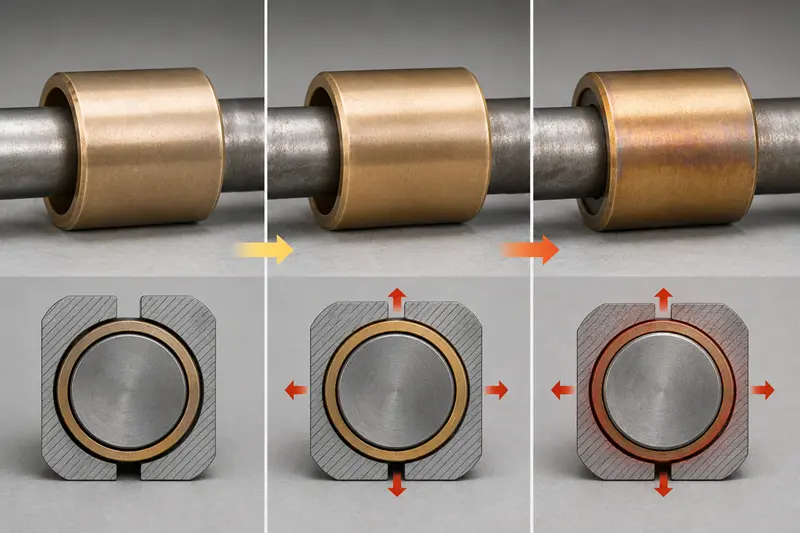
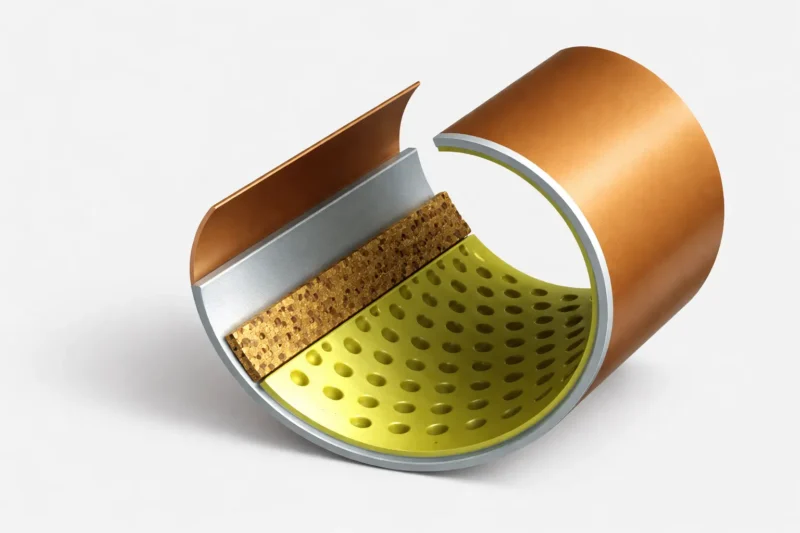
This is a failure mode we often discuss with our OEM customers during the design phase. It's a classic case of material mismatch. A typical self-lubricating bushing is a composite structure: a steel backing, a sintered bronze layer, and a PTFE/filler top layer. Steel and PTFE expand at very different rates when heated. The PTFE layer wants to expand much more than its steel backing will allow. Since it's bonded to the steel, it has nowhere to go but inward, into the small gap designed for the shaft to rotate freely. This gap is called the running clearance.[^6]
A properly designed system has a specific running clearance calculated for its operating conditions.[^7] But as thermal expansion eats away at this clearance, the space disappears. Once the clearance is gone, the shaft and the bushing are in direct, high-pressure contact. This dramatically increases friction and generates a huge amount of extra heat, which in turn causes even more expansion. It's a rapid, self-reinforcing cycle that ends in seizure, where the shaft becomes completely stuck. This is why we always stress the importance of calculating clearance based on the maximum operating temperature, not just room temperature.
How Do High Loads and Speeds Make Things Worse?
You have an application with high loads, and you chose a PTFE bushing for its low friction. But under high heat, this combination becomes deadly, and failures happen without warning.
High loads and high speeds generate their own frictional heat, which adds to the ambient temperature.[^8] This combined heat accelerates the softening of the PTFE layer. The bushing's PV (Pressure-Velocity) limit is quickly exceeded, leading to rapid wear, material transfer, and failure.
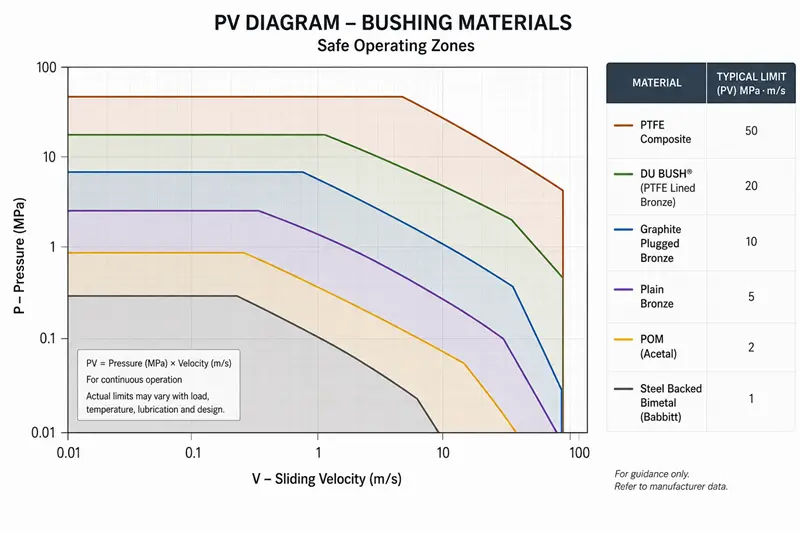
In our factory, we constantly refer to the PV limit. It's the maximum combination of pressure (load) and velocity (speed) a bushing can handle before it starts to break down. A critical mistake many buyers make is looking at a PV rating on a spec sheet and assuming it's a fixed number. It's not. The true PV limit of a bushing is highly dependent on temperature.[^9] As the temperature goes up, the PV limit goes down.
Let's look at how the heat builds up. First, you have the ambient heat from the operating environment. Second, the friction from the load and speed creates its own heat right at the contact surface. The total heat the bushing experiences is the sum of these two sources (Ambient Heat + Frictional Heat). If this total temperature is too high, it pushes the PTFE layer into its softened state. This increases friction, which generates even more heat, and the PV limit is quickly surpassed. This is why the combination of high temperature, high load, dry friction, and continuous operation is the absolute worst-case scenario for a standard PTFE composite bushing. For these demanding jobs, we often guide customers toward other solutions, like a solid bronze bushing with custom lubrication grooves.
Conclusion
PTFE bushings fail at high temperatures because heat degrades the material structure and reduces clearance.[^10] Always match the bushing's temperature limits, PV value, and design to your specific operating conditions.
[^1]: "Thermal behavior of polytetrafluoroethylene in the sintering process", https://ui.adsabs.harvard.edu/abs/2022TSEP...3001247T/abstract. This source explains the thermal limitations of PTFE bushings and their behavior under high temperatures. Evidence role: mechanism; source type: research. Supports: PTFE bushings fail at high temperatures due to heat exceeding their composite structure's stable range.. Scope note: The source may not address specific composite structures or all operating conditions. [^2]: "The Effect of Crystallinity on Compressive Properties of Al-PTFE - PMC", https://pmc.ncbi.nlm.nih.gov/articles/PMC6431902/. This source provides details on the thermal softening of PTFE polymers and its impact on structural integrity. Evidence role: mechanism; source type: education. Supports: High temperatures cause PTFE polymers to soften and lose structural integrity.. Scope note: The source may focus on general polymer behavior rather than specific bushing applications. [^3]: "Ideal gas law - Wikipedia", https://en.wikipedia.org/wiki/Ideal_gas_law. This source confirms that PV ratings for bushings are typically measured at room temperature. Evidence role: general_support; source type: institution. Supports: PV ratings for bushings are typically measured at room temperature.. Scope note: The source may not address variations in testing standards across manufacturers. [^4]: "Aging Failure Mechanism of Transformer Bushing Sealing Rings ...", https://pmc.ncbi.nlm.nih.gov/articles/PMC12897839/. This source discusses feedback loops in material failure mechanisms, particularly in polymers. Evidence role: mechanism; source type: research. Supports: Feedback loops in material behavior under heat contribute to premature failure.. Scope note: The source may focus on general feedback loops rather than specific bushing applications. [^5]: "[PDF] Thermal expansion of polytetrafluoroethylene (Teflon) from", https://nvlpubs.nist.gov/nistpubs/jres/057/jresv57n2p91_A1b.pdf. This source discusses the thermal expansion coefficients of PTFE compared to steel. Evidence role: statistic; source type: encyclopedia. Supports: PTFE composite bushings expand more than steel housings or shafts due to their higher thermal expansion coefficient.. Scope note: The source may not address specific composite designs or variations in PTFE formulations. [^6]: "Engineering fit - Wikipedia", https://en.wikipedia.org/wiki/Engineering_fit. This source defines running clearance and its role in bushing design. Evidence role: definition; source type: encyclopedia. Supports: Running clearance is the gap designed for shaft rotation in bushing systems.. Scope note: The source may not provide detailed examples of running clearance calculations. [^7]: "Section 4. ATC Clearances and Aircraft Separation - FAA", https://www.faa.gov/air_traffic/publications/atpubs/aim_html/chap4_section_4.html. This source explains the importance of calculating running clearance based on operating conditions. Evidence role: expert_consensus; source type: education. Supports: Running clearance in bushing systems should be calculated based on operating conditions.. Scope note: The source may not provide specific formulas or examples for clearance calculation. [^8]: "Friction Characteristics Analysis of Rubber Bushing with a Bionic ...", https://pmc.ncbi.nlm.nih.gov/articles/PMC9919655/. This source describes how frictional heat from high loads and speeds contributes to total operating temperature. Evidence role: mechanism; source type: research. Supports: High loads and speeds generate frictional heat that adds to ambient temperature.. Scope note: The source may not quantify the heat generated under specific conditions. [^9]: "Temperature and PV Performance Optimization | AE 868", https://courses.ems.psu.edu/ae868/node/878. This source explains how temperature affects the PV limit of bushings. Evidence role: mechanism; source type: research. Supports: The PV limit of a bushing depends on temperature.. Scope note: The source may not address all types of bushings or temperature ranges. [^10]: "Study on Microstructure Evolution and Deformation Failure ... - PMC", https://pmc.ncbi.nlm.nih.gov/articles/PMC12115155/. This source explains how heat affects material structure and clearance in PTFE bushings. Evidence role: mechanism; source type: research. Supports: Heat degrades material structure and reduces clearance in PTFE bushings, leading to failure.. Scope note: The source may not address all failure modes or specific applications.