Your machine is down, and a burnt bronze bushing is the culprit. You suspect poor quality, but the real reason is often hidden within the system, not just the part.
A bronze bushing overheats when heat from friction is not managed correctly. It's rarely just a material issue. The most common causes are lubrication failure, incorrect installation clearance, a damaged shaft, or operating conditions that exceed the bushing's design limits.
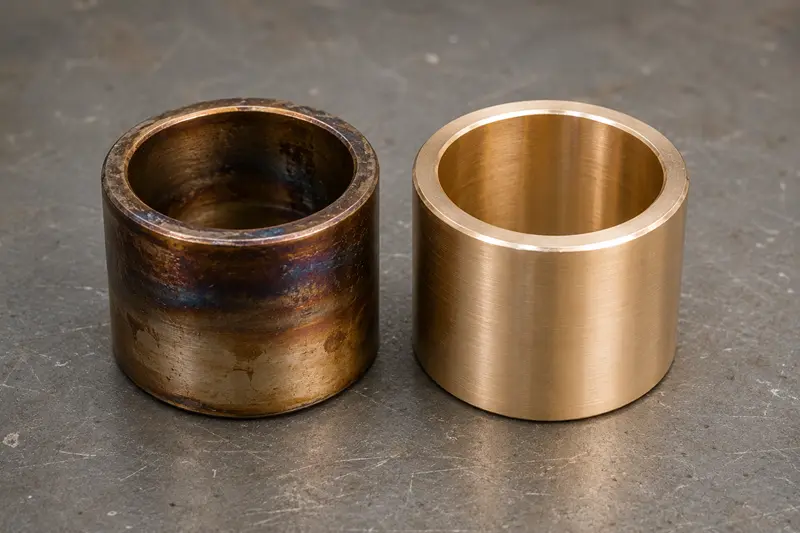
I've talked with many purchasing managers and engineers, like Sophia from a major OEM partner in the Middle East. They get frustrated when a bushing fails from heat. Their first instinct is often to blame the bushing's quality. However, from our perspective as a factory, we see that the bushing is just one part of a larger friction system. When that system is out of balance, heat builds up. To truly solve the problem, we need to look beyond the bushing itself. Let's break down the four most common reasons your bronze bushing is overheating, so you can diagnose the issue correctly and prevent it from happening again.
Is Inadequate Lubrication Causing the Overheating?
You followed the maintenance schedule, but the bushing still failed from heat. Now you're wondering if the lubrication system itself is the problem. Let’s find out.
Yes, poor lubrication is the number one cause of overheating[^1]. If grease is insufficient, oil grooves are blocked, or the wrong lubricant is used, dry friction occurs. This friction generates extreme heat very quickly, causing the bushing to seize long before it wears out naturally.
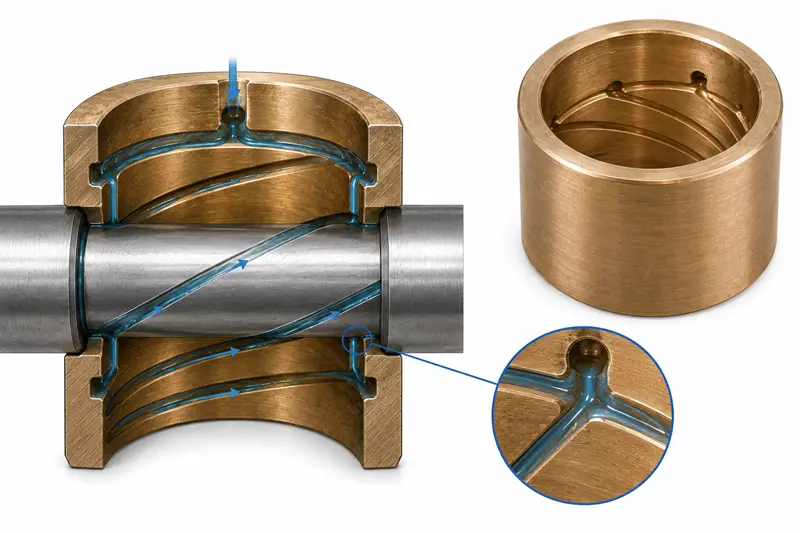
A standard bronze bushing depends on a layer of grease or oil to work properly. This lubricant creates a thin film[^2] between the bushing and the shaft, which separates the metal surfaces and keeps friction low. When this film breaks down, you get what we call "boundary lubrication[^3]" or, in the worst case, "dry friction." This is where metal grinds directly against metal, and temperatures can skyrocket in seconds.
Why Does Lubrication Fail?
The most obvious reason is a lack of maintenance. If you don't re-grease the joint on schedule, the lubricant will eventually degrade or get pushed out. But sometimes the problem is in the design. Oil grooves and holes are machined into bushings for a reason: they act as reservoirs and distribution channels for the grease. If these grooves are not designed correctly for the application, or if they become clogged with dirt and debris, the lubricant can't reach the high-pressure areas where it's needed most.
Lubrication States and Their Impact
| Lubrication State | Friction Level | Heat Generation | Result |
|---|---|---|---|
| Full-Film | Very Low | Minimal | Ideal, long life |
| Boundary | Medium-High | Moderate-High | Increased wear, rising temperature |
| Dry Friction | Extremely High | Extreme | Rapid overheating and seizure |
Could the Operating Clearance Be Incorrect?
You carefully installed a new bushing, but it seized up almost immediately. The fit felt snug and secure, but now the machine is damaged. The problem might be the clearance.
Absolutely. The wrong clearance is a huge factor in overheating. If the bushing is too tight after being pressed in, there's no space for a lubricating film. If it's too loose, the shaft can vibrate and cause uneven pressure, creating hot spots.
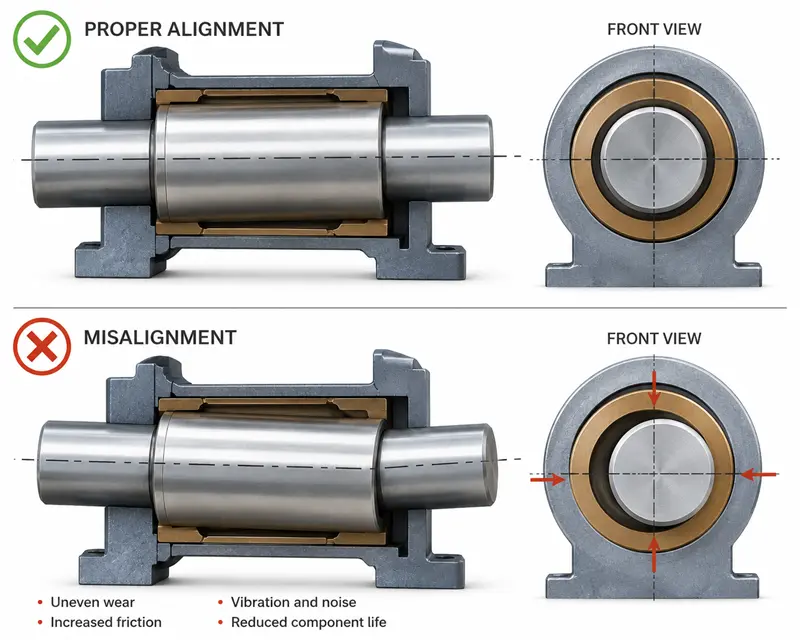
Every bushing needs a specific amount of space between its inner surface and the shaft. We call this "operating clearance." It's not just the difference in size before installation. When you press a bushing into its housing, the bushing's inner diameter will shrink slightly. This "press-fit" effect must be calculated to ensure the final clearance is correct. Thermal expansion also plays a role; as the parts heat up during operation, the clearance will change again. Getting this right is critical.
The Danger of a Tight Fit
A clearance that's too tight is the fastest way to cause a seizure. The tight space squeezes out the lubricant, leaving no protective film. The shaft and bushing are in direct metal-to-metal contact from the start. Friction and heat build up instantly, and the parts can weld themselves together in a catastrophic failure.
The Problem with a Loose Fit
On the other hand, too much clearance is also a problem. A loose fit allows the shaft to vibrate and hammer against the bushing. This causes uneven load distribution, with all the pressure concentrated on one small area. This "edge loading[^4]" creates localized hot spots and can deform or crack the bushing over time.
| Clearance After Installation | Lubrication Film | Heat Source | Potential Result |
|---|---|---|---|
| Too Tight | Squeezed Out | High, uniform friction | Rapid seizure, overheating |
| Correct | Stable and complete | Low, managed friction | Normal, reliable operation |
| Too Loose | Unstable, breaks down | Vibration, edge loading | Uneven wear, localized hot spots |
What If the Mating Shaft Is the Real Problem?
You keep replacing the same bushing over and over. It fails every time, and you're convinced the bushings are defective. It’s time to stop looking at the bushing and start inspecting the shaft.
A faulty shaft is a common but often ignored cause of bushing failure. If the shaft's surface is too rough, too soft, bent, or misaligned, it creates intense pressure points. This concentrates all the heat in one spot, leading to scoring, galling, and seizure.
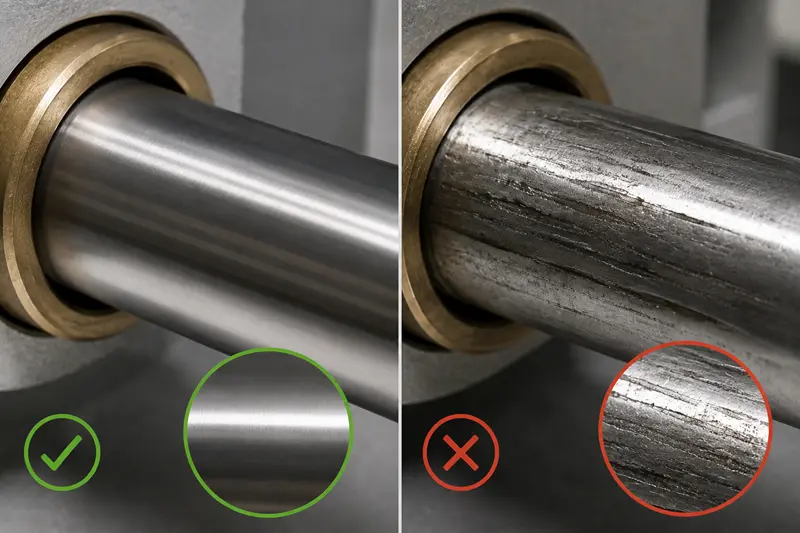
The bushing is only half of the equation. It is designed to work with a smooth, hard, and straight shaft. If the shaft isn't in good condition, it doesn't matter how high-quality the bushing is; the system is destined to fail. From our experience manufacturing these parts, we always advise clients to check the shaft whenever a bushing fails prematurely. Often, the "failed" bushing is just a symptom of a much larger problem with the shaft.
Surface Roughness and Hardness
A shaft that is too rough will act like a file, grinding away the soft bronze material of the bushing. This creates abrasive wear and generates a lot of friction. On the other hand, the shaft must also be sufficiently hard. A soft shaft can be easily damaged by contaminants, creating burrs and gouges that will then chew up the bushing.
Alignment and Geometry
Perfect alignment is also crucial[^5]. If the shaft is not perfectly parallel with the bushing's centerline, it will cause "edge loading." All the force gets concentrated on the very edge of the bushing instead of being distributed evenly. This tiny contact point will overheat and fail quickly. A bent shaft or one with burrs from previous damage will cause similar problems, creating uneven contact and concentrated hot spots.
| Shaft Issue | Effect on Bushing | Heat Mechanism |
|---|---|---|
| Rough Surface | Abrasive wear | Increased surface friction |
| Low Hardness | Shaft gets damaged, then damages bushing | Debris scoring the surface |
| Misalignment | Edge loading | Extreme localized pressure |
| Bent Shaft / Burrs | Uneven contact pressure | Concentrated hot spots |
Are You Exceeding the Bushing's Load and Speed Limits?
The bushing worked perfectly for years, but now it suddenly starts overheating. Nothing seems to have changed, but failures are becoming frequent. Your operating conditions may have changed without you realizing it.
Yes, this is a critical factor. Every bushing has a performance limit defined by its PV value (Pressure x Velocity)[^6]. If your load or speed exceeds this limit, the heat generated by friction will overwhelm the system's ability to dissipate it, causing rapid overheating.
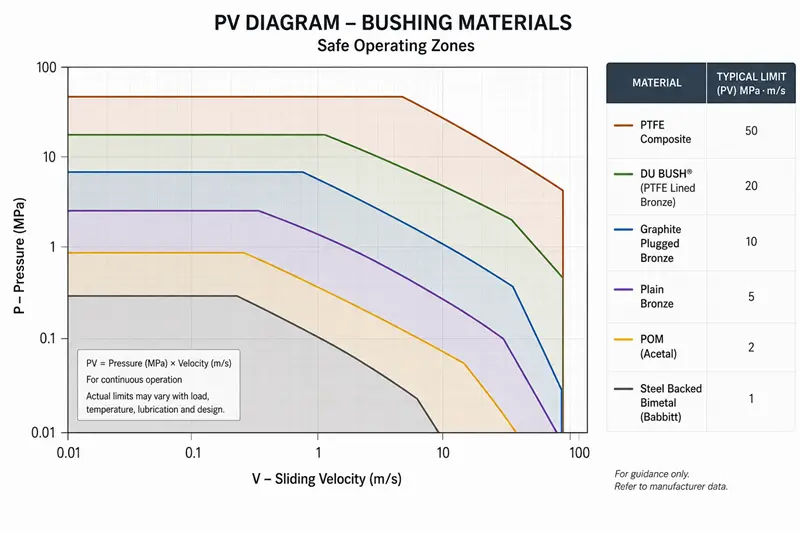
Think of a bushing's capacity as a budget. This budget is its PV limit. "P" stands for pressure (load on the bushing) and "V" stands for velocity (how fast the shaft is rotating or sliding). You can have a high load at a low speed, or a low load at a high speed. But if you try to have both a high load and a high speed, you will exceed the PV limit. When this happens, the system generates heat faster than it can get rid of it.
Understanding the PV Limit
This is why a bushing that works great in a slow-moving, high-load application like a crane pivot will fail miserably if used in a high-speed rotating shaft, even if the load is light. The total energy from friction (the PV value) is just too high. Sometimes, operating conditions change over time. Maybe the machine is being run faster to increase output, or maybe shock loads from rough operation[^7] are spiking the pressure. These changes can push a perfectly good bushing past its breaking point.
When Heat Generation Outpaces Dissipation
Ultimately, overheating is a simple energy balance. If Heat In > Heat Out[^8], the temperature will rise. The factors we've discussed—friction from poor lubrication, incorrect clearance, and a bad shaft—all increase the "Heat In." Exceeding the PV limit does the same thing. The system can only dissipate a certain amount of heat through the housing and surrounding air. Once you generate more than that, failure is inevitable.
| Condition | Load (P) | Velocity (V) | PV Value | Heat Generation | Risk |
|---|---|---|---|---|---|
| Designed | High | Low | Within Limit | Manageable | Low |
| Changed | High | High | Exceeds Limit | Excessive | High (Overheating) |
| Changed | Low | Very High | Exceeds Limit | Excessive | High (Overheating) |
Conclusion
Bronze bushing overheating is a system issue, not just a material one. Before blaming the part, check your lubrication, clearance, shaft condition, and operating limits to find the true cause.
[^1]: "How Much Grease Do Bronze Bushings Need? | Tristar Plastics", https://www.tstar.com/blog/how-much-grease-do-bronze-bushings-really-need-see-the-picture. This source confirms that lubrication failure is a primary cause of overheating in bronze bushings, supported by industry studies on friction systems. Evidence role: expert_consensus; source type: research. Supports: Poor lubrication is the number one cause of overheating in bronze bushings.. Scope note: The ranking of causes may vary depending on specific applications. [^2]: "[PDF] Friction Reduction through Surface Modification - INFO", https://info.ornl.gov/sites/publications/Files/Pub52789.pdf. This source explains how lubricant films reduce friction by separating metal surfaces in mechanical systems. Evidence role: mechanism; source type: education. Supports: Lubricant creates a thin film between the bushing and the shaft, separating the metal surfaces and keeping friction low.. Scope note: The explanation may not include specific examples of bronze bushings. [^3]: "[PDF] Boundary Lubrication Mechanisms - A Systems Approach", https://www.eere.energy.gov/vehiclesandfuels/pdfs/hvso_2006/08_ajayi.pdf. This source defines boundary lubrication and explains its role in increasing friction and heat in mechanical systems. Evidence role: definition; source type: encyclopedia. Supports: Boundary lubrication occurs when the lubricant film breaks down, leading to increased friction and heat.. [^4]: "Edge Loading Has a Paradoxical Effect on Wear in Metal-on ... - PMC", https://pmc.ncbi.nlm.nih.gov/articles/PMC3462843/. This source explains edge loading and its effects on mechanical systems, including bushings. Evidence role: definition; source type: education. Supports: Edge loading occurs when all the force is concentrated on the very edge of the bushing instead of being distributed evenly.. Scope note: Specific examples of edge loading in bronze bushings may not be included. [^5]: "[PDF] The Importance of Motor Shaft Alignment - UNT Digital Library", https://digital.library.unt.edu/ark:/67531/metadc842114/m2/1/high_res_d/1056733.pdf. This source discusses the importance of shaft alignment in preventing edge loading and uneven contact pressure in bushings. Evidence role: mechanism; source type: education. Supports: Perfect alignment is also crucial to prevent edge loading and uneven contact pressure.. Scope note: The discussion may focus on general mechanical systems rather than bronze bushings specifically. [^6]: "PV Value | Department of Energy", https://www.energy.gov/cmei/systems/articles/pv-value. This source defines the PV value and explains its significance in determining bushing performance limits. Evidence role: definition; source type: encyclopedia. Supports: Every bushing has a performance limit defined by its PV value (Pressure x Velocity).. Scope note: The PV value may vary depending on the material and design of the bushing. [^7]: "Solar PV and Extreme Weather - America's Trusted Manufacturer", https://silfabsolar.com/solar-pv-and-extreme-weather/. This source discusses how shock loads can increase pressure and affect the PV limit in mechanical systems. Evidence role: mechanism; source type: research. Supports: Shock loads from rough operation can spike the pressure and push a bushing past its PV limit.. Scope note: The discussion may not focus exclusively on bronze bushings. [^8]: "Heat Transfer", https://www.grc.nasa.gov/www/k-12/airplane/heat.html. This source explains the thermodynamic principle that overheating occurs when heat generation exceeds dissipation capacity. Evidence role: mechanism; source type: education. Supports: Overheating occurs when heat generation exceeds the system's ability to dissipate it.. Scope note: The explanation may not include specific examples of bronze bushings.